San Francisco Bay Fishing Guide: Striped Bass, Halibut & Sturgeon in the Bay Area
I pulled up to the Berkeley Marina launch ramp at 6 AM on a gray October morning, coffee in hand, watching a guy load up his boat with a cooler already full of ice. He asked if I'd fished the Bay before. I told him I was visiting from the Outer Banks, doing some research. He laughed and said, "East Coast girl? You're going to love this place. The fish are the same as yours — they just speak with a different accent."
He wasn't wrong. San Francisco Bay is one of the most productive inshore fisheries on the Pacific Coast, and the mechanics of why fish stack where they do are surprisingly familiar — tidal flow, structure, baitfish concentrations. But the Bay has its own rhythms, its own quirks, and a three-species puzzle (striped bass, halibut, and white sturgeon) that rewards anyone who takes the time to learn it.
Whether you're a Bay Area local or you're making a trip out west, this guide will help you stop guessing and start fishing with a plan.
Understanding San Francisco Bay: The Tidal Engine
San Francisco Bay is not a simple body of water. It's a 1,600-square-mile estuary system fed by the Sacramento and San Joaquin Rivers, with tidal exchanges so powerful they can move hundreds of thousands of acre-feet of water through the Golden Gate in a single cycle. NOAA tidal predictions for the Bay show tidal ranges that commonly hit 5-6 feet, and on big spring tides, you're looking at even more movement than that.
That movement is the whole ballgame.
Why Tidal Phase Matters More Than Anything Else
In my experience guiding tide-based trips on the East Coast, I've seen anglers obsess over rods, reels, and lures — and completely ignore the tide. On the Bay, that mistake costs you fish.
Here's the basic principle: moving water concentrates bait. Concentrated bait attracts predators. When the tide rips through a channel, around a point, or over a flat, it creates current edges, eddies, and ambush zones that predators use like conveyor belts.
San Francisco Bay has four daily tidal shifts — two highs and two lows — and the strongest bite windows typically fall during the two hours before and two hours after a tide change, particularly when current velocity is at its peak mid-cycle. Not every tide is equal. Mixed semi-diurnal tides in the Bay mean one high is often higher than the other, and one ebb runs stronger than the other. Those larger exchanges push more bait and generally produce better.
The outgoing tide is especially productive in the South Bay, where shallow mud flats drain and funnel baitfish — anchovies, herring, and smelt — into deeper channels where stripers and halibut are waiting.
Field observation: The last two hours of the outgoing tide on the Central Bay flats can be some of the most electric striper fishing you'll ever experience. Bait gets pinched off the flats and the fish stack at the channel edges like they're at a buffet.
Before any Bay trip, I pull up tide charts for your area to map out exactly which windows I want to be on the water. Planning around the tide phase — not just the time of day — is what separates consistent anglers from hopeful ones.
Reading Bay Structure
San Francisco Bay is divided into distinct zones, each with different characteristics:
- San Pablo Bay (North Bay): Shallower, heavily influenced by freshwater inflow from the Delta. Historically strong for sturgeon and early-season stripers.
- Central Bay: Deep shipping channels, strong current, rocky structure near the Golden Gate. Prime striper and halibut water.
- South Bay: Extensive shallow mud flats, slower current, warmer water. Good for stripers during spring and fall runs, but often dead in summer.
- The Delta: Not technically the Bay, but connected — the Sacramento-San Joaquin Delta is one of the most important striper nursery habitats on the West Coast.
Water temperature and salinity gradients shift dramatically from north to south, and understanding where fish are in their seasonal movements requires paying attention to those changes.
San Francisco Bay Striped Bass: Chasing the Chrome
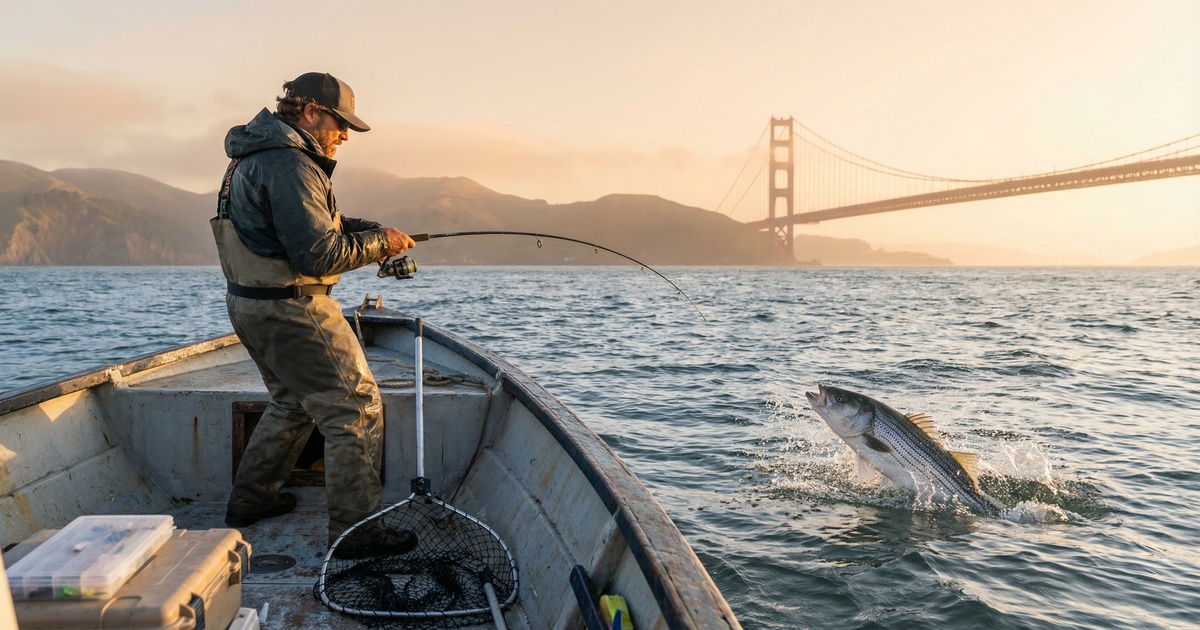
California's striped bass are Atlantic fish — they were transplanted here in 1879 — and they've thrived in a way that would have surprised even their original transporters. Today, SF Bay and the Delta support one of the few self-sustaining striped bass populations on the West Coast, and NOAA Fisheries recognizes the population as a distinct, fishable stock despite ongoing management pressures.
Seasonal Movements
Spring (March–May): Stripers stage for the spawn. Fish move from the Bay into the Delta, concentrating around warm, shallow areas near freshwater influence. This is when big fish — fish over 30 pounds — are most accessible from shore and boat. Focus on the Carquinez Strait and lower Delta channels during the outgoing tide.
Summer (June–August): The fishery splits. Some fish push into the ocean and follow anchovies north along the coast. Bay fish tend to concentrate near the Golden Gate and Central Bay where cooler, oxygenated water from the Pacific keeps conditions right. Surface activity — birds working bait, fish busting topwater — happens early morning during this period.
Fall (September–November): This is the money season. Stripers pull back into the Bay in force, chasing concentrations of anchovies and herring. The bite on the Central Bay flats and around the Bay Bridge pilings can be exceptional. Water temps dropping into the 58–65°F range is a strong trigger.
Winter (December–February): A leaner season but not dead. Fish move deeper, concentrate in channels, and feed more lethargically. Slow presentations near structure — especially around the Richmond–San Rafael Bridge and the shipping channel near Point San Pablo — can produce quality fish.
How to Fish Stripers in the Bay
Trolling: Trolling swimbaits or white bucktail jigs along current edges is one of the most consistent methods on the Central Bay. Speed matters — match the pace to the current speed, generally 2.5–3.5 mph. Lines set at different depths help you locate the school.
Casting from shore: Pier and jetty fishing is productive at Berkeley Pier, Crockett, and the Emeryville Boardwalk. A 3- to 4-ounce swimbait on a jig head, worked along the bottom near structure during moving water, is a reliable setup. I've had success with white, chartreuse, and natural anchovy colors — match the bait in the water.
Anchovies under a float: Live-lining anchovies under a slip float is the Bay's equivalent of live-bait fishing in the surf — devastatingly effective. Find the bait schools on your fishfinder, drop to their depth, and let the current work the presentation.
SF Bay Halibut: Flat Fish on the Flats
California halibut are a different animal entirely from the Pacific halibut anglers target offshore. They're smaller — most Bay fish run 5–15 pounds, with 20-pound fish considered a trophy — and they're aggressive ambush predators that use the Bay's shallow sandy zones as hunting grounds.
Where Halibut Stack in the Bay
Halibut are structure-oriented fish that prefer sandy or mixed-sand-and-mud bottom near channel edges. They bury into the substrate and attack bait passing overhead. The key zones in the Bay:
- The shoals off Alameda: Classic halibut territory, especially during incoming tide when bait moves over the shallows.
- The Central Bay flats near Coyote Point: Good spring and early summer fish.
- Raccoon Strait (between Angel Island and Tiburon): The current rips here during tide changes, funneling bait and halibut stack on the down-current edges.
- The mouth of the Delta near Pittsburg and Antioch: Halibut push this far inland during summer.
Seasonal Timing for Halibut
The Bay halibut season is concentrated from April through October, with peak action in May through July. Fish move into the Bay from the ocean to spawn and feed during this window. Water temperatures between 55–65°F are the sweet spot — check current Bay conditions via HookCast to track when those temps arrive.
Techniques That Work
Drifting live bait: The most consistent halibut method in the Bay. Use a 3/0–5/0 hook on a sliding sinker rig, with a live anchovy or small shiner perch. Drift with the current along the channel edges and let the bait work the bottom. A slow drift, approximately 0.5–1.5 mph, is ideal.
Swimbaits on a jig head: A 4–6 inch paddle-tail swimbait in white or chartreuse, worked slowly along the bottom with a lift-pause retrieve, imitates a wounded anchovy perfectly. When the tide is moving, cast uptide and work the lure back downtide at bottom depth.
Field observation: I've found halibut to be much less forgiving about tide timing than stripers. If the current is dead, so are they. The 90-minute window around peak ebb or flood is where the majority of Bay halibut bites happen.
White Sturgeon: The Bay's Ancient Predator
If you've never caught a white sturgeon, you're missing one of the most primal fishing experiences in North America. These are prehistoric fish — relatives of species that swam with dinosaurs — and the San Francisco Bay and Delta system supports the largest white sturgeon population in California, possibly in the world.
White sturgeon in the Bay commonly run 3–6 feet. Fish over 6 feet (approximately 100+ pounds) are not rare. The current California regulations, which are actively managed by the California Department of Fish and Wildlife, include a slot limit — check current rules before you go because they update regularly.
When and Where to Target Sturgeon
San Pablo Bay is the historic heart of Bay Area sturgeon fishing. The shallow, muddy bottom and freshwater mixing zone create ideal feeding conditions. November through March is prime, coinciding with herring spawns and rainy season freshwater inflows that bring nutrients and food into the system.
USGS stream gauge data for the Sacramento River is worth bookmarking — elevated river flows after winter rains push organic material and invertebrates into San Pablo Bay, triggering sturgeon feeding activity. When the river is running higher than baseline, sturgeon often move shallow and become much more catchable.
Key spots:
- The flats near Point Pinole in San Pablo Bay — classic winter sturgeon grounds
- Mare Island Strait — channel structure and current create reliable feeding zones
- The Carquinez Strait — narrows the tidal exchange between San Pablo Bay and the Delta, creating strong current that pushes food sources
Sturgeon Gear and Bait
Sturgeon are bottom feeders that rely primarily on scent and electroreception (they have sensory organs called ampullae of Lorenzini). This means:
- Heavy terminal tackle: 50–80 lb leader, 7/0–9/0 circle hook
- Bottom rig: A sliding three-way rig or high-low setup with enough weight to hold in current — often 6–12 ounces
- Bait: Ghost shrimp is the gold standard. Grass shrimp, pile worms, clams, and cut herring also work. Fresh, strongly scented bait outperforms frozen every time.
The key with sturgeon is patience. Unlike chasing stripers in current, sturgeon fishing is often a waiting game — anchor or drift slowly over known feeding areas and let the scent do the work. Rod tips will show subtle pickup bites; don't set hard, just come tight and let the circle hook do its job.
Practical Planning: Reading the Conditions
Barometric Pressure and the Bay Bite
Pressure swings affect fishing behavior in the Bay just like anywhere else. Standard atmospheric pressure sits at 1013.25 hPa per NOAA. A rapid drop — 0.10 inches of mercury or more in under three hours — often triggers a feeding frenzy as fish sense the change. Post-front conditions, where pressure rises sharply after a storm, tend to suppress the bite for 24–48 hours.
The Bay Area's marine layer and fog systems mean conditions can shift fast. Before any trip, I check the barometric trend on HookCast's weather tool to see whether pressure is stable, rising, or falling. A stable or slowly dropping pressure window is often the best time to be on the water.
Wind and Fog Considerations
Bay Area anglers deal with two classic conditions: summer afternoon westerlies that can build to 20+ knots by early afternoon, and winter fog that limits visibility. Both require planning:
- Wind: Plan to fish morning windows, especially in summer. By noon, chop on the Central Bay can make small-boat fishing miserable and unproductive.
- Fog: Not inherently bad for fishing — overcast, low-light conditions often improve topwater striper activity — but navigation demands attention. Know your electronics.
Bay Fishing Access Points
| Location | Species | Best Tide Phase | Access Type |
|---|---|---|---|
| Berkeley Pier | Stripers, halibut | Outgoing | Free public pier |
| Emeryville Marina | Stripers, sturgeon | Both | Launch ramp |
| Point San Pablo | Sturgeon, stripers | Incoming | Boat preferred |
| Raccoon Strait | Halibut, stripers | Peak ebb/flood | Boat required |
| Coyote Point | Halibut | Incoming | Shore/kayak |
| San Pablo Bay flats | Sturgeon | Incoming | Boat preferred |
Quick-Reference: SF Bay Fishing Cheat Sheet
Striped Bass
- Peak seasons: Spring spawn (March–May), Fall feed (Sept–Nov)
- Best tide: Outgoing, peak ebb on flats and channel edges
- Top baits: Live anchovies, white swimbaits, trolled bucktails
- Target temp: 58–68°F
California Halibut
- Peak season: April through July
- Best tide: Peak ebb or flood, 90-minute window either side
- Top baits: Live anchovies, paddle-tail swimbaits (white/chartreuse)
- Target temp: 55–65°F
White Sturgeon
- Peak season: November through March
- Best conditions: Post-rain, elevated river inflows, incoming tide on San Pablo Bay flats
- Top baits: Fresh ghost shrimp, grass shrimp, cut herring
- Gear: 50–80 lb leader, circle hooks, heavy bottom rig
Before every trip, check:
- [ ] Tide phase and timing (fishingweather.app/tides)
- [ ] Barometric trend (stable or dropping = fish; rising post-front = wait)
- [ ] Wind forecast — plan morning if summer westerlies are expected
- [ ] Current CDFW regulations for sturgeon slot limit
- [ ] Water temperature trend for your target species
The Bay will humble you sometimes. But when the tide is right, the bait is stacked, and you're in the right zone at the right moment — there's not much better fishing on the West Coast.
FAQ
What is the best time of year to fish San Francisco Bay for striped bass?
Fall — specifically September through November — is the peak season for striped bass in San Francisco Bay. During this period, stripers return to the Bay in large numbers to chase concentrations of anchovies and herring, and water temperatures in the 58–65°F range keep fish active and feeding aggressively. Spring is the second-best window, particularly March through May when large fish stage near the Delta before spawning.
How do tides affect fishing in San Francisco Bay?
Tidal movement is the single most important factor in San Francisco Bay fishing. Moving water concentrates baitfish along channel edges and structure, which draws striped bass, halibut, and sturgeon into predictable feeding positions. The strongest bite windows typically fall during the two hours before and after a tide change, especially during peak ebb or flood. Slack water periods — when the tide has stopped moving — tend to produce far fewer bites across all three species.
What is the best bait for white sturgeon in the Bay Area?
Fresh ghost shrimp is the top-producing bait for white sturgeon in San Francisco Bay and San Pablo Bay. Grass shrimp, pile worms, and cut herring are solid alternatives when ghost shrimp aren't available. The key factor is freshness and scent — sturgeon feed heavily by smell and electroreception, so fresh or fresh-frozen bait significantly outperforms old or dried-out options. Rig bait on a bottom setup with enough weight (6–12 ounces) to hold in current.
Can you catch California halibut from shore in San Francisco Bay?
Yes, shore access is possible for Bay Area halibut, though boat fishing covers more productive water. Coyote Point in San Mateo, Berkeley Pier, and certain shoreline areas in Alameda offer wade or shore access to halibut habitat during the April–July peak season. The best approach from shore is to fish a live anchovy or paddle-tail swimbait along sandy bottom near channel edges during the two hours around peak tidal flow — halibut rarely bite during slack water.
Do I need a license to fish San Francisco Bay, and are there any special regulations?
Yes, a valid California sport fishing license is required for anyone 16 years or older fishing in San Francisco Bay. White sturgeon are subject to a slot limit — only fish within a specific length range may be kept — and regulations can change annually. Striped bass and halibut also have size and bag limits. Always check the current California Department of Fish and Wildlife regulations at wildlife.ca.gov before your trip, as these rules are actively managed and updated.