Carolina Rig vs Texas Rig: When to Use Each for Bass Fishing
Last spring I pulled up to a lake in southern Missouri that I'd been hitting for years. Water temp was just cracking 58°F, the bass had barely moved off their deep winter haunts, and I had two rods rigged up—one Texas, one Carolina. A buddy fishing nearby was throwing a Texas rig along a shallow flat and getting nothing. I dragged my Carolina rig through a transition zone between a gravel hump and a muddy basin and put three fish in the kayak before he made it back to the ramp.
Same lake. Same morning. Same plastic worm. Different rig—totally different result.
That's the whole story of Carolina rig vs Texas rig in a nutshell. Both are foundational bass setups. Both work. But knowing which one fits the moment is what separates a good day from a frustrating one. If you've ever wondered why one outfishes the other, or when to make the switch, this is the breakdown you need.
What Each Rig Actually Does (And Why It Matters)
Before getting into situations and tactics, it helps to be on the same page about how each rig behaves in the water. The mechanics drive everything else.
The Texas Rig: Weedless and Tight
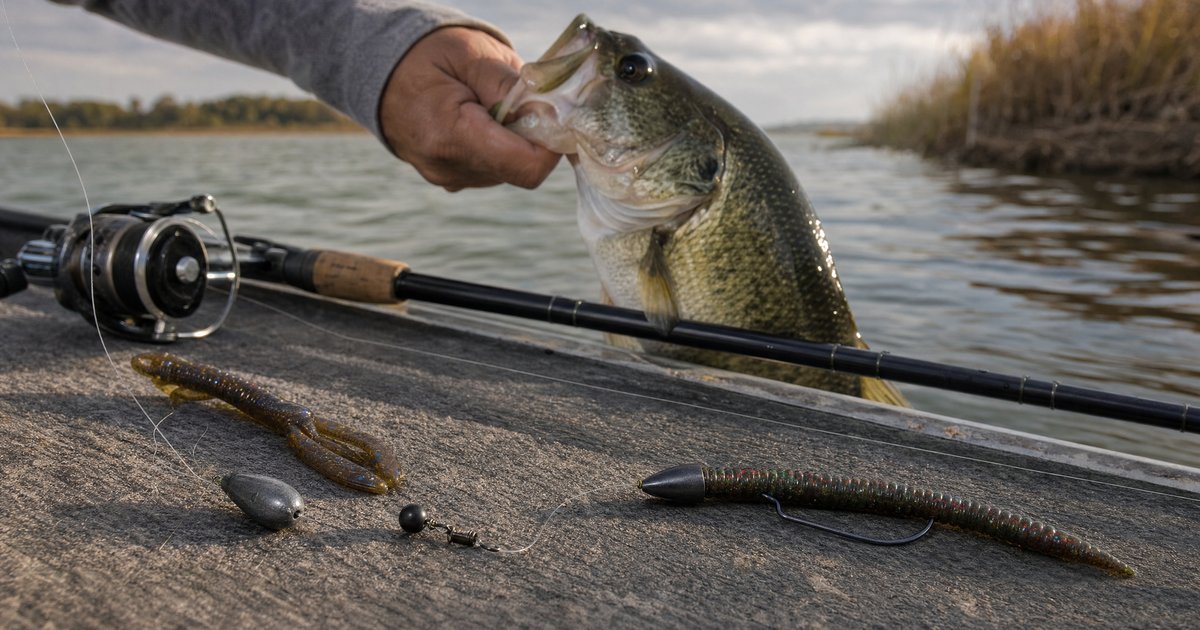
The Texas rig is about as simple as bass fishing gets. Slide a bullet-shaped weight directly onto your line, add a bead if you want, tie on an offset wide-gap hook, and rig your soft plastic weedless by threading the point back into the body. The weight sits right on the nose of the bait.
What this does: the lure sinks fast, stays compact, and the bait and weight move together as one unit. When you hop it, twitch it, or drag it, the plastic responds almost instantly to rod input. It's a precision tool—great for targeting specific structure and punching into cover.
The Carolina Rig: Separation Is the Secret
The Carolina rig puts a heavy egg or barrel weight (typically ¾ oz to 1 oz, sometimes heavier) on your main line, followed by a bead, then a swivel. From the swivel, you run a fluorocarbon leader—usually 18 to 36 inches—down to a hook and your soft plastic.
That separation between the weight and the bait is everything. When you drag the rig across the bottom, the weight plows through mud, rocks, and debris while your bait floats, flutters, and dances behind it on the leader. The bait has a life of its own. It reacts to currents, to subtle rod moves, to the weight bumping over structure—things the angler doesn't even consciously control.
Why the Difference Matters on the Water
Think of it this way:
- Texas rig = sniper. You're placing a bait in a specific spot and working it through tight cover.
- Carolina rig = dragnet. You're covering water, letting the bait's action do the work across larger areas.
Neither is better. They solve different problems.
When to Throw the Texas Rig
The Texas rig earns its reputation in specific conditions where getting your bait into tight spaces and keeping it there matters more than covering ground.
Fishing Heavy Cover
If there's grass, pads, wood, or laydowns in the picture, the Texas rig is usually the call. The weedless design lets you drop a bait into a mat, poke it into a brush pile, or crawl it over a log without fouling your hook on every cast. Bass holding in thick cover aren't interested in chasing—they want the bait to come to them.
Flippin' and pitchin' a Texas-rigged creature bait or beaver-style plastic into dock pilings, laydowns, and grass clumps is one of the most reliable bass techniques across all seasons. I keep a heavy-action rod with a ½ oz bullet weight punching mats all summer.
Shallow Water and Spawning Season
During pre-spawn and spawn, bass move shallow and become much more structure-oriented. They relate to specific spots—a patch of gravel, a stump, a dock corner. The Texas rig's precision makes it ideal here. You can place a bait exactly where you need it and keep it in the strike zone without dragging it away from the target.
A quick note on spawning season: if you're targeting bedding bass, handle them carefully and get them back quickly. Fish caught off beds and kept out of the water too long can abandon their nests. A 30-second release matters.
Cold Water and Tough Bites
When the bite gets finicky—post-cold front, pressured water, late fall—a Texas rig with a smaller bait fished painfully slow will often out-produce just about anything. The bait stays in place, you can dead-stick it, and bass that won't chase have a stationary target to pick up.
Largemouth bass metabolism slows significantly as water temperatures drop, which is why slow, bottom-hugging presentations often outperform fast-moving baits in cold conditions. Matching that reduced aggression with a tight, subtle Texas rig presentation makes biological sense.
Best Scenarios for a Texas Rig
- Fishing visible isolated cover (stumps, rocks, docks)
- High-percentage flipping and pitching
- Shallow water clarity situations where boat noise matters
- Heavy vegetation where weedless design is essential
- Drop shot isn't getting bit and you need something with more weight
When to Throw the Carolina Rig
The Carolina rig doesn't get enough credit these days. With finesse tactics dominating tournament talk, a lot of anglers have put the C-rig in the back of the tackle bag—which is honestly good news for those of us who still throw it.
Covering Deep Structure and Transition Areas
This is the Carolina rig's home turf. When bass are sitting just off the bottom in 15 to 25 feet of water, staged on a ledge, a point, or along a creek channel edge, dragging a C-rig through that zone is deadly. The weight finds the bottom contour and communicates it back through your rod, while the bait stays in the strike zone above the mud and silt.
I've spent a lot of time fishing Ozark impoundments where bass stack up on submerged gravel points in early summer. A Carolina rig with a straight-tail worm or a floating lizard on an 18-inch leader will get bit there when nothing else will.
Post-Spawn Patterns
After the spawn, bass scatter. They're not locked to beds and they're not in predictable summer haunts yet—they're transitioning, and they cover a lot of water. The Carolina rig lets you match that behavior. You can cover a long stretch of bottom, feel every change in composition, and present your bait to fish spread across a large area.
Before heading out, I'll pull up HookCast's weather and pressure tracker to see what the barometric trend looks like. During the post-spawn period especially, a steady or rising pressure day after a front can trigger those transitioning fish to start feeding—and a Carolina rig covering water is a great way to find them.
Hard Bottom and Rock
The Carolina rig shines on hard substrates. Gravel, shell, chunk rock—places where the dragged weight clicks and clacks along the bottom and telegraphs the structure to your rod hand. That tactile feedback is useful. When the weight transitions from gravel to sand or drops off a ledge, pause the bait right there. Bass stack up at those transition points.
When Bass Are Neutral or Suspended Just Off Bottom
Sometimes bass aren't tight to cover and they're not chasing. They're just sitting in a general zone, neutral. The floating action of a C-rig bait on a long leader, drifting over them with no aggressive rod input, can trigger reaction strikes from fish that won't react to anything else.
In my experience, a floating plastic—something like a floating worm or buoyant lizard—on the Carolina rig leader out-produces standard sinking plastics most of the time. The bait stays up, moves more naturally, and sits in that strike zone right above the mud where bass can see it.
Best Scenarios for a Carolina Rig
- Deep ledges and offshore structure (10–25 feet)
- Covering large flats efficiently
- Rocky bottom and shell beds
- Early summer post-spawn transitions
- Any time you need the bait to hover above a silty or muddy bottom
Gear Setup: Getting Both Rigs Right
Rigging matters. A Texas rig thrown on the wrong setup loses half its effectiveness, and a Carolina rig with a leader that's too short won't give the bait enough freedom to work.
Texas Rig Setup
- Rod: 7' to 7'3" medium-heavy to heavy action, fast tip
- Reel: Baitcaster, 7:1 gear ratio or higher (for fast pick-up in cover)
- Line: 15–20 lb fluorocarbon or 30–65 lb braid for punching
- Weight: 3/16 oz to ½ oz bullet, pegged or unpegged depending on cover density
- Hook: 3/0 to 5/0 EWG or offset wide-gap, matched to bait size
For light cover and finesse situations, you can run a Texas rig on spinning tackle with lighter fluorocarbon—this is the "Tex-posed" or shaky head adjacent approach that works well in clear water.
Carolina Rig Setup
- Rod: 7'6" to 8' medium-heavy, moderate-fast action (the longer rod sweeps more water on the drag)
- Reel: Baitcaster, 6.4:1 to 7:1
- Main line: 17–20 lb fluorocarbon or monofilament (mono has some stretch that helps on sweeping hooksets)
- Leader: 17–20 lb fluorocarbon, 18 to 36 inches (longer in clear water, shorter in dirty)
- Weight: ¾ oz to 1 oz egg or barrel weight
- Bead: Glass bead between weight and swivel (the click noise attracts attention)
- Hook: 2/0 to 4/0 EWG, depending on bait
The longer rod on the Carolina rig isn't just preference—it gives you more leverage to move the rig across long stretches of bottom and drive the hook home on a long-distance bite.
Quick Comparison Table
| Feature | Texas Rig | Carolina Rig |
|---|---|---|
| Weight position | On the line, nose of bait | 18–36" above the bait |
| Bait action | Tight, responsive to rod | Floating, independent action |
| Best depth | Shallow to mid-depth | Mid to deep (10'+ typically) |
| Cover capability | Excellent (weedless) | Moderate |
| Coverage speed | Slow, targeted | Faster, covers water |
| Hookset style | Short to medium, sharp upward | Long sweeping set |
| Typical weight | 3/16 – ½ oz | ¾ – 1 oz |
Reading the Conditions: Making the Call on the Water
Knowing the theory is one thing. Making the call in real time is where it clicks.
Water Temperature and Season
Spring through early summer, as water climbs from 50°F toward 70°F, the Carolina rig covers the transition zones where bass are staging and moving. Once summer sets in and fish push deep or lock into specific cover, you're splitting time—C-rig for offshore ledges, Texas rig for wood and grass in the shallows.
Fall is Texas rig season in my boat. Bass chase shad shallow, they're in and around the cover, and a Texas-rigged swimbait or fluke fished through laydowns and dock lines produces well.
Winter? Texas rig, finesse style, worked very slowly near the warmest water you can find—deeper main lake structure, creek mouths, anything that holds temperature.
Water Clarity
Dirty water (under 12 inches visibility) compresses fish into tighter areas—they use their lateral line more than their eyes. The Texas rig and its precise presentation near visible structure makes sense here.
Cleaner water gives bass more time to inspect a bait. The Carolina rig's floating, natural action on a longer leader can actually be more convincing in clear water because bass get a good look at a bait that's moving naturally, not being dragged along the bottom.
Checking Conditions Before You Go
Before I commit to a location, I check the HookCast fishing forecast to get a read on pressure trends, wind, and cloud cover. A cold front moving through can completely shut down the shallow bite and push fish deep—that's a Carolina rig day on the ledges, not a Texas rig day in the flats. Standard atmospheric pressure sits around 1013.25 hPa per NOAA, and a significant drop heading into your fishing day is usually a sign of tough fishing ahead regardless of what you throw.
USGS stream gauge data is also worth a check if you're fishing any river or connected system—rising or falling water levels change where bass position dramatically, and that affects which rig gives you access to them.
When Bass Aren't Where You Think They Are
Here's a practical rule I follow: if I've worked an area thoroughly with a Texas rig and haven't gotten bit, before I move I'll make a half-dozen drags through that same zone with a Carolina rig. Different presentation, same fish. You'd be surprised how often the first cast with the C-rig gets bit immediately—the fish were there, just not reacting to a tight bottom-contact presentation.
Key Takeaways
Throw the Texas Rig when:
- You're fishing visible cover—docks, laydowns, grass
- Water is shallow (under 8 feet)
- You need weedless delivery into tight spots
- The bite is finicky and you need to slow way down
- It's fall and bass are chasing shad into the cover
Throw the Carolina Rig when:
- Bass are offshore on ledges, points, or channel edges
- Water is over 10 feet and you need coverage
- The bottom is hard—gravel, rock, shell
- It's post-spawn and fish are scattered
- You want a floating, natural bait action above silty bottom
Rig setup reminders:
- Carolina rig = longer rod, long leader (18–36"), heavy weight, glass bead
- Texas rig = faster gear ratio reel, heavier line for cover, pegged weight in dense cover
- Use floating plastics on the Carolina rig leader whenever possible
- Long sweeping hookset on the C-rig; sharp upward hookset on the Texas rig
Neither rig is magic. Both take some time on the water before you start reading the feedback they give you—what the bottom feels like, when to pause, when to speed up. But if you're walking to the water only knowing one of these two, you're leaving fish uncaught.
FAQ
What is the main difference between a Carolina rig and a Texas rig?
The key difference is where the weight sits relative to the bait. On a Texas rig, the bullet weight is positioned directly above the bait on the line, so the weight and lure move together as one unit. On a Carolina rig, a heavy egg or barrel weight is separated from the bait by an 18 to 36-inch fluorocarbon leader, allowing the bait to float and move independently while the weight drags along the bottom.
When should I use a Carolina rig for bass fishing?
A Carolina rig works best when bass are positioned offshore on deeper structure—ledges, points, creek channel edges, or rocky flats in the 10 to 25-foot range. It's especially effective in the post-spawn period when fish are scattered, and anytime you need a floating bait presentation above a silty or muddy bottom. Clear water and hard substrates like gravel and shell also play to the Carolina rig's strengths.
Can you fish a Carolina rig in shallow water?
You can, but it's not the most efficient choice. The Carolina rig's long leader and heavier weight are designed for covering deeper, more open bottom. In shallow water with cover present, the Texas rig's weedless design and compact presentation is usually more practical. That said, some anglers do fish Carolina rigs in 4 to 6 feet of water over clean hard bottom with good results—especially on clear-water fisheries.
What size weight should I use for a Carolina rig?
Most Carolina rig setups use a ¾ oz to 1 oz egg or barrel weight. Heavier weights keep better bottom contact in wind and current, and give you more tactile feedback through the rod. Some anglers drop down to ½ oz in very calm, shallow conditions or when fish are being particularly finicky, but in general the heavier weight is part of what makes the rig work—it anchors the system while the bait floats freely behind it.
Is a Texas rig or Carolina rig better for tournament bass fishing?
Both are proven tournament rigs depending on the conditions. The Carolina rig historically dominated in warm-weather offshore tournaments where fish stack up on ledges and deep points—it's been a key setup on fisheries like Table Rock and Kentucky Lake. The Texas rig is more versatile across all conditions and is a go-to for flipping and pitching cover in shallow-water events. Most tournament anglers have both rigged and ready, switching based on where they find fish during practice.