Crappie Fishing Guide: Spider Rigging, Dock Shooting, and Slab Tactics
Last April I pulled into a public boat ramp on a Missouri reservoir just as another angler was loading up. His livewell had barely any water in it — so I assumed he'd struck out. Then he lifted the lid and I counted at least 30 crappie, most of them pushing 14 inches. I asked what he was doing. He just said "spider rigging the channel edge" and pointed south.
I spent the next three hours figuring out what that meant by watching him from across the cove. Learned more in those three hours than I had in years of randomly jigging docks.
That's crappie fishing. There's real technique here — patterns, timing, seasonal adjustments. Once you understand the why behind each method, your catch rate climbs fast. This guide covers the three most effective tactics for freshwater crappie — spider rigging, dock shooting, and general slab hunting — plus when and why each one works.
Understanding Crappie Behavior Before You Pick a Tactic
You can't fish crappie effectively if you don't understand how they think. These fish are mid-column feeders that relate heavily to structure, but they move. A lot.
The Two Species: Black vs. White Crappie
Most anglers fish both without knowing which they're catching. It matters.
Black crappie (Pomoxis nigromaculatus) prefer clearer, cooler water. They tolerate lower temperatures, thrive in lakes with submerged vegetation, and tend to scatter more across structure. You'll find them in Ozark-style reservoirs, natural lakes in the upper Midwest, and the Great Lakes region.
White crappie (Pomoxis annularis) are more tolerant of turbid, warmer water. They school tighter, especially in river impoundments and southern reservoirs. When white crappie stack up on a channel ledge, they stack up hard — you can catch 20 fish off one spot.
Both species are among the most widely distributed panfish in North America, found in 48 states. Understanding which species dominates your home water shapes everything from lure color to preferred depth.
Seasonal Movements in a Nutshell
| Season | Where They Are | Primary Tactic |
|---|---|---|
| Pre-spawn (early spring) | Transitional flats, 6–12 ft | Slow vertical jigging |
| Spawn (spring) | Shallow docks, brush, 2–6 ft | Dock shooting |
| Post-spawn (late spring) | Moving deeper, 10–18 ft | Spider rigging |
| Summer | Deep timber, channel edges, 15–25 ft | Spider rigging, vertical jigging |
| Fall | Baitfish schools, mid-column | Casting small swimbaits |
| Winter | Deepest accessible structure | Slow vertical jigging, live minnows |
The biggest mistake I see is people fishing the same depth all year. Crappie move vertically more than most anglers account for — sometimes 10 feet or more within the same week based on water temperature and barometric pressure. Before any crappie trip, I'll check current pressure and conditions on HookCast to see if we're on a rising or falling trend. Falling pressure typically pushes fish deeper and kills the bite.
Spider Rigging: The Long-Rod Deep-Water Method
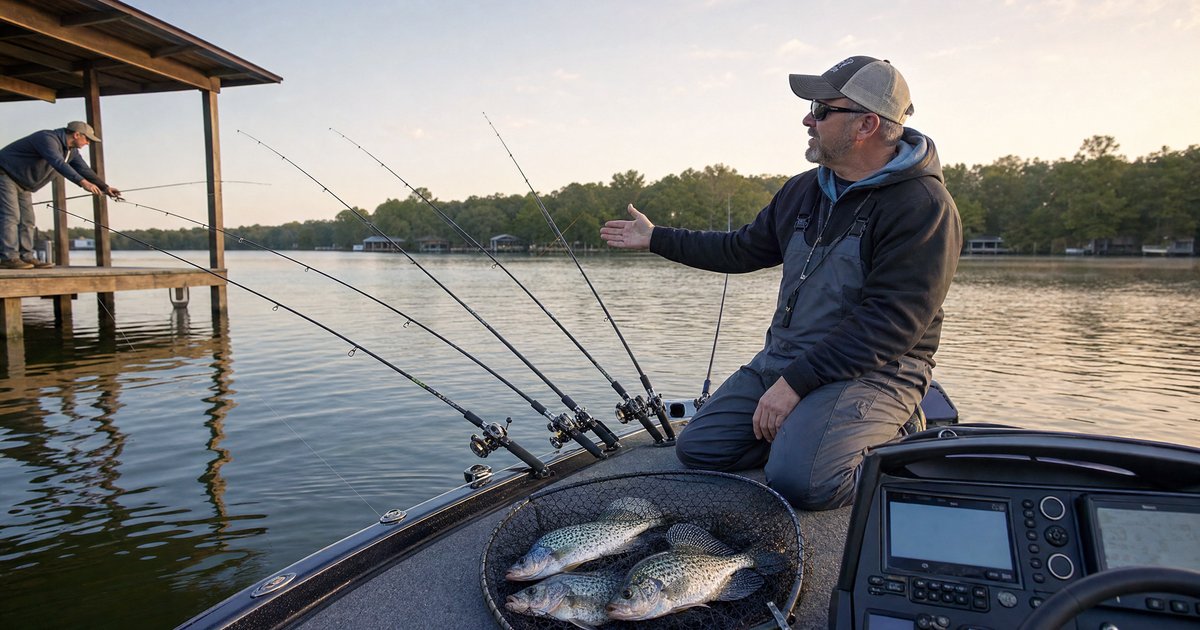
Spider rigging is arguably the most effective technique for targeting crappie post-spawn through fall. It looks complicated from the outside — a boat with six to eight long rods fanned out like a spider — but the core concept is simple.
How Spider Rigging Works
You run multiple rods simultaneously off the bow, each tipped with a jig or live minnow, trolling at a slow speed (typically 0.3–0.8 mph) over structure. The rods are held in rod holders angled outward, covering a wide horizontal and vertical zone at once.
What makes it deadly is the ability to probe multiple depths simultaneously. You might have rods set at 10, 14, 18, and 22 feet at the same time. When one rod doubles over, you note the depth and adjust the others. Within a few bites you've dialed in exactly where the school is suspended.
Basic spider rig setup:
- Rods: 10–16 ft B'n'M or similar crappie rods (light action, sensitive tips)
- Reels: Spinning reels loaded with 6–8 lb monofilament or fluorocarbon
- Jig option: 1/16 to 1/4 oz jig heads paired with 2–3 inch soft plastic bodies
- Live bait option: Single hook minnow rig — size 2 hook, small split shot, live minnow hooked under the dorsal fin
Finding the Right Depth and Speed
Structure is everything. You're looking for:
- Channel ledges — where the bottom drops from a flat into deeper water
- Submerged timber — old flooded trees that haven't rotted out
- Bridge pilings and road beds — consistent fish holders
- Creek channel intersections — where two underwater creek channels meet
Use your electronics to mark fish before making a pass. Crappie show up as arcs or compact clouds between 12 and 22 feet in summer. If you see marks but aren't getting bites, bump your speed up slightly or switch from plastic to a live minnow. In my experience, live minnows outperform plastics on spider rigs in cold water — roughly anything below 55°F.
Field observation: On Table Rock Lake last May, I couldn't buy a bite on chartreuse tubes until I watched an older guy in a jonboat land four in a row on a white/silver shad pattern. Color matters more than most people think when the fish are being finicky. Match the hatch — if shad are the primary forage, go white or silver.
Spider Rigging Without a Big Boat
I fish a kayak. Spider rigging isn't as natural in a paddle craft, but you can adapt it. A hand troll with two rods off the bow works surprisingly well. Use a pedal drive kayak or a small trolling motor attachment, set two rods in horizontal holders angled to the sides, and slow-pedal over channel edges. I've done this on Truman Lake and caught slabs doing it.
If you're in a small aluminum boat, a four-rod spread is plenty. Don't overthink the rod count — the depth coverage matters more than the width of your spread.
Dock Shooting: The Short-Game Technique for Spawning Fish
Dock shooting is exactly what it sounds like — you skip a jig under a dock by holding the line and loading the rod like a slingshot, then releasing it low and flat so the jig skips across the surface and slides back into the shade.
It's a technique borrowed from bass fishing, but crappie anglers have refined it into its own thing. And during the spawn (typically March through May depending on your region), dock shooting flat-out catches fish.
Why It Works
Spawning crappie move shallow — sometimes absurdly shallow. A two-foot-deep dock with shade and structure underneath is prime real estate. The problem is you can't make a regular cast back there without hanging up on dock boards or posts. The skip cast solves that.
The fish under those docks are actively defending nests or staging nearby. They're aggressive. A jig that skips back into their living room and drops in front of them almost always gets hit.
How to Shoot a Dock
This takes practice. Expect to lose a few jigs and feel frustrated for your first 30 minutes.
Setup:
- Light 5.5–7 ft spinning rod with a fast tip (medium-light action works best)
- 6 lb fluorocarbon — it sinks and has low visibility
- 1/16 oz jig head with a compact soft plastic (tube bait or small paddle tail)
- Avoid treble hooks or bulky plastics — they don't skip cleanly
The motion:
- Hold the jig by pinching the hook bend between your thumb and forefinger.
- Load the rod back like a slingshot — bend the tip by pulling the jig against the line tension.
- Aim low, about 6–12 inches off the water.
- Release the jig and follow through with the rod tip staying low.
The jig should skip two to four times and slide back under the dock into darkness. Let it fall on a semi-slack line. Most bites come on the fall.
Tip: Skip to the far back corners of the dock first. The crappie under the most angling pressure are the ones right at the edge. The fish nobody's reached are tucked deep in the corners.
Reading Docks for Crappie
Not every dock holds fish. Look for:
- Older wooden docks — more algae, more invertebrates, more bait
- Docks over structure — a brush pile, old tire, or concrete block below
- Shaded side of the dock — especially important in afternoon sun
- Dock ladders and vertical posts — crappie love anything vertical
Aluminum pontoon docks in open water with nothing below them are usually empty. A rickety old wooden dock over four feet of water with sunken branches underneath? That's a different story.
During spawning season, practice responsible catch and release — especially with larger females. Crappie beds can be concentrated in small areas. Removing too many fish from a spawn site disrupts the year class. Handle fish with wet hands, support their body horizontally, and get them back in the water quickly.
Hunting Slabs: General Tactics for Big Crappie
"Slabs" are what crappie anglers call fish in the 1.5–2+ pound range. They're not rare, but they don't come easy either. Big crappie behave differently than average fish.
Why Big Crappie Are Harder to Find
Larger crappie tend to be more solitary or found in smaller groups compared to juvenile fish. They also tend to hold deeper and relate tighter to specific pieces of structure. You can catch 40 small crappie off a brush pile in eight feet of water and miss the three 15-inch fish sitting on the channel ledge 12 feet away.
Tactics that specifically target larger fish:
- Fish deeper than everyone else. The biggest crappie in pressured lakes often live 18–25 feet down. Drop your bait lower than you think is necessary.
- Use larger jig profiles. A 3-inch swimbait or tube bait selects for larger fish. Small fish can't eat it easily — the big ones can.
- Slow down. Bigger crappie won't chase as hard. A jig hanging nearly motionless at depth, barely quivering, often outfishes any active retrieve for slabs.
- Fish at night. During summer, big crappie move shallower under lights after dark. A dock light over clear water at night can be one of the most productive spots you'll ever fish.
Night Fishing for Crappie
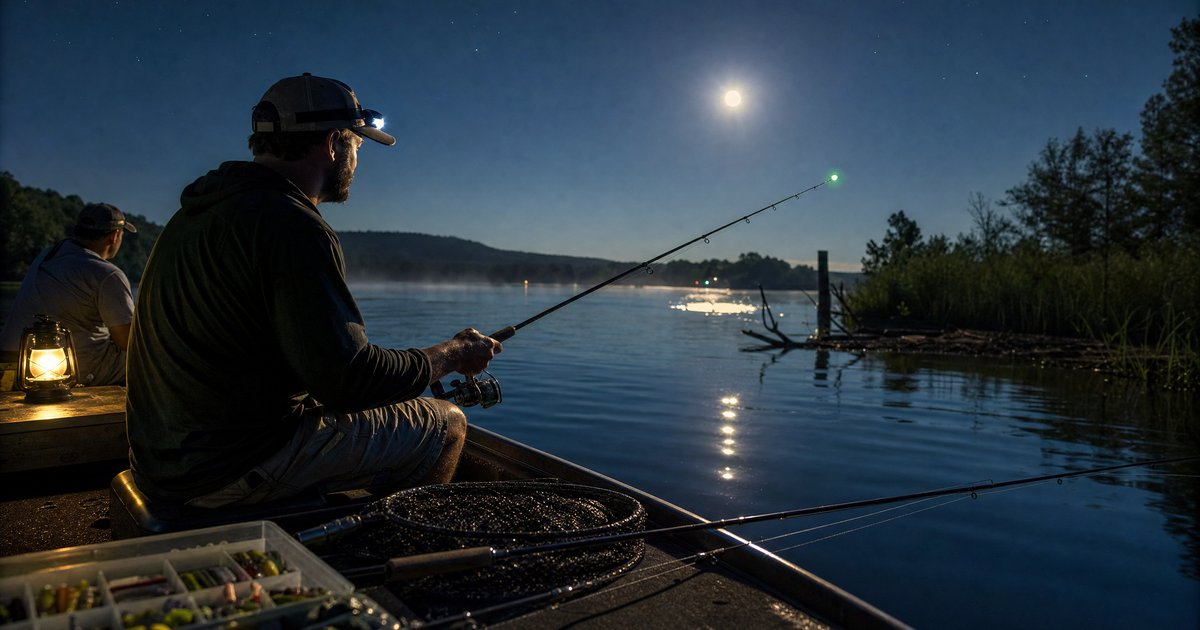
Summer nights are underrated for crappie. Once water temps climb above 75°F, daytime fishing gets tough. But crappie feed aggressively after dark when water temps drop a few degrees and shad move shallow.
Dock lights and bridge lights concentrate baitfish, and crappie follow. Position yourself outside the light's edge — cast into the light from outside, not while you're standing in it. Fish see better in the dark than you do.
Safety note: Night fishing on open water requires a properly functioning white anchor light visible from 360 degrees and red/green navigation lights if you're moving. Always wear a PFD after dark. A simple headlamp and a buddy are cheap insurance.
Seasonal Slab Tips
Spring pre-spawn slabs — These fish are feeding up before the spawn. Target transitional areas: 8–12 foot flats adjacent to spawning coves. Small swimbaits in shad patterns work. This is often the best two-week window of the year.
Summer deep fish — Spider rig channel ledges at 18–22 feet. Use electronics. Check the HookCast solunar calendar before heading out — solunar peaks are noticeably more productive for summer crappie than random hours.
Fall schooling fish — Crappie follow shad schools in fall, suspending in open water and on main lake points. Cast small 2-inch swimbaits on 1/16 oz heads and work the water column. This is one of the few times crappie act almost like bass.
Winter fish — Slow down and go deep. Crappie in 20–28 feet are lethargic. Vertical jigging with a 1/8 oz head and a live minnow — barely moving it — can still catch fish. Just expect longer gaps between bites.
Gear and Setup: What You Actually Need
You don't need a dedicated crappie boat to fish these tactics well. Here's a practical gear breakdown.
Rods and Reels
- Dock shooting / light jigging: 6–7 ft light spinning rod, 2500-series reel, 6 lb fluorocarbon
- Spider rigging: 12–16 ft B'n'M or Shakespeare crappie rod, small spinning reel, 8 lb mono
- Casting swimbaits (fall): 7 ft medium-light spinning rod, 8 lb braid with 6 lb fluoro leader
You don't need expensive gear for crappie. I've caught plenty of slabs on a $40 ultralight spinning combo.
Jig Selection
| Type | Best Conditions | Notes |
|---|---|---|
| Tube jig | Clear water, dock shooting | 2-inch tubes in white or chartreuse |
| Bobby Garland Baby Shad | All-around | Classic crappie bait for good reason |
| Curl tail grub | Spider rigging | Steady movement at slow troll speed |
| Small paddle tail swimbait | Fall, open water | Mimics shad |
| Live minnow | Cold water, finicky fish | Size 2–4 hook under the dorsal |
Jig head weight: Lighter is usually better. Start at 1/16 oz. Drop to 1/32 oz in shallow clear water or when fish are extremely finicky, and go up to 1/8 oz in deeper water or when fishing in wind.
Quick-Reference Checklist
Before your next crappie trip, run through this list:
- ✅ Know your water's dominant species — black crappie or white crappie, and adjust depth expectations accordingly
- ✅ Match your tactic to the season — dock shooting in spring, spider rig post-spawn through summer, swimbait casting in fall
- ✅ Check barometric pressure — stable or rising pressure means a better bite; rapidly falling pressure means fish go deep or go quiet
- ✅ Prioritize depth over location — find the right depth first, then fish that depth systematically across structure
- ✅ Target big fish differently — go deeper, use bigger jigs, fish slower
- ✅ Practice dock shooting before the spawn — the technique takes time to learn, and the spawn window is short
- ✅ Release spawning fish carefully — wet hands, horizontal hold, quick release
- ✅ Check local regulations — size and bag limits vary significantly by state and reservoir; always verify before your trip
Crappie are accessible, good-eating (if you keep a few within legal limits), and legitimately technical once you dig into it. The guy I watched on that Missouri reservoir last April wasn't lucky. He had a system. Now you do too.
Frequently Asked Questions
What is spider rigging for crappie?
Spider rigging is a slow-trolling technique where multiple long rods (typically six to eight) are fanned out from the bow of a boat, each running a jig or live minnow at a specific depth. The goal is to cover multiple depths simultaneously while moving slowly over channel ledges, submerged timber, or other structure. When a fish hits, you identify the productive depth and adjust your other rods to match it.
When is the best time to catch big crappie?
The pre-spawn period in early-to-mid spring is generally the most productive time to target large crappie, as fish are feeding heavily before moving onto beds. Post-spawn fish moving to deeper structure in late spring and early summer are also consistently large. Nighttime fishing near dock lights in summer is another underrated window for slab-sized crappie.
How do you shoot a dock for crappie?
Dock shooting involves pinching a small jig between your thumb and forefinger, loading the rod tip back like a slingshot, and releasing the jig low and flat so it skips across the water and slides back under the dock. Use a 1/16 oz jig head on a light spinning rod with 6 lb fluorocarbon. The technique targets crappie holding in the shaded, back corners of docks during the spring spawn.
What depth do crappie hold at in summer?
In most Midwestern and Southern reservoirs, crappie move to 15–25 feet during summer as surface temperatures rise. They typically suspend near channel ledges, submerged timber, or bridge pilings, often relating to thermocline depth. Electronics help locate them precisely — look for fish marks clustered in a narrow depth band rather than scattered throughout the water column.
What size jig is best for crappie?
A 1/16 oz jig head paired with a 2–3 inch soft plastic body is the most versatile crappie setup in most conditions. Drop to 1/32 oz in shallow clear water or when fish are extremely finicky, and go up to 1/8 oz in deeper water or when fishing in wind. In cold water below 55°F, a live minnow on a light wire hook often outperforms any plastic bait.