Fly Fishing the Appalachian Mountains: Best Trout Streams from Georgia to New York
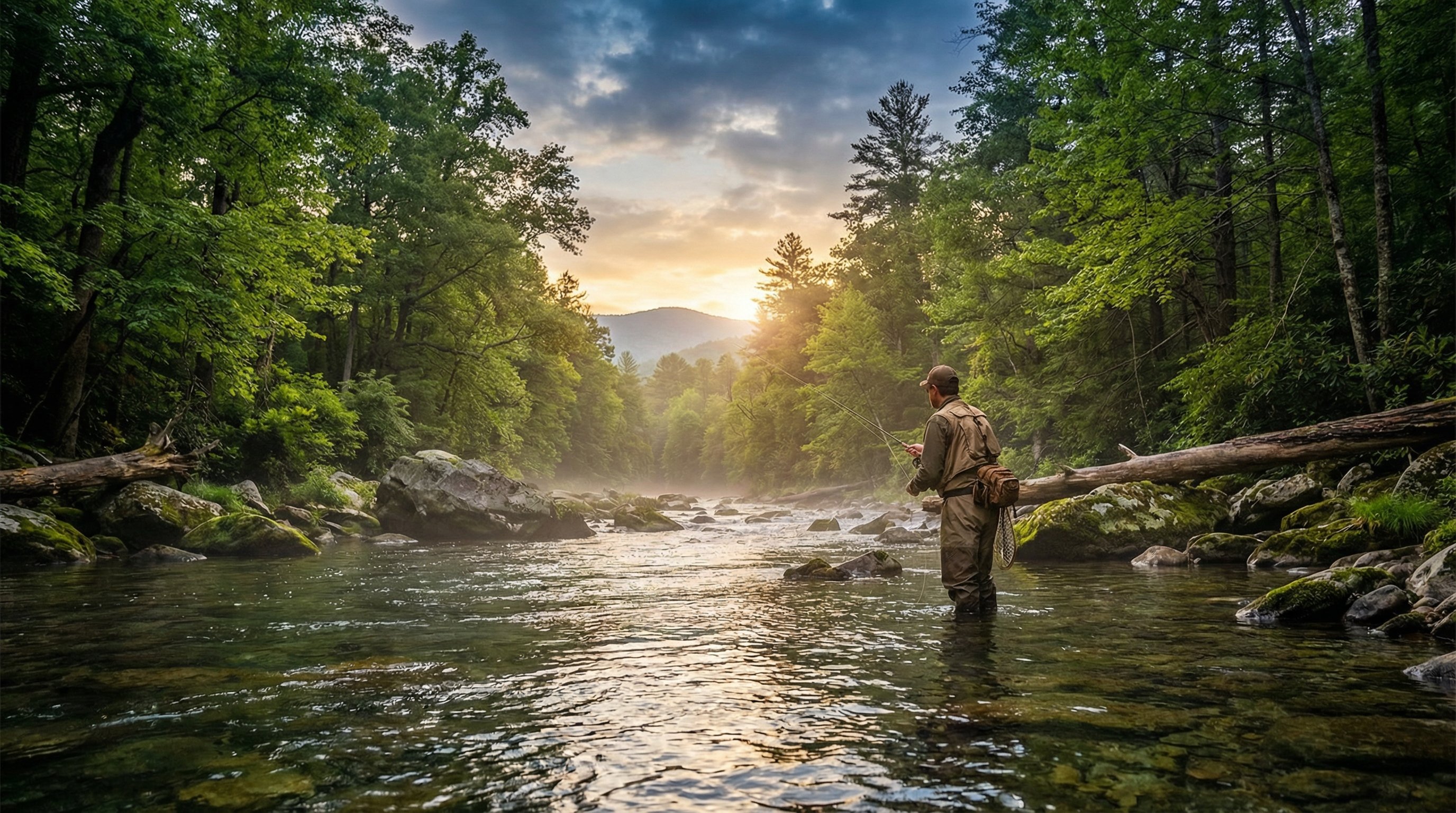
There's a moment on the Chattooga River in late April when everything clicks. The water temperature reads 52°F on your thermometer, a Hendrickson hatch begins drifting off the riffles upstream, and wild browns start rising with the regularity of a clock. You have maybe 90 minutes before the hatch collapses and those fish vanish back into the depths. If you understood what was coming, you were already in position. If you didn't, you're standing in the wrong pool eating a sandwich while the best fishing of the season happens fifty yards away.
That's the central lesson of Appalachian fly fishing: the angler who understands why fish behave the way they do across thousands of miles of mountain water consistently outfishes the one who simply shows up with good gear. Water temperature, current seams, hatch timing, barometric pressure — these variables don't care how expensive your rod is. They reward preparation and punish guesswork.
This guide covers the best trout streams running from Georgia to New York, with field notes on what makes each system fish the way it does in spring, and the practical information you need to plan a real trip.
Understanding Spring Conditions in Appalachian Streams
Before you point the truck toward the mountains, understand what spring actually means across this corridor. It isn't a single event — it's a northward progression that advances roughly 100 to 150 miles per week as temperatures climb through March, April, and May.
Water temperature is the single most important variable. Trout metabolism is directly controlled by water temp. Below 45°F, feeding activity slows to something between lethargic and nonexistent. Between 50°F and 65°F, you're inside the prime feeding window — bugs hatch in numbers, trout become aggressive, and presentations that were getting refused start getting inhaled. Above 68°F, metabolic stress becomes a conservation concern, and responsible anglers stop fishing until temperatures drop.
USGS stream gauge data is free, real-time, and genuinely useful. Check temperature and flow before you drive anywhere.
Spring Runoff and What It Does to the Bite
Snowmelt and April rains push flows high and turbid throughout the northern Appalachians from late March into May. Many anglers arrive at blown-out water and go home frustrated. But there is a specific window — usually 24 to 72 hours after peak flows begin dropping — when Appalachian trout fishing absolutely lights up, and understanding it changes how you plan your trips.
Here's the mechanism: high water dislodges crayfish, worms, and aquatic insects from the streambed in large quantities. As clarity returns and flows begin stabilizing, trout position tight to current seams and bank edges and feed aggressively on everything the flush kicked loose. Streamers and weighted nymphs in natural colors dominate during this window.
Key spring flow thresholds to watch:
| Flow Condition | What It Means |
|---|---|
| 150%+ above median | Likely blown out — wait it out |
| 110–150% above median | Good streamer conditions, slight stain |
| Near median | Optimal for nymphing and dry flies |
| Well below median | Clear water, spooky fish — go long and fine |
The Appalachian Spring Hatch Calendar
Spring hatches define the mountain fly fishing calendar, but they don't follow fixed dates. They follow water temperature and barometric pressure. A falling barometer ahead of a cold front shuts hatches down hard. Rising pressure after a front often triggers explosive emergence. You can use HookCast's weather tool to track pressure trends before a trip — it's one of the more practically useful pre-trip checks you can make.
| Hatch | Region | Approx. Water Temp | Timing |
|---|---|---|---|
| Blue-winged Olive | Georgia to New York | 48–55°F | March–May |
| Quill Gordon | Southern/Mid Appalachians | 50–56°F | April |
| Hendrickson | Mid to Northern Appalachians | 52–58°F | April–May |
| March Brown | Mid-Atlantic Appalachians | 56–62°F | May |
| Sulphur | Pennsylvania to New York | 58–65°F | May–June |
Southern Appalachians: Georgia, North Carolina, and Tennessee
This is where the Appalachian spring fly fishing season actually begins. The southern mountains reach prime conditions in March and early April, weeks before Mid-Atlantic streams hit their stride.
Georgia: The Chattooga and Upper Toccoa
The Chattooga River, straddling the Georgia–South Carolina border, holds one of the most underrated wild brown and rainbow trout populations in the South. The upper catch-and-release sections protect fish that have grown genuinely large by Appalachian standards, and educated is an understatement for fish that have seen pressure for years. Blue-winged olives can be prolific from late March onward, and while the Hendrickson hatch runs lighter here than it does further north, a good afternoon emergence will bring up fish that normally refuse to move for anything.
The Toccoa River tailwater below Blue Ridge Dam operates on a different logic entirely. Bottom-release dam water keeps temperatures cold year-round, which means the Toccoa is already fishing in early spring when high-elevation freestone streams are running cold and off-color. Expect rainbows stacked in the slower pools below the dam, feeding selectively on midges and small nymphs.
Field note: On tailwaters, always check dam release schedules before wading in. Flows on the Toccoa can change dramatically within a few hours when generation starts. Wading in rising water is dangerous, and the character of the fishing shifts completely when flows increase.
North Carolina: Davidson River and the Smokies
The Davidson River in Pisgah National Forest is legitimately one of the finest wild trout streams in the Southeast. It holds all three salmonid species — brook, brown, and rainbow trout — and the lower catch-and-release section below Calvert Bridge offers technical fishing as demanding as anything in the region. Spring brings heavy BWO hatches through mid-April and the first Hendricksons by late April.
The Davidson runs tight against the road, which makes it easy to access and easy to overcrowd. Fish it on a Tuesday morning in April and you'll feel like you have the entire state to yourself. Fish it on a Saturday in May and you'll understand why timing matters as much as location.
The Great Smoky Mountains National Park streams — including Hazel Creek, Deep Creek, and the upper Oconaluftee — protect native Southern Appalachian brook trout, a genetically distinct strain that NOAA Fisheries recognizes as a species of conservation concern. These streams are not stocked. Every fish you catch in the backcountry is wild, native, and hard-won on small dry flies. A size 14–16 elk hair caddis or parachute adams covers most situations. Learn to roll cast before you go — overhead casting room is a luxury in these drainages.
What to bring for the southern mountains:
- 9-foot 4-weight rod for open water on the Davidson and Chattooga
- 7.5 to 8-foot 3-weight for tight Smokies streams
- Tippet in 5X and 6X fluorocarbon
- Tungsten bead nymphs in sizes 14–18 (pheasant tail, hare's ear)
- BWO and Hendrickson dry flies in sizes 14–16
Tennessee: The Watauga and South Holston Tailwaters
If you want size and consistent numbers, Tennessee's Watauga River and South Holston River tailwaters are legitimately world-class. Both are regulated fisheries with delayed harvest and catch-and-release water, and both hold large populations of wild rainbows and browns that grow large on cold, nutrient-rich tailwater flows.
The South Holston has earned a specific reputation for difficulty. Fish rising consistently to size 24 sulphur emergers on 7X tippet is the norm here, not the exception. Spring is the prime season before summer heat pushes fish deep and surface activity declines. If you want a humbling afternoon on beautiful water with big fish that will refuse every fly you own at least once, the South Holston delivers that experience reliably.
Mid-Atlantic Appalachians: Virginia, West Virginia, and Pennsylvania
By May, the center of gravity for Appalachian fly fishing shifts north into some of the most historically significant trout water on the continent.
Virginia: Mossy Creek and the Rapidan
Mossy Creek in the Shenandoah Valley represents a fundamentally different style of fishing from the freestone streams further south. This is limestone spring creek water — crystal clear, flat meadow runs, with brown trout that will inspect your fly the way a watchmaker inspects a movement. The primary spring forage here includes cress bugs, a small freshwater crustacean that thrives in spring-fed limestone systems and conditions the trout to feed selectively on small, precise imitations. Long leaders, delicate presentations, and a strong commitment to catch-and-release are the entry requirements.
The Rapidan River in Shenandoah National Park carries genuine American history — President Herbert Hoover fished here, and the wild brook trout fishing he valued is still intact in the upper reaches. The fish aren't large. They're beautiful, willing to rise, and they live in a place worth the walk to reach.
Pennsylvania: Penns Creek and Spring Creek
Pennsylvania is where Appalachian fly fishing takes on something approaching reverence. Penns Creek — a limestone stream cutting through the ridge-and-valley country of central Pennsylvania — hosts what is arguably the most significant Green Drake hatch in the eastern United States. In late May and early June, size 8 green drakes emerge in numbers that seem implausible until you watch it happen, and the large, selective brown trout that normally refuse everything become temporarily aggressive and catchable. It's a genuinely rare kind of fishing.
Spring fishing before the Drake arrives is excellent in its own right. Sulphurs, March Browns, and blue-winged olives cycle through Penns from April onward in a reliable progression. Check USGS gauge data before heading to central PA — the creek runs big after spring rain events, and high water on Penns is a different proposition from high water on a smaller mountain stream.
Spring Creek near State College is shorter but arguably more technically demanding. Fed entirely by springs, it runs cold and clear year-round and has served as a proving ground for fly tiers and anglers for generations. Presentations here get scrutinized.
Local knowledge: During the Green Drake hatch on Penns Creek, parking areas fill by mid-afternoon. Park at upper access points and walk downstream. Fish see fewer flies down-current from the crowds, and as light fades, the drifts get better and the fish get less cautious.
West Virginia: The Elk and Cranberry Rivers
West Virginia is the dark horse of Appalachian fly fishing — seriously underrated, consistently less crowded than Virginia and Pennsylvania equivalents, and holding wild trout in freestone structure that rewards exploratory fishing. The Elk River and Cranberry River in the Monongahela National Forest both hold holdover wild fish in addition to stocked populations. Peak spring conditions here run slightly behind Virginia's timing, with the best fishing from mid-April through May.
What distinguishes West Virginia streams:
- Substantially lower fishing pressure than comparable Virginia and Pennsylvania waters
- Diverse structure — deep pools, classic freestone runs, technical pocket water
- Strong caddis hatches alongside the standard mayfly progression
- Broad national forest access that is largely free and publicly available
Northern Appalachians: New York and the Catskills
The Catskill Mountains occupy a specific and irreplaceable position in American fly fishing history. Theodore Gordon developed American dry-fly technique on these streams in the early 1900s. The Quill Gordon, Hendrickson, and the distinctly spare Catskill-style tying tradition all originated here. Fishing in the Catskills in late April connects you to something larger than a single trip.
The Delaware River System
The West Branch of the Delaware is, by the judgment of most serious eastern trout anglers, the finest wild brown trout river in the eastern United States. Running cold out of the Cannonsville Reservoir, it holds an extraordinary population of large wild browns — fish averaging 14 to 18 inches with legitimate trophy fish pushing 20-plus inches in certain pools. This is not incidental — it reflects decades of conservation regulation and the consistent cold temperatures a tailwater provides through the season.
Spring on the West Branch opens with the Hendrickson hatch in late April, followed by March Browns and Cahills into May. The river is wide and wading demands comfort and judgment. The fish are highly educated. This isn't water that rewards sloppy presentation, but it rewards skilled anglers more consistently than almost anywhere else in the East.
The main stem Delaware, where the West and East Branches converge, also holds world-class wild trout fishing and is one of the few large rivers in the Northeast where drift boat nymphing in spring is both practical and genuinely productive.
The Beaverkill and Willowemoc
The Beaverkill is the most storied trout stream in American fly fishing. The historic Catskill Fly Fishing Center sits on its banks. Wild browns and rainbows here have been caught and released for over a century, and the fish behave accordingly. The Junction Pool — where the Willowemoc joins the Beaverkill — is iconic water that every serious Appalachian fly angler should wade at least once, not because it fishes better than other pools, but because of what it represents.
Spring on the Beaverkill centers on the Hendrickson hatch from late April into early May. Afternoon rises during this window can be frantic. The fish are educated — 6X tippet is the minimum entry point, drag-free drifts are non-negotiable, and the difference between a dun and a spinner presentation often determines whether fish eat or ignore you entirely.
Northern Appalachian spring essentials:
- 9-foot 5-weight rod for the wide Delaware system
- 4-weight for the Beaverkill and Willowemoc
- Hendrickson duns and spinners in sizes 12–14 — non-negotiable in late April
- Quill Gordon in sizes 12–14 for early April
- Long leaders: 12 to 14 feet is standard on flat Delaware pools
Gear and Logistics for an Appalachian Spring Trip
Planning across this geographic corridor requires thinking in terms of latitude and elevation. A trip to the Smokies in late March and a trip to the Catskills in late April are both called "spring fishing" — but they are operating in different seasons in practice, with different hatches, different water temperatures, and different fish behavior.
Rod Selection by Water Type
| Water Type | Rod Length | Rod Weight | Tippet |
|---|---|---|---|
| Tight mountain brook streams | 7–8 ft | 2–3 weight | 6X–7X |
| Mid-size freestone streams | 8.5–9 ft | 4 weight | 5X–6X |
| Limestone spring creeks | 9 ft | 4–5 weight | 6X–7X |
| Large tailwaters and Delaware system | 9–9.5 ft | 5–6 weight | 5X–6X |
Licenses and Regulations
Every state along the Appalachian corridor has different trout season opening dates, licensing requirements, and special regulation sections. Critical notes for multi-state trips:
- Great Smoky Mountains National Park requires no state fishing license — it's federal land — but operates under its own NPS regulations on tackle and methods. Check the NPS website directly before fishing.
- Pennsylvania requires a trout/salmon stamp in addition to the base fishing license.
- New York opens most Catskill waters on the first Saturday in April, with some special regulation sections operating under different rules.
- North Carolina and Tennessee both maintain hatchery-supported sections, wild trout sections, and delayed harvest water with different rules for each designation.
Verify current regulations on each state's fish and wildlife agency website before any multi-state trip. Regulations change year to year, and ignorance isn't a defense when a conservation officer is writing a citation.
Pair HookCast's fishing forecast tool with USGS gauge data and you have a solid operational picture before you leave the driveway — current conditions, pressure trends, and flow data in one planning session.
Spring Appalachian Fly Fishing: Quick-Reference Checklist
Before the Trip
- [ ] Check USGS stream gauge for temperature and flow (target 50–65°F, flows near median)
- [ ] Verify fishing license requirements for each state and purchase stamps where required
- [ ] Confirm hatch timing based on current water temps for your target stream
- [ ] Check barometric pressure trend — stable or rising pressure favors dry-fly activity
- [ ] Research special regulations for your specific stream section
Gear Pack
- [ ] Minimum two rod setups covering different water types
- [ ] Tippet from 4X through 7X
- [ ] Dry flies: BWO, Quill Gordon, Hendrickson, March Brown (sizes 12–16)
- [ ] Nymphs: Pheasant Tail, Hare's Ear, Copper John in tungsten bead (sizes 12–18)
- [ ] Streamers: Woolly Bugger and sculpin patterns in olive and black
- [ ] Forceps, net, polarized glasses
On the Water
- [ ] Read current seams and deeper holding water before entering the river
- [ ] Check for rising fish before blind casting
- [ ] Observe natural flies on the water and in the air before selecting a pattern
- [ ] Work upstream, approach each pool from the tail
- [ ] Release fish quickly — and if water temps exceed 68°F, stop fishing entirely until temperatures drop
FAQ
What is the best time of year to fly fish the Appalachian Mountains?
Spring — roughly late March through early June — is the prime season for Appalachian fly fishing. Water temperatures climb into the ideal feeding range of 50–65°F, and the major mayfly and caddis hatches occur during this window. The timing progresses northward with the season: Georgia and North Carolina peak in March and April, the Mid-Atlantic streams hit their stride through May, and New York's Catskills reach prime condition in late April and May.
Which Appalachian trout stream is best for beginners?
North Carolina's Davidson River in Pisgah National Forest and Tennessee's Watauga tailwater are both well-suited for anglers building skills. Both offer accessible banks, clear water where you can observe fish and learn to read feeding behavior, and active fish populations. Avoid tight Smoky Mountain backcountry streams until you're comfortable with roll casts and short-line nymphing presentations — overhead casting room is minimal in those drainages and casting failure there is costly.
Do I need a separate license for each state when fly fishing the Appalachians?
Yes. Fishing licenses are state-specific, and a multi-state Appalachian trip requires a valid license for each state you fish. Some states, including Pennsylvania, require a trout or salmon stamp in addition to the base license. The one exception is the Great Smoky Mountains National Park, which as federal land requires no state license — though its own NPS regulations still apply and must be followed.
What fly patterns should I bring for spring Appalachian trout fishing?
A functional spring box should include blue-winged olives (sizes 14–18), Hendricksons (sizes 12–14), Quill Gordons (sizes 12–14), pheasant tail nymphs, hare's ear nymphs, and a selection of olive or black woolly buggers for off-color or high-water conditions. Matching the specific hatch and its stage of emergence matters more than fly selection in the abstract — spend a few minutes observing what's actually on the water before deciding what to tie on.
How do I know if a stream is too high to fly fish safely after spring rain?
Check the USGS National Water Information System for real-time stream gauge readings at your target river. If flows are more than 150% above the historical median for that calendar date, the water is likely too high and potentially unsafe to wade. Slightly elevated flows — 110 to 130% above median — can actually produce excellent streamer fishing as clarity begins returning after a flood event, but wading safety always takes priority. Never enter water moving faster than you can comfortably manage, regardless of what the fishing might be doing.