Late Spring Topwater Fishing: Frogs, Buzzbaits, and Walking Baits for Bass
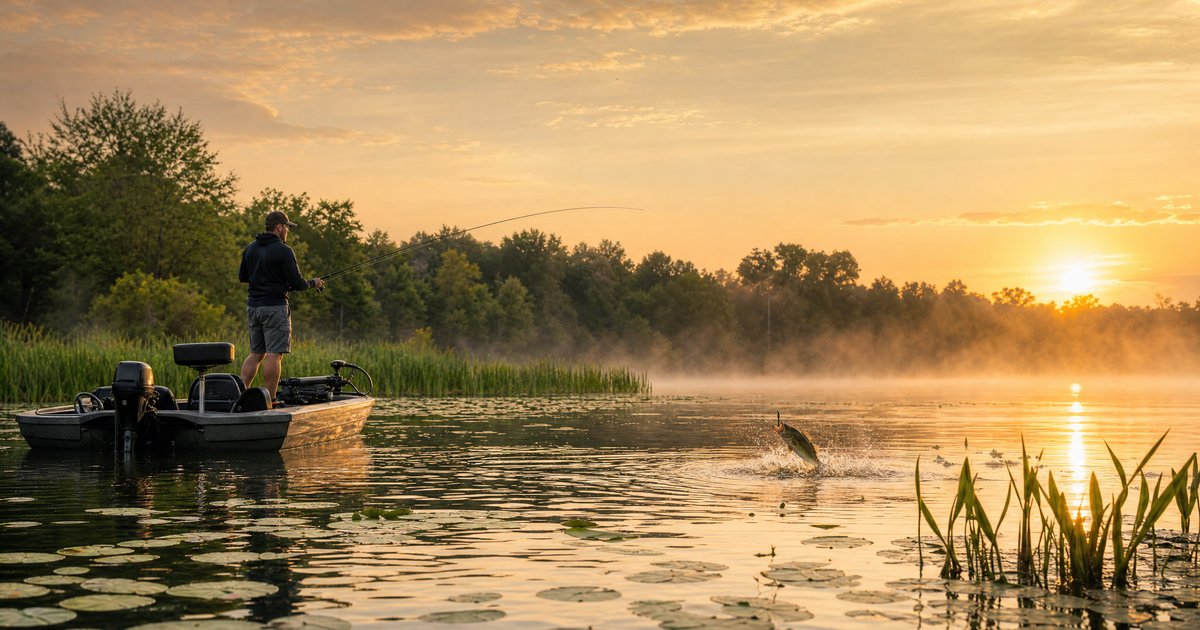
There's a morning I keep coming back to. Mid-May, a Missouri reservoir, water temperature sitting right around 68°F. I paddled my kayak into a shallow cove just as the sun crested the tree line, and the surface was absolutely alive — bass busting shad in open water, swirls beneath overhanging willows, the occasional slurp along an algae mat creeping out from the bank.
First cast with a buzzbait: fish on. Second cast: another blow-up. I caught eight bass in 45 minutes before the bite went cold.
That morning wasn't luck. It was late spring doing exactly what late spring does.
The post-spawn window — when water temperatures climb through the mid-60s into the low 70s — is arguably the single best stretch of the year for topwater bass fishing. Bass are aggressive, shallow, and actively hunting. They've weathered the physical stress of the spawn and they're feeding hard to recover. If you know which baits to reach for and when to throw them, you can have mornings that ruin you for slower fishing the rest of the year.
This guide breaks down the three workhorses of late spring topwater fishing: frogs, buzzbaits, and walking baits. We'll cover when each one shines, how to work them effectively, and how to read conditions before you ever leave the driveway.
Why Late Spring Is the Peak Window for Topwater Bass
Water Temperature Is the Trigger
Bass physiology drives everything. Largemouth bass feed most aggressively as water temperatures climb into the 65–75°F range — a window that aligns almost perfectly with the post-spawn period across much of the Midwest and South, typically running from late April through early June depending on your latitude.
Inside that temperature band, several things happen at once:
- Bass metabolism is running hot, and they need to eat frequently to recover from spawn-related energy expenditure
- Shad and bluegill are spawning in the shallows, pulling predatory bass up near the surface
- Aquatic vegetation is growing fast, creating the shallow structure bass use to ambush prey
- Low-light surface activity intensifies as fish actively chase bait near the top of the water column
Below 60°F, topwater is generally too slow to be reliable. Above 80°F, bass push deeper during midday hours. The 65–75°F band is your prime time — fish it hard.
Barometric Pressure Matters More Than Most Anglers Realize
Barometric pressure has a measurable influence on surface feeding activity, and it's a variable that's easy to track before any trip.
Bass tend to feed most aggressively on the surface when pressure is stable or rising after a weather system moves through. A dropping barometer ahead of a cold front can trigger a short, frenzied feeding window — but the front itself and the high-pressure period immediately following typically kill topwater action. In my experience, waiting 24–48 hours after a cold front clears out is almost always worth it.
Standard atmospheric pressure sits around 1013.25 hPa. I use HookCast's weather tool to track what the barometer has been doing over the previous 24 hours before committing to a topwater morning. If pressure has been stable or climbing steadily, that's a green light. If it spiked sharply post-front and is still rising fast, give it another day.
The Daily Feeding Windows
Late spring topwater fishing is rarely an all-day affair — at least not on bright, calm days. The prime windows are:
- Early morning: First light through roughly two hours after sunrise
- Evening: The last 90 minutes of daylight into dusk
- Overcast days: Cloud cover can extend productive topwater action throughout the entire day, sometimes dramatically
Midday on a bluebird day in late May is often tough on the surface. That's when I reach for something subsurface and wait for the light to drop again. But when conditions align — mild temps, stable pressure, low light, and some wind texture on the water — the bite can run all day.
I also pay attention to solunar timing. Using HookCast's solunar calendar to identify major and minor feeding periods and stacking those with my early-morning topwater windows has made a real difference. It's not a guarantee, but when a major period lines up with first light, you notice it.
Buzzbaits: The Search Bait for Late Spring
If I had to choose one topwater bait for late spring, it might be the buzzbait. It's loud, it moves fast, and it triggers reaction strikes from bass that aren't even necessarily in active feeding mode.
Why Buzzbaits Work So Well This Time of Year
A buzzbait running across the surface mimics a fleeing or injured baitfish — exactly what a recovering, aggressive bass wants to chase. In late spring, shad and bluegill are stacked in the shallows, and bass are dialed into anything moving at the surface. The blade's clatter and the wake it kicks up is hard for a shallow-running, spring-fed largemouth to ignore.
The buzzbait bite in mid-May is often the fastest fishing I see all year. If a bass is going to eat it, the strike usually comes within the first few feet of the retrieve.
How to Work a Buzzbait
The retrieve is simple in concept, but the details matter:
- Slow it down more than feels comfortable. Most anglers reel too fast. Drop your speed until the bait is barely maintaining surface contact — that slow, rhythmic gurgle often draws more fish than a racing blade
- Fish it on a long rod. A 7-foot medium-heavy gives you the reach to keep the blade planing and control fish when they hit near heavy cover
- Add a trailer. A short chunk trailer or a compact swimbait on the hook adds bulk, slows the bait slightly, and gives bass something to grab onto
- Wait on the hookset. This is the hardest part to teach yourself. When a bass blows up, resist the instinct to swing immediately — let the fish turn with the bait, feel the weight, then set with authority
Best Buzzbait Conditions
| Condition | Buzzbait Rating |
|---|---|
| Early morning, calm water | ⭐⭐⭐⭐⭐ |
| Overcast, light chop | ⭐⭐⭐⭐⭐ |
| Post-storm clearing | ⭐⭐⭐⭐ |
| Bluebird midday | ⭐⭐ |
| Active cold front | ⭐ |
Where to Throw It
Buzzbaits are at their best as a search bait — covering ground efficiently to locate active fish. Fan-cast them across:
- Shallow flats with scattered grass, stumps, or wood
- Points and pockets on the north bank, which warm fastest in spring
- Laydowns and dock edges — place the bait tight to cover and rip it away
- Creek channel mouths where feeding fish stage in late spring before moving onto adjacent flats
Frog Fishing: Precision Over the Mats
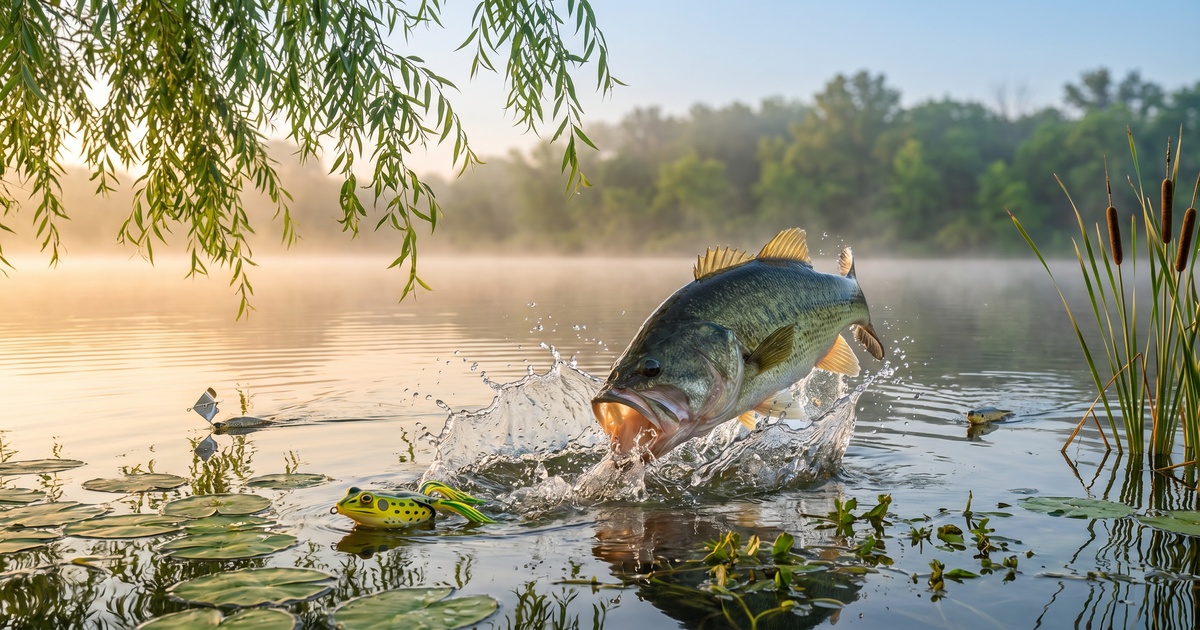
The hollow-body frog is the most satisfying bait in freshwater fishing, full stop. When a largemouth hammers a frog on a matted surface and you drive the hook home and it's a four-pounder — nothing else in bass fishing quite touches that.
Frog fishing rewards patience, accuracy, and the willingness to fish heavy cover that most anglers walk past. It's a technique game as much as a gear game.
Reading the Cover: Where Frogs Excel
Late spring is when aquatic vegetation really fires up. Lily pad fields, floating algae mats, hydrilla and milfoil beds reaching the surface — this is prime frog water. Bass use this cover to stage ambushes, and a hollow-body frog walking right across the top of it matches what they're looking for: a natural, easy meal presented directly in their living room.
The thicker and nastier the cover, the better. Bass under heavy mats feel protected and bold — they'll blow through several inches of vegetation to eat a bait. That's the hollow-body's advantage: it's weedless by design and built for places that would hang up almost any other presentation.
Field note: Some of my best frog fishing has come from mats so thick they barely rippled when the bait crossed them. Don't avoid the ugliest stuff — that's where the biggest fish hold.
How to Work a Frog
The basic cadence:
- Cast past your target and pull the frog onto the mat
- Use short, rhythmic downward twitches with the rod tip low to walk the bait side-to-side
- Pause at every opening, edge, and pocket in the vegetation
- When a fish blows up: wait. Count to two. Then set hard with a sweeping hookset — not a straight-up pull that yanks the bait out of the fish's mouth
The pause is everything. Bass often miss on the initial blow-up and circle back. If you rip the frog the moment the water erupts, you lose the fish. If you wait and feel weight before swinging, your hookup rate climbs significantly.
Gear Matters Here
Frog fishing is heavy-contact work. You're pulling fish out of thick vegetation under load, and gear failures at that moment are particularly painful.
- Rod: 7'3" to 7'6" heavy or extra-heavy baitcasting rod
- Line: 50–65 lb braided line — stretch is the enemy in heavy cover
- Hooks: Check and sharpen frog hooks before every trip. Most hollow-body frogs ship with mediocre hardware; upgrading to quality wide-gap hooks makes a measurable difference in hookup percentage
Hollow-Body Frog vs. Popping Frog
The standard walking hollow-body is the right tool for heavy mat work. But when bass are showing on open water or patrolling pad edges, a popping frog with a cupped mouth adds noise and splash that pulls fish from a distance. I keep both rigged in late spring — the walker in the nastiest cover, the popper for cleaner water and edge situations.
Walking Baits: The Open-Water Topwater Workhorse
When bass aren't buried in cover — when they're out on open flats, cruising points, or visibly chasing bait — a walking bait like the Heddon Zara Spook is often the most effective surface presentation available.
The side-to-side "walk-the-dog" action mimics a disoriented or fleeing baitfish in a way that drives bass to commit. It also lets you cover open water methodically and slow down precisely when needed, without losing contact with the strike zone the way a buzzbait does.
Mastering Walk-the-Dog
This technique takes real time on the water to develop. The mechanics:
- Rod tip pointed down, slack built into the line
- Short, rhythmic downward twitches with your rod hand while reeling slowly to take up slack
- The bait should swing left, right, left, right in an even, consistent cadence
- Vary the pace. A fast, aggressive walk triggers fish sometimes. Other times a slow, wandering drift draws the strike. Let the fish tell you which they want on a given day
The most common mistake beginners make is twitching too hard or keeping too much tension in the line. The slack is what creates the swing. Practice in calm, open water until the action becomes automatic before you try to drop it precisely along a dock edge.
When Walking Baits Shine in Late Spring
Walking baits are at their best in these late-spring scenarios:
- Bass busting shad on open flats — match the size profile of what they're chasing
- Rocky points and chunk-rock banks where bass patrol at low light
- Boat docks and piers — walk the bait parallel to the dock face rather than casting directly at it
- Pre-frontal feeding windows when fish are active and roaming open water
- Clear to lightly stained water — the visual action works best when fish can see and track the bait
In very turbid water, a buzzbait with more vibration and auditory disturbance typically outperforms a walking bait that relies primarily on visual tracking to trigger a strike.
Size and Color Notes
In late spring, I reach for 3.5–5-inch walking baits most often. Shad-pattern colors — chrome, white, bone — in clearer water, and something with chartreuse or an orange belly when there's color in the water. In low light or predawn darkness, I'll sometimes tie on a black or dark walking bait — the silhouette contrast against the bright sky-lit surface is surprisingly effective and tends to draw larger fish.
Putting It Together: Choosing the Right Bait for the Moment
The most common question from anglers getting into topwater fishing: how do I know which bait to throw? Here's the framework I've settled into after years of working through this by trial and error.
The Decision Framework
Step 1: Read the water
- Heavy mats or thick vegetation present → Frog
- Open water, flats, and visible structure points → Walking bait
- Mixed cover with a need to locate fish first → Buzzbait
Step 2: Factor in light and conditions
- Low light, calm surface → All three can produce; buzzbait and walking bait are especially efficient
- Overcast with slight wind chop → Buzzbait shines
- Bright midday sun → Frog over heavy cover where bass are holding tight; walking bait near shade and shadow lines
Step 3: Read the fish's activity level
- Bass actively blowing up at the surface → Match the bait profile to what they're chasing; open with a buzzbait or walking bait
- Inactive fish holding in cover → Slow everything down; park a frog at a mat edge and work it in place with subtle twitches
A Late-Spring Morning Sequence: What I Actually Do
On a typical late-May morning from the kayak, my topwater rotation looks like this:
- First 30 minutes: Buzzbait across every likely point and flat I paddle past. Covering water, marking where active fish are holding.
- If fish respond aggressively: Stay with the buzzbait, or transition to a walking bait if fish are following but not fully committing to the blade bait.
- When I hit a mat or thick vegetation: Switch to the frog and slow down. Work the edges first, then push into the thickest stuff.
- As the sun climbs high: Walking bait on shaded dock edges and woody cover. If the surface bite goes quiet, I move subsurface and wait for the light to change.
A Note on Handling Bass During Spawn and Post-Spawn
Late spring topwater fishing overlaps directly with spawning activity — particularly in northern states where the spawn can run into early June. Bass on beds and recently post-spawn fish are stressed, and how you handle them matters.
If you're fishing areas with active spawning:
- Handle fish quickly and with wet hands — dry hands strip protective mucus from the body
- Minimize time out of the water, especially with females that may still be holding eggs or recovering from spawning stress
- Release fish in the same general area where you caught them so they can return to the nest or recovery area
- Consider barbless hooks or quick-release techniques when fishing beds specifically — they make release faster and less traumatic for the fish
Bass populations are resilient, but spawn-period handling has a direct effect on recruitment and year-class strength in pressured fisheries. NOAA Fisheries has solid resources on largemouth bass spawning biology if you want to understand the timing and stress factors in more depth.
One more thing: always verify your state's current regulations before you go. Slot limits, bag limits, and seasonal restrictions vary significantly by state and sometimes by individual water body. A two-minute check on your state fish and wildlife agency's website is all it takes — and it matters for keeping these fisheries healthy long-term.
Quick-Reference: Late Spring Topwater Cheat Sheet
Prime Conditions:
- Water temp: 65–75°F
- Barometric pressure: stable or rising for 24+ hours
- Time of day: early morning, evening, all-day overcast
- Post-front: wait 24–48 hours before committing to topwater
Bait Selection at a Glance:
| Bait | Best Cover | Best Conditions | Key Technique |
|---|---|---|---|
| Buzzbait | Open flats, mixed edges | Early morning, overcast | Slow retrieve; wait before setting |
| Hollow-body frog | Heavy mats, pad fields | Any low-light period | Pause at openings; count before setting |
| Walking bait | Open water, points, docks | Calm to light chop, clear water | Walk-the-dog; vary cadence to match mood |
Gear Essentials:
- Frog: Heavy or XH baitcaster, 50–65 lb braid
- Buzzbait and walking bait: Medium-heavy 7-foot baitcaster, 17–20 lb fluorocarbon or 40–50 lb braid
- Always carry all three rigs — conditions can shift within a single morning
FAQ
When is the best time to throw topwater lures for bass in late spring?
The most productive topwater windows in late spring are early morning — from first light through roughly two hours after sunrise — and the final 90 minutes of daylight into dusk. Overcast days can extend surface activity throughout the entire day. Water temperatures between 65–75°F produce the most consistent topwater action, which typically falls between late April and early June across most of the Midwest and South.
What's the difference between a buzzbait and a walking bait for spring bass fishing?
A buzzbait is a bladed search bait built to cover water quickly using noise and surface disturbance — ideal for locating active fish across flats and mixed cover. A walking bait is a more precise topwater presentation that uses a side-to-side "walk-the-dog" action to mimic a disoriented baitfish in open water. Buzzbaits tend to generate more instinctive reaction strikes; walking baits perform better when bass are following but not committing, or when fish are visibly keyed in on specific baitfish.
How do you fish a hollow-body frog for bass in spring vegetation?
Cast the frog onto or past a mat of vegetation and use short, rhythmic rod twitches with the tip pointed down to walk the bait side-to-side across the surface. The most critical skill is the pause — particularly at gaps, edges, and openings in the mat where bass are staged below. When a fish blows up, wait a full count of two before setting the hook with a hard, sweeping strike. Use a heavy baitcasting rod with 50–65 lb braided line to power fish out of thick cover before they can bury themselves deeper in the vegetation.
Does barometric pressure affect topwater bass fishing?
Yes, and meaningfully so. Bass tend to feed most aggressively on the surface when barometric pressure is stable or rising after a weather system has cleared through. A falling barometer ahead of a cold front can trigger a brief, intense feeding window — but the front itself and the high-pressure period immediately following typically shut down topwater action. Waiting 24–48 hours after a cold front passes before targeting fish on the surface tends to produce far better results than fishing the day after a system moves through.
Can you catch bass on topwater lures during the spawn?
Yes — bass are catchable on topwater during the spawn and are often especially aggressive during the post-spawn recovery period. That said, responsible handling matters. Handle fish carefully and quickly, keep them out of the water as briefly as possible, and release them in the same area where you caught them. Use wet hands to protect the fish's protective mucus layer, and consider barbless hooks when targeting fish that may still be on beds. Thoughtful catch-and-release practices during the spawn protect year-class strength and keep the fishery productive for seasons to come.