Outer Banks Fishing Guide: Surf, Pier & Offshore Fishing on North Carolina's Coast
It's 5:45 AM at Cape Point, and the sky is just starting to go gray. You've got your rod planted in the sand, a fresh chunk of menhaden on a fish-finder rig, and the tide is two hours into the outgoing. The slough right off the point is churning, and somewhere in that dark water, red drum are moving with the current. If you've done your homework, the next couple hours are going to be electric. If you haven't, you might be staring at a motionless rod tip until the sun gets high and the bite goes cold.
The Outer Banks isn't the easiest place to fish — it rewards anglers who understand what they're looking at. But when it comes together, this 200-mile stretch of barrier islands along North Carolina's coast is genuinely one of the best fishing destinations on the entire East Coast. I've been guiding surf trips here for years, and every season still surprises me.
Here's what you need to know to make the most of a trip — whether you're throwing plugs from the beach, dropping baits off a pier, or heading offshore for the big stuff.
Understanding the OBX: Why Location Changes Everything
The Outer Banks is not a single fishery. It's a chain of narrow barrier islands separated from the mainland by sounds — Pamlico, Albemarle, Roanoke — with inlets cutting through at irregular intervals. That geography creates a huge variety of fishing environments within a short drive.
The ocean-facing beaches take the full force of Atlantic swells and tides. Structure here is constantly shifting — sandbars form and disappear after every storm, sloughs cut new channels, and cuts form between bars that concentrate baitfish and attract predators.
The sound side is calmer, shallower, and warmer. It's important habitat for juvenile fish and a great option when the surf is rough or during summer when the beaches get crowded.
The inlets — Oregon, Hatteras, Ocracoke — are where the two worlds collide. Moving water, strong currents, and a constant mixing of prey makes inlets some of the most productive spots on the entire coast during spring and fall runs.
If you want to check the tidal flow for specific OBX inlets before you head out, that's often the single most useful piece of pre-trip research you can do.
The Role of Cape Hatteras
Cape Point, at the southern tip of Hatteras Island, deserves its own mention. This is where the warm Gulf Stream collides with the cold Labrador Current — a convergence zone that creates extraordinary biological productivity. Baitfish stack here, and so do the predators that follow them. NOAA Fisheries notes that this kind of thermal boundary is a key driver of coastal fish distribution along the Mid-Atlantic. In my experience, Cape Point fishes best when the current rips are active and there's some chop on the water. Flat calm, high-sun conditions push fish off the point.
Surf Fishing the Outer Banks: Reading the Water
Surf fishing on the OBX is as much about reading the beach as it is about casting distance or bait choice. A well-presented bait 40 feet out in the right structure will out-fish a 100-yard bomb into dead water every time.
What to Look For
When you walk the beach, you're looking for three things:
- Sloughs: These are depressions running parallel to the beach between the shoreline and the outer sandbar. Baitfish use them as travel corridors. Drop a chunk of cut bait into a slough during the outgoing tide and you're in the feeding zone.
- Cuts: Where the outer bar breaks — either natural gaps or storm-cut channels — bait gets flushed through, and predators position just on the downcurrent side waiting.
- Discolored water: A visible color change where sand-stained water meets cleaner water usually signals a rip or current edge. That edge is a feeding lane.
Field observation: I've seen anglers drive right past Cape Point slots that were stacked with red drum because they didn't notice the subtle color change 30 yards out. Take five minutes to read the water before you set up. It changes everything.
Target Species by Season
Red Drum (Redfish): The Outer Banks is famous for its fall red drum run, roughly mid-September through November. These are big fish — slot is 18 to 27 inches in North Carolina, with one over-slot fish allowed per day. Cape Point and the Hatteras Island beaches south of the lighthouse get the most attention, but any productive slough on the ocean beach can hold drum during the run. Fresh or cut menhaden, mullet, and crab are top baits.
Striped Bass: The spring run (March–May) and fall/winter run (November–January) bring stripers down from the north. Colder water is your friend here — once surface temps drop into the low-to-mid 50s (°F), stripers move into the surf zone. Bucktail jigs, soft plastics, and cut bunker work well.
Bluefish: Present nearly year-round in some numbers, with heavy concentrations in spring and fall. Blues are aggressive and fast — if you see birds diving, there are blues underneath. They'll hit anything shiny or bloody.
Pompano: Summer species, best in warm water from June through September. They run tight to the first bar and love sand flea (mole crab) imitation jigs. Light tackle makes them a blast.
Flounder: The guts and sloughs are flounder habitat. Work a bucktail or live finger mullet slowly along the bottom in 2–4 feet of water.
The Tide Factor in Surf Fishing
I can't overstate this: the two hours on either side of a tidal phase change are your prime windows. As the tide transitions — particularly on the outgoing — water drains from the sloughs and pushes bait through the cuts. Predators position on the downcurrent side and feed actively.
Slack tide is generally the slow period. During full slack, water movement stops and fish often suspend or move deeper. This isn't absolute — sometimes a slack period with good solunar factors will still produce — but as a baseline, fish the moving water.
NOAA tidal predictions for Hatteras Inlet are accurate and free. Match your beach time to the moving tide and you'll immediately start catching more fish.
Pier Fishing the Outer Banks
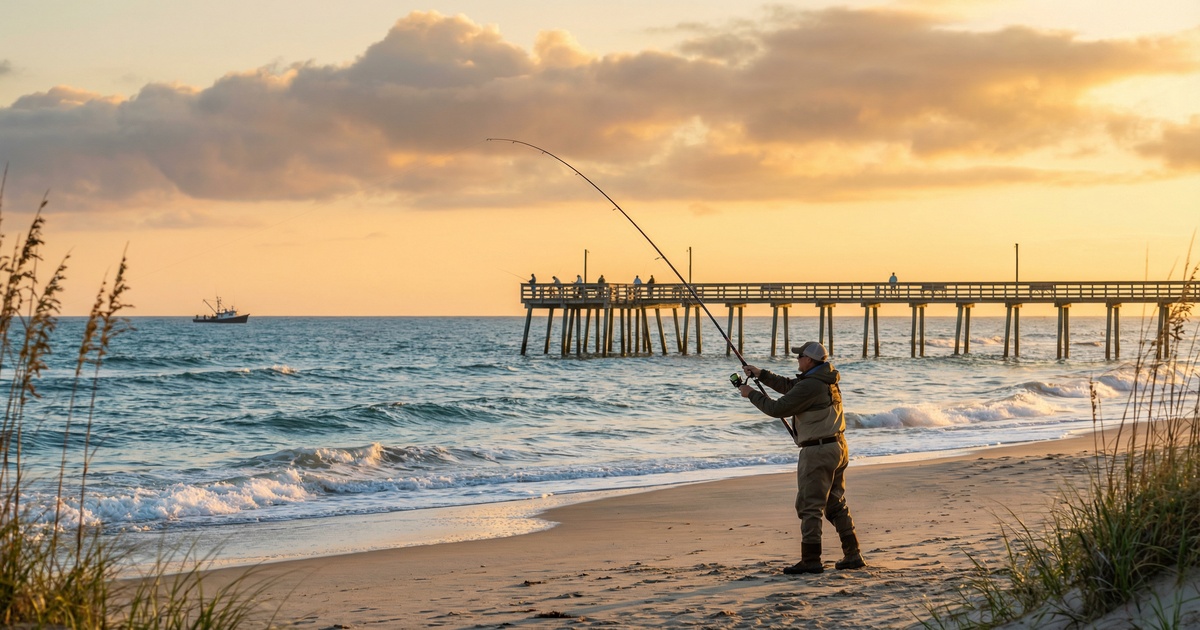
The OBX piers extend well past the inner bar zone and put you over water that's hard to reach from the beach. During spring and fall, that access makes all the difference.
Top Piers
Nags Head Fishing Pier (Nags Head) — One of the longer piers on the coast, it reaches into productive Spanish mackerel and bluefish territory in summer, and stripers congregate around the pilings in cold weather.
Avon Pier (Avon, Hatteras Island) — Further south, closer to the Cape Hatteras zone. Prime for pompano in summer and red drum in fall. The pilings hold sheepshead.
Rodanthe Pier — Good access to the offshore bar zone. King mackerel run past here in late summer, and local anglers set up with live bait rigs.
Pier Fishing Tactics
Pier fishing rewards patience and awareness. A few things that consistently make a difference:
- Fish the shadow lines at night: Lights on the pier attract bait and predators. Spanish mackerel and bluefish slash bait in the lit zones; larger fish like stripers often work just outside the light edge.
- Bottom rigs under the pier: Sheepshead, black drum, and flounder hold tight to the pilings. Drop a fiddler crab or sand flea on a Carolina rig right against the structure.
- Watch other anglers: When a species moves through, pier regulars react fast. If someone three sections down starts clearing their rod, look up.
- Timing still matters: Even on a pier, tidal movement triggers feeding. An active tide moving through pilings creates micro-eddies that bait and predators respond to.
Pro tip: Pier regulars at Avon often tip me off to the first red drum of the fall before it even makes the forums. Coffee and conversation with the locals is genuinely good intel.
Offshore Fishing from the Outer Banks
The Gulf Stream runs closer to the OBX than almost anywhere else on the East Coast — in some places, it's only 30-35 miles offshore. That proximity is why Hatteras and Nags Head support a serious offshore fleet.
The Species
Yellowfin Tuna: Summer and fall, sometimes into winter when the Stream runs warm. Trolling skirted lures along color changes or temperature breaks finds them. Once you locate a feeding school, casting small jigs or live bait keeps the action going.
Mahi-Mahi (Dolphin): Spring through fall. Floating debris, weedlines, and the edges of current rips are key. A weedline in warm, blue water almost always holds mahi.
Blue Marlin & White Marlin: The OBX hosts several major tournaments including the Big Rock Blue Marlin Tournament, based out of Morehead City (roughly 2 hours south), but Hatteras boats access the same fishery. Peak months are June through August.
Wahoo: Fast, deep-running fish that like the edges of the Gulf Stream in fall. Trolling deep-diving lures at speed is the standard approach.
King Mackerel: Accessible without going all the way offshore — kings run along the nearshore lumps and ledges from late spring through fall. Live-lining menhaden or bluefish off a flat-line spread is hard to beat.
Booking a Charter vs. Running Your Own Boat
If you're trailering a boat to the OBX, launching options include Oregon Inlet Marina (maintained by the National Park Service) and Hatteras village. Oregon Inlet can be tricky — the bar shifts frequently, and shoaling is a real hazard. Check the latest inlet conditions before running out; local charter captains maintain this intel informally, and it's worth a phone call before your first time through.
For anglers without a boat, the charter fleets out of Hatteras and Oregon Inlet offer both full-day offshore trips and nearshore half-days. If you're after tuna or marlin, commit to a full day — you need time to run to the Stream and back.
Reading Offshore Conditions
Offshore success on the OBX depends heavily on:
- Sea surface temperature: Yellowfin and mahi want water in the upper 70s°F minimum. The NOAA CoastWatch SST charts are useful for locating the Stream edge before you leave the dock.
- Water color: Blue water is warm, productive Gulf Stream water. Green water is shelf water — still fishable, but typically less productive for pelagics. Find the color change.
- Barometric pressure: Stable or slowly rising pressure correlates with more active feeding behavior offshore. A sharp pressure drop ahead of a front often slows the bite. You can check current pressure trends on HookCast before committing to a long run — standard atmosphere is 1013.25 hPa per NOAA, and I start paying attention when pressure drops more than 5-6 hPa in 12 hours.
Seasonal Timing: When to Go for What
The Outer Banks fishes year-round, but peak activity is heavily season-dependent.
| Season | Top Species | Best Locations |
|---|---|---|
| Spring (Mar–May) | Stripers, bluefish, mahi (late) | Oregon Inlet, Cape Point, piers |
| Summer (Jun–Aug) | Mahi, tuna, pompano, Spanish mack | Offshore, surf (pompano), piers |
| Fall (Sep–Nov) | Red drum, stripers, bluefish, wahoo | Cape Point, Hatteras beaches, offshore |
| Winter (Dec–Feb) | Stripers, speckled trout (sound side) | Sound-side docks, inlets, jetties |
Fall is the crown jewel of OBX fishing. The red drum run aligns with migrating stripers and bluefish, birds are working the beaches, and the weather is cool enough to fish comfortably through the day. If you can only make one trip, late October or early November is hard to argue with — though based on field experience, I've seen years where the drum run peaked as late as Thanksgiving.
Weather and Cold Fronts
Cold fronts significantly affect the OBX bite, particularly in fall and spring. The 24–48 hours before a front passes — when pressure is dropping and winds are shifting southwest — typically triggers aggressive surface feeding. The actual frontal passage shuts things down. Post-front, with a northwest wind and rising pressure, the bite can be off for one to three days before recovering.
For surf fishing specifically, frontal wind shifts change the wave angle and can entirely reshape the bars and sloughs overnight. Walk the beach after a blow and you'll often find completely new structure to fish.
OBX Regulations You Need to Know
North Carolina's regulations apply in state waters (within 3 miles of shore). Beyond that, federal regulations through NOAA apply for offshore species.
Key basics as of current regulations (always verify before you fish — rules change):
- Red Drum: 18–27-inch slot limit, 1 over-slot fish per day, 3 in slot per day
- Striped Bass: Variable by season; check the NCDEQ Fisheries regulations page for current year rules — striped bass management has been in flux on the Mid-Atlantic coast
- Flounder: Check current minimum size and bag limits — Southern flounder has faced restrictions in recent years
- Saltwater fishing license: Required for NC saltwater fishing; available online or at local tackle shops
A valid license and knowledge of the current regulations are non-negotiable. The OBX is heavily patrolled, particularly around Cape Hatteras National Seashore.
OBX Fishing: Key Takeaways
- Read the structure first: Sloughs, cuts, and rip edges matter more than casting distance in the surf
- Fish the moving tide: The two hours on either side of tide phase change are your peak windows — check your tide charts before you pick your spot or drive to the beach
- Match your target to the season: Fall for drum, spring/fall for stripers, summer for offshore pelagics
- Cape Point is real: The Gulf Stream convergence at Hatteras creates exceptional conditions — when the current is running and bait is present, it fishes as good as anywhere on the East Coast
- Cold fronts are the variable: Fish hard in the pre-frontal window, plan rest time post-front
- Pier fishing extends your reach: When the surf isn't cooperating, pier access over the outer bar changes the math
- Offshore is world-class: 30-35 miles to the Gulf Stream is a short run by Mid-Atlantic standards — make use of it
FAQ
When is the best time to fish the Outer Banks?
Fall — roughly mid-September through November — is widely considered the peak season, driven by the red drum surf run at Cape Hatteras and simultaneous striper and bluefish migrations. Spring (March–May) is strong for stripers and bluefish at Oregon Inlet. Summer offers excellent offshore fishing for mahi and yellowfin tuna, plus pompano in the surf. The Outer Banks technically fishes year-round, with speckled trout in the sounds during winter.
What fish can you catch surf fishing at Cape Hatteras?
Cape Hatteras surf fishing produces red drum (the fall run is world-famous), striped bass, bluefish, pompano, flounder, and Spanish mackerel. The Cape Point area at the southern tip of Hatteras Island is particularly productive because of the convergence of the Gulf Stream and Labrador Current, which concentrates baitfish and predators. Cut menhaden and mullet are the standard surf baits, while bucktail jigs and plugs work well for stripers and bluefish.
Do you need a fishing license to fish the Outer Banks?
Yes. North Carolina requires a Coastal Recreational Fishing License for saltwater fishing, which covers both the ocean beaches and the sounds. It's available online through the NC Wildlife Resources Commission or at local tackle shops throughout the OBX. Licenses are checked regularly in the Hatteras National Seashore area. Federal licenses apply for offshore fishing beyond three miles.
How do tides affect surf fishing on the Outer Banks?
Tides are the primary driver of surf fishing activity on the Outer Banks. As the tide moves — especially on the outgoing — water drains from the sloughs and pushes baitfish through cuts and channels in the sandbars. Predators like red drum and stripers position on the downcurrent side of these cuts to intercept the bait. The most productive windows are typically the two hours before and after each tidal phase change. Slack tide generally produces the slowest action.
How far is the Gulf Stream from the Outer Banks?
The Gulf Stream runs approximately 30–35 miles offshore from Hatteras Island, making it one of the closest Gulf Stream access points on the entire East Coast. This proximity is what supports the OBX's world-class offshore fishery for yellowfin tuna, mahi-mahi, blue and white marlin, and wahoo. Charter fleets out of Hatteras village and Oregon Inlet regularly make the run in under two hours in favorable conditions.