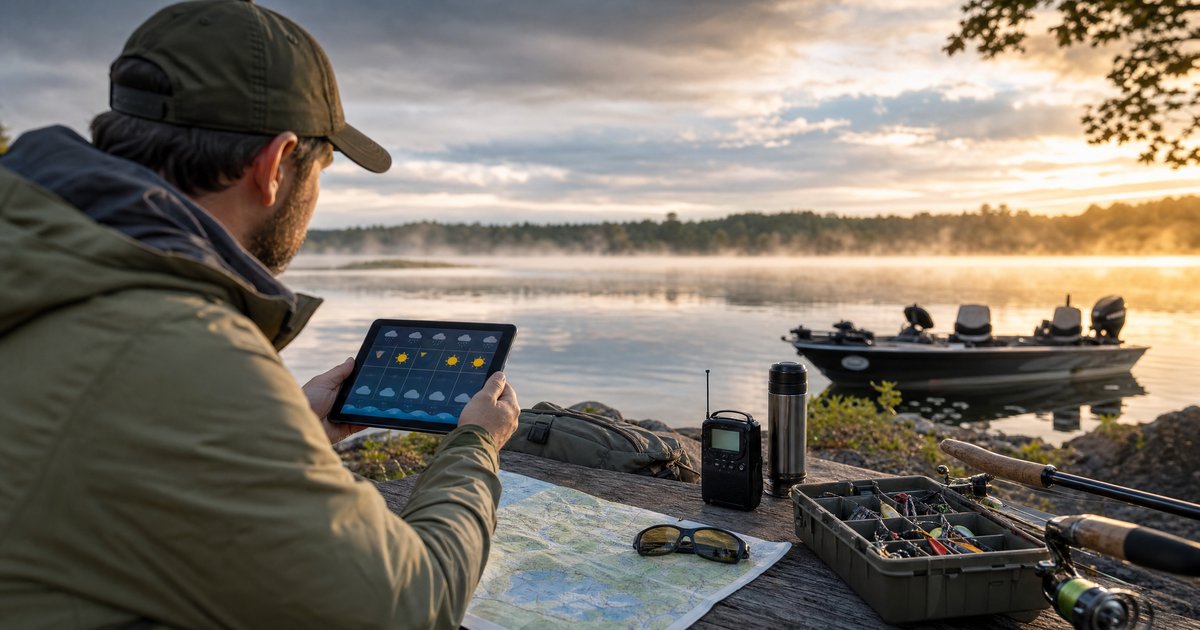
How to Plan a Fishing Trip Using Weather Forecasts: 7-Day Planning Strategy
You've done it. We've all done it.
You block off a Saturday, wake up at 4:30 AM, drive two hours to your favorite lake, and by 10 AM you haven't had a tap. The water's dead. The fish aren't there — or they are, but they're completely locked down. You pack up by noon, wondering what you missed.
Most of the time, the answer was in the forecast. Not the "will it rain on me" forecast, but the deeper stuff — pressure trends, wind direction, temperature swings, and how those factors stack up across a full week.
I've been paddling Ozark streams and Midwest reservoirs for eight years now, and the biggest upgrade I ever made wasn't a rod or a reel. It was learning to read weather like a fishing tool. Once you understand how a cold front moving through on Thursday affects a Saturday morning bite, you stop guessing and start making decisions that actually put fish in the net.
Here's how I plan a trip using a full 7-day forecast window.
Why Weather Matters More Than the Spot
Before we get into the week-by-week strategy, let's be clear about something: a great spot on a bad weather day will fish worse than a mediocre spot on a good weather day. Location matters, but timing often matters more.
Fish are cold-blooded. Their metabolism, feeding windows, and movement are all tied directly to environmental conditions — water temperature, light penetration, barometric pressure, and oxygen levels. Fish behavior shifts significantly in response to changes in water temperature and atmospheric pressure, because these variables directly affect their metabolic rate and feeding triggers.
The three biggest weather factors that control freshwater fishing are:
- Barometric pressure and its direction of change
- Temperature trends (air and water)
- Wind speed and direction
Understanding all three — and how they interact across a week — is the difference between a productive trip and a frustrating one.
How to Read the 7-Day Forecast as a Fishing Window
Think of a 7-day forecast not as seven separate days but as a story. There's a pressure system building, a front coming through, and a recovery period. Your job is to identify where in that story the best fishing window lives.
The Front Cycle: The Most Important Pattern to Understand
Almost every weather forecast, especially in the Midwest and Eastern US, revolves around frontal systems. Here's the basic cycle and what it means for fishing:
Pre-front (1–2 days before):
Pressure starts dropping. Temperatures rise. Winds often shift south or southwest. This is frequently the best fishing window of the entire cycle. Bass, walleye, and panfish tend to feed aggressively ahead of an incoming front. In my experience, a slow, dropping barometer with warming air is one of the most reliable bite triggers in freshwater fishing.
During the front:
Rain, thunderstorms, wind, pressure swings. Some anglers love fishing right before the leading edge of a storm — fish activity can spike hard. But once the front actually arrives and you're getting wind gusts and cold rain, the bite typically shuts down. Safety note: never be on open water during a lightning storm, especially in a kayak. Get off the water.
Post-front (1–3 days after):
This is where most anglers get burned. Clear skies, cold temps, high pressure, and a lethargic bite. Fish drop deeper, hug cover tighter, and refuse faster-moving presentations. The post-front period can last anywhere from 24 to 72 hours depending on how strong the front was.
Stable weather:
Once pressure stabilizes at a consistent level — typically around 1013.25 hPa (the standard atmospheric measurement) — fish patterns become more predictable. This is when you can rely on solunar windows, time-of-day patterns, and location knowledge.
Field note: In eight years of kayak tournament fishing, I've noticed the worst days to fish are usually 24–36 hours after a sharp cold front in late spring or fall. Crystal clear skies, north wind, and a high that won't quit. Save that day for rigging up tackle at home.
Mapping the Week: An Example Forecast Breakdown
Say your forecast looks like this for the coming week:
| Day | Conditions | Pressure Trend | Fishing Outlook |
|---|---|---|---|
| Monday | Partly cloudy, 68°F | Rising, stable | Decent — stable conditions |
| Tuesday | Cloudy, 74°F | Dropping slowly | Good — pre-front activity |
| Wednesday | Storms, 71°F | Dropping fast | Risky — fish hard in the morning |
| Thursday | Clearing, 58°F | Spiking high | Poor — post-front lockdown |
| Friday | Sunny, 54°F | High and stable | Slow — deep and tight to cover |
| Saturday | Partly cloudy, 62°F | Stable/slight drop | Improving — worth going |
| Sunday | Overcast, 67°F | Dropping again | Good — another pre-front window |
Looking at that week, Tuesday morning is your best shot. Saturday afternoon is your backup. Thursday is the day to skip if you can. This kind of analysis takes about five minutes with a decent forecast tool.
I use HookCast's weather page to track barometric pressure trends alongside the standard forecast. The pressure graph is what really tells the story — seeing a pressure line drop steadily over 18 hours is way more useful than a rain percentage.
Understanding Barometric Pressure and Freshwater Fish
This is the piece most anglers skip because it feels technical. But once it clicks, it becomes your most reliable planning tool.
Barometric pressure is the weight of the atmosphere pressing down on the water's surface. Fish — especially those with a swim bladder, like bass, walleye, and crappie — are sensitive to these changes because the pressure affects their internal buoyancy and comfort level.
What the Numbers Mean
- High pressure (above ~1020 hPa): Fish tend to be sluggish, especially right after a front. They may feed, but windows are short and subtle.
- Normal/stable pressure (around 1013 hPa): Predictable behavior. Fish follow standard time-of-day and location patterns.
- Low or dropping pressure (below ~1009 hPa): Fish often feed aggressively, particularly in the hours before a front arrives.
The direction of change matters as much as the actual number. A rapidly falling barometer triggers a feeding response in many species. A rapidly rising barometer after a front can temporarily suppress feeding.
Species-Specific Pressure Responses
Bass (largemouth and smallmouth): Highly responsive to pressure drops. Pre-front bass will chase faster presentations — crankbaits, swimbaits, topwater. Post-front, slow down dramatically. Think drop shots, shaky heads, finesse jigs.
Walleye: Less dramatically affected than bass, but they do respond. Low-light feeding periods (dawn, dusk) become even more important during high-pressure periods. Post-front walleye often pull deep and can be picky.
Crappie and panfish: Often suspend in odd locations post-front. A school that was stacked on a brush pile at 8 feet might slide out to 15 feet suspended after a cold front.
Trout: Stream trout are somewhat insulated from pressure changes due to current and dissolved oxygen levels, but stillwater trout in lakes react similarly to bass and walleye.
Factoring in Wind, Temperature, and Water Clarity
Pressure is the most overlooked variable, but it works together with wind and temperature to shape the full picture.
Wind Direction and Speed
Wind does two things that matter for fishing: it oxygenates the water and it pushes baitfish.
In Midwest reservoirs, a sustained south or southwest wind will blow warm, oxygenated surface water toward the north and east banks — and baitfish follow. Predators follow baitfish. So on a steady southwest wind day, I'll often focus on protected north and east-facing points and pockets.
Wind speed thresholds to know:
- Under 10 mph: Minimal impact; fish where you planned.
- 10–15 mph: Creates productive choppy water on windward banks; can suppress topwater bite.
- 15–20 mph: Limits presentation control, especially from a kayak; focus on sheltered water.
- 20+ mph: On a kayak or small boat, this is a safety concern on open water. Stick to rivers, coves, or skip the day.
Safety note: If you're paddling open water, check wind forecasts obsessively. A 15 mph crosswind on a flat lake can make the return paddle miserable — or dangerous. I always check the forecast window for wind speed and direction change throughout the day, not just at launch time.
Air Temperature and Water Temperature
These aren't the same thing, and confusing them trips up a lot of anglers.
Air temperature affects comfort and sets up what's coming. A 20-degree air temperature swing over 48 hours is a signal that something significant is changing. Fish feel it before the official front arrives.
Water temperature changes slowly — and that's what fish actually live in. A spring cold front that drops air temps from 70°F to 45°F overnight won't change the water temp much, but three or four consecutive cold days will.
Track water temperature trends across the week, not just today's number. USGS stream gauge data is excellent for this on rivers and streams — you can check current water temps and discharge levels for most major waterways before you head out.
How Temperature Affects Seasonal Patterns
Spring: Water temps rising toward the 55–65°F range trigger pre-spawn bass movement. A late cold front in April that drops water temps back several degrees can stall the spawn and shut down the bite hard.
Summer: Surface temps above 80°F push fish deep during midday. Wind and cloud cover become your friends. Early morning and evening windows get compressed and more important.
Fall: Cooling water temps in the 55–65°F range trigger a feeding binge as fish prepare for winter. Fall bass and walleye fishing can be exceptional — but cold fronts hit harder and fish recover slower than in spring.
Winter: Low water temps mean slow metabolisms. Slow presentations, midday timing (warmest part of the day), and south-facing shallow areas that warm up fastest.
Building Your Trip Around the Best Window
Here's how this all comes together practically. When I'm planning a trip seven days out, I run through this sequence:
Step 1: Identify the Pressure Story
Pull up the forecast and look at the pressure trend across the week, not just the daily weather icons. Is there a front moving through? When? Is it a weak system or a strong cold front?
Step 2: Pick Your Primary Day Based on the Cycle
Using the front cycle framework above, identify which day falls in the best position: ideally pre-front or two to three days after a front has fully passed and conditions have stabilized. Mark your first and second choice days.
Step 3: Check Wind and Water Conditions
Confirm that your chosen day has manageable wind (under 15 mph for kayak anglers, or find sheltered water). Check the water temperature trend for your target body of water. If it's a stream or river, check the USGS gauge for current flow — fishing a river running three times normal flow after heavy rain isn't productive and can be dangerous.
Step 4: Adjust Your Tactics to Match the Conditions
Don't just pick the day — plan what you're going to fish with based on what the conditions call for.
- Pre-front, dropping pressure → faster presentations, broader search patterns, topwater, reaction baits
- Post-front, high pressure → slow down, finesse tactics, tight to cover, deeper presentations
- Stable, overcast → follow standard solunar windows, more flexible presentations
HookCast has a solunar and fishing forecast tool that layers these variables together — pressure, moon phase, and bite windows — which makes this step faster when you're trying to plan a week out.
Step 5: Have a Backup Plan
Sometimes you can't pick your day. You've got Saturday off and that's it. If Saturday is a post-front bluebird day, adjust your expectations and your tactics. Fish slower, go lighter, fish deeper. A tough day with the right approach still beats a tough day with the wrong one.
Quick Reference: 7-Day Fishing Forecast Checklist
Use this before every trip:
1–2 days before your trip:
- [ ] Pull up the 7-day forecast and identify pressure trend direction
- [ ] Note any fronts moving through — before, during, or after your trip
- [ ] Check wind forecast: speed, direction, and any changes throughout the day
- [ ] Check air temperature trend and overnight lows
Day before:
- [ ] Confirm pressure is doing what the forecast predicted
- [ ] Check current water temperature for your target water (USGS for rivers, state DNR for lakes)
- [ ] Review solunar windows for your target day
- [ ] Note wind direction — plan which bank or side of the lake to focus on
Morning of:
- [ ] Quick pressure check — is it still dropping, stable, or rising?
- [ ] Wind speed at launch time and expected change through the day
- [ ] Safety check: lightning forecast, wind gusts, wave height if applicable
- [ ] Adjust bait selection based on confirmed conditions
On the water:
- Look for fish activity clues: surface movement, baitfish, birds working
- If the bite is slow, slow down before moving — post-front fish are there, just reluctant
- Note what's working and tie it back to conditions for next time
Fishing will always have uncertainty — that's part of what makes it worth doing. But the anglers who consistently put fish in the boat aren't necessarily fishing the best spots. They're fishing the right conditions. Spend five minutes reading the weather story before your next trip, and that two-hour drive starts paying off a lot more often.
FAQ
What is the best weather for a fishing trip?
The best fishing weather is typically the day or two before a cold front arrives — when barometric pressure is slowly dropping, temperatures are mild or rising, and winds are light from the south or southwest. Stable, overcast conditions with consistent pressure around 1013 hPa also produce reliable fishing. Clear, high-pressure days immediately following a cold front are generally the toughest conditions for most freshwater species.
How does barometric pressure affect fishing?
Barometric pressure affects fish behavior because species with swim bladders — including bass, walleye, and crappie — are sensitive to changes in atmospheric pressure that shift their buoyancy and comfort. A falling barometer tends to trigger aggressive feeding, while a sharp rise after a cold front often causes fish to go inactive, suspend at odd depths, or refuse most presentations. The direction and speed of the pressure change matters as much as the actual pressure reading.
How far in advance should I plan a fishing trip using weather forecasts?
A 7-day window gives you a useful planning horizon. Use days five through seven out to identify the general weather pattern and front timing, days three and four to narrow down your best fishing window, and the day before to confirm conditions and adjust tactics. Forecasts become significantly more reliable inside 48–72 hours, so treat early-week projections as a rough guide and refine your plan as you get closer to your trip.
Why does the fishing die after a cold front?
Cold fronts trigger a rapid rise in barometric pressure, a drop in water temperature, and increased light penetration from clearing skies — all of which make fish less active and harder to catch. Fish often move deeper, tighten to heavy cover, and reduce their feeding windows to very brief periods. The effect typically lasts 24–72 hours depending on how strong the front was, after which fish gradually return to more normal feeding patterns as conditions stabilize.
Does wind direction really matter for freshwater fishing?
Yes, wind direction meaningfully affects where baitfish concentrate and where feeding fish position themselves. In most Midwest lakes and reservoirs, a sustained wind from the south or southwest pushes warm, oxygenated surface water — and the baitfish that follow it — toward north and east-facing banks and points. Fishing the windward shore during a steady wind is a reliable strategy for finding actively feeding bass and walleye, though very strong winds above 15–20 mph can make boat control difficult and reduce fishing effectiveness.