Speckled Trout Fishing: Tides, Temperature & Tactics Along the Gulf Coast
It was a January morning on Tampa Bay. Cold enough that my coffee had gone lukewarm before I reached the flat. Barometer sitting at 30.22 and steady. Water temp: 58°F. My client — a retired contractor from Ohio who'd spent 30 years chasing trout up north — looked skeptical when I cut the engine in two feet of water over a grass flat.
"This looks too skinny," he said.
We landed 14 trout in three hours. The biggest pushed 24 inches.
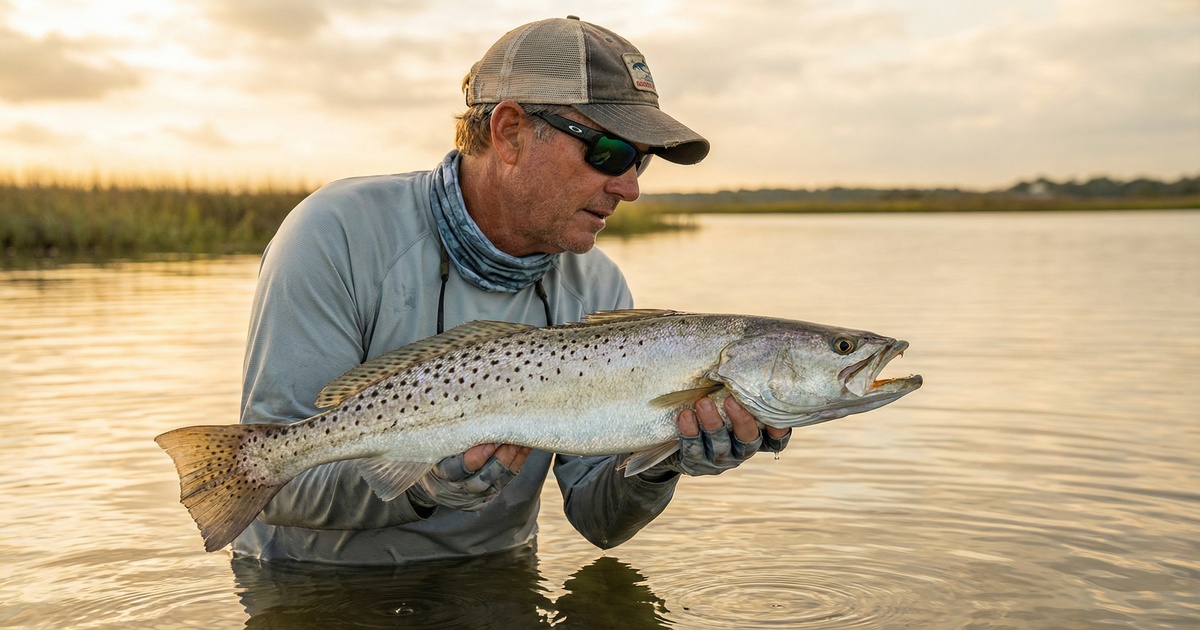
That trip wasn't luck. It was pattern recognition built over years of watching how speckled trout — also called spotted seatrout (Cynoscion nebulosus) — respond to conditions. Temperature, tide stage, water clarity, time of year. Get those variables dialed in and trout become one of the most predictable fish on the Gulf Coast. Ignore them and you're just making noise in the water.
Here's what actually matters.
Understanding Speckled Trout Behavior: The Foundation
Speckled trout are estuarine fish. They spend the bulk of their lives in the shallow coastal bays, grass flats, and tidal creeks stretching from the Florida Panhandle through Texas — and most populations stay within a surprisingly small home range year-round. That's exactly why local knowledge pays so hard with this species. These aren't fish that move three states away when conditions change. They compress into whatever habitat works and wait you out.
According to NOAA Fisheries, spotted seatrout rank among the most recreationally targeted species in the Gulf of Mexico. Accessibility is a big part of that — you can reach productive trout water by kayak, by wading, or from a shallow-draft skiff. But the other part is that when conditions align, trout hit both live bait and artificials with genuine aggression. They're not a default difficult fish. They're a conditional fish.
Four things drive almost every trout decision:
- Water temperature — Cold-sensitive to a degree most anglers underestimate. Below 50°F, metabolism slows dramatically. Above 85°F, fish abandon the flats entirely.
- Grass and structure — Seagrass beds are their primary feeding habitat. Oyster bars, dock pilings, and channel edges are their fallback.
- Baitfish presence — Where mullet, pilchards, and glass minnows concentrate, trout are usually close behind.
- Tidal movement — Trout feed opportunistically when current sweeps bait past them. Dead slack tide is often dead fishing.
That last point is where most recreational anglers leave fish in the water.
How Tides Control the Speckled Trout Bite
This is the single most underestimated factor for the average angler. I've watched people fish the same flat two hours apart — same lures, same technique, same general location — where one person limits out and the other catches nothing. The difference wasn't skill. It was tide stage.
The Incoming Tide Advantage
When water rises over a grass flat, baitfish pour in with it. Trout know this and position themselves along the leading edge of the incoming water — typically at the outer grass line or where a flat transitions to a channel. They're not chasing. They're ambushing whatever gets swept to them.
On an incoming tide, work the upcurrent side of points and any structure that creates a natural funnel. Cast parallel to the grass edge rather than out into open water. You're trying to intercept fish that are holding and waiting, not fish that are actively hunting.
The Outgoing Tide Sweet Spot
A falling tide pulls bait off the flat and concentrates it at drain points — tidal creek mouths, channel edges, and any low depression in the flat bottom that holds water longer than the surrounding area. These become killing zones during the last two hours of an outgoing tide.
In my experience, the final 90 minutes of a falling tide on a grass flat is some of the most reliable speckled trout fishing you'll find anywhere on the Gulf Coast. Fish stack at drain points and they're feeding hard, because they know the food is leaving with the water.
The critical piece is knowing your flat well enough to identify where water flows off it, not just where it's shallowest. Spend time with a tide chart and a push pole before you fish it for the first time. Mark those drain points on your GPS and they'll pay you back for years.
Slack Tide: The Honest Assessment
Slack tide is usually slow for trout. When water stops moving, bait disperses and fish go neutral. This is the time to reposition, eat something, or switch to working oyster bar structure — where wind and boat traffic tend to generate enough current to keep a few fish active even when the tide isn't cooperating.
Always check tide charts for your area before you load the truck. The 20-minute windows on either side of a tidal peak are worth more than three hours at slack, and planning around them is the easiest upgrade most anglers can make.
Tidal Range: What It Means Practically
The Gulf Coast operates largely on a diurnal tide system — one high and one low per day, with modest tidal range compared to the Atlantic coast. Tampa Bay might see 2–3 feet of swing. Parts of the Florida Panhandle see less than a foot.
Smaller tidal range doesn't mean worse fishing. It means current is more subtle and you have to read it more carefully. In low-range areas, wind-driven water movement often outweighs the tide itself. A sustained northwest wind stacking water into a flat can produce the same feeding conditions as a strong incoming tide — and most anglers who fish those areas miss it entirely because they're watching the tide charts instead of the wind.
Temperature Windows and Seasonal Patterns
If tides are the daily clock, water temperature is the seasonal calendar. Unlike species that can buffer temperature swings by moving offshore or into deep water, trout are largely committed to shallow estuarine habitat. A cold front that drops water temps 10 degrees overnight doesn't just slow the bite — it can pull fish completely off a flat you've been fishing all week.
Spring (March–May): The Rebound
As water climbs back through the 65–75°F range, trout that spent winter compressed into deeper basins push onto the flats and feed with the aggression of fish that have been waiting. Grass flat edges in 2–4 feet of water are the starting point. This is also pre-spawn staging, so fish are building weight and not shy about burning calories.
Morning topwater is genuinely worth fishing during spring. If you've never watched a 20-inch trout detonate on a walking bait at first light, it's worth setting an early alarm.
Summer (June–August): Timing Over Location
Shallow flat temperatures routinely push into the 85–90°F range by mid-morning, and trout simply won't stay there. Your options are limited but reliable:
- Fish first and last light — The 45-minute window on either end of daylight when temperatures are at their lowest is often the only productive shallow-water window worth targeting
- Go deeper — Trout stage in 6–10 foot channels, basin areas, and passes during midday heat. Deep-running soft plastics and slow-sinking jigs outperform surface presentations in these conditions
- Work spoil islands and dock structure — Shade concentrates fish during summer months when open-water temperatures are prohibitive
Summer trout fishing isn't hard to understand. The fish are predictable — they're just uncooperative until conditions give them a reason to feed.
Fall (September–November): The Prime Window
Ask Gulf Coast guides their favorite season and most will tell you fall. Water temperatures drop into the 70–80°F range, bait schools are enormous after months of summer growth, and trout feed with urgency ahead of the cold months.
The mullet migration is the defining event. As water cools, mullet move through the bays in dense schools, and trout follow them with commitment. Watch for nervous water, diving birds, and mullet showering on the surface — then get your presentation in front of the commotion before it moves.
Fall is also when gator trout — fish over 5 pounds — become accessible in open water rather than holding tight to structure. A big trout chasing mullet in a foot and a half of water is one of the better things inshore fishing has to offer.
Winter (December–February): Patience and Precision
Cold fronts define Gulf Coast winters, and they define how trout behave during them. A strong front compresses barometric pressure dramatically before the front arrives, then sends it rising sharply afterward. Check current pressure trends before any winter trip — if the barometer is dropping fast, you're likely heading into deteriorating conditions.
Standard atmospheric pressure sits at 1013.25 hPa. When pressure drops 10 or more hPa in a 24-hour window ahead of a front, expect a feeding burst followed by a near-complete shutdown once the front arrives.
What actually works in winter:
- Fish 24–48 hours before a front — Slowly falling pressure triggers feeding behavior. Some of the most productive winter sessions I've had came the day before a front made landfall
- Target dark-bottom mud flats — Dark substrate absorbs solar heat more efficiently. On a sunny winter day, a black mud flat can run 3–4 degrees warmer than a nearby sand flat. Trout know this and use it
- Slow everything down — Cold-water trout won't chase. A soft plastic on a 1/8 oz jig head, barely moving along the bottom, will outfish a faster retrieve almost every time
- Fish midday — Unlike summer, the most productive winter window is typically 10am–2pm, after the sun has had time to warm the water column
The most common winter mistake I see is anglers fishing cold water the same way they fished it in September. Cold trout don't chase. You have to put the bait in front of them and give them time to commit.
Tactics That Actually Catch Fish
Live Bait vs. Artificials
Both work. Here's how to decide which to reach for:
Lean toward live bait when:
- Trout are finicky in the days after a front
- Water clarity is poor
- You're fishing unfamiliar water and need to understand how fish are positioned
- You're fishing with anglers who need consistent action to stay engaged
Lean toward artificials when:
- Fish are actively feeding
- You want to cover water efficiently and find fish faster
- You're targeting specific structure and need precise placement
- You're trying to match a particular baitfish profile
For live bait, live shrimp remains the default for good reason. Under a popping cork over grass or free-lined on a light jig head near structure, it's difficult to beat year-round. Finger mullet and small pinfish are better options when targeting larger fish specifically.
For artificials, three setups cover the majority of situations:
- 3–4 inch soft plastic paddle tail on a 1/4 oz jig head — the reliable workhorse
- Suspending hard baits like the Mirrolure MR17 — particularly effective in cold water because you can hold them in the strike zone without dropping to the bottom
- Topwater walking baits during low-light periods in spring and fall
Reading the Flat
If I had one skill to hand to a newer trout angler, it would be learning to read a flat before making a cast. The information is always there:
- Pot holes in the grass — Depressions in the grass bottom hold fish during low tide when surrounding areas go dry
- Irregular grass edges — A ragged, uneven grass line creates more ambush points than a clean edge, and trout use every one of them
- Color lines — Where clear water meets slightly stained water is often a feeding lane, especially when wind is driving the color change
- Nervous water — Subtle surface disturbances over a flat usually mean baitfish activity below, which means something is pushing them
Once you start reading these signals reliably, you stop fishing water at random and start making targeted presentations. That shift is the difference between grinding through a flat and fishing it efficiently.
Gear Considerations
Trout have notoriously soft mouths and hooks pull more often than most anglers expect. A few adjustments help:
- Medium-light to medium power rod, 7–7'6" with a fast action tip for sensitivity and better hook detection
- 10–15 lb braid with a 15–20 lb fluorocarbon leader — fluorocarbon is less visible in clear Gulf water and more resistant to abrasion from grass and oysters
- Upsize your hooks slightly — a 2/0 or 3/0 on a soft plastic gives you more purchase in a soft mouth
- Set your drag conservatively — a hard-running trout hitting firm resistance is far more likely to throw the hook than one that can take line
Where to Focus on the Gulf Coast
The Gulf Coast offers thousands of miles of productive trout habitat. These areas produce consistently:
| Region | Prime Areas | Best Season |
|---|---|---|
| Tampa Bay, FL | Middle and lower bay grass flats | Fall, Winter |
| Charlotte Harbor, FL | Turtle Bay, Matlacha Pass | Spring, Fall |
| Florida Panhandle | St. Andrews Bay, Choctawhatchee Bay | Spring, Fall |
| Mississippi Sound | Dog Keys Pass, barrier island shorelines | Summer (early AM), Fall |
| Louisiana Delta | Chandeleur Islands, Lake Borgne | Fall |
| Matagorda Bay, TX | Mid-bay reefs and east shoreline flats | Fall, Winter |
Each of these areas has its own tidal quirks and seasonal timing. The framework — temperature and tides driving fish behavior — is consistent, but local application requires local data. I check the fishing forecast for Tampa Bay when I'm on home water, and pull location-specific forecasts anytime I'm fishing somewhere new.
Worth noting: SeaGrant research on coastal fisheries shows a direct relationship between seagrass bed health and trout population density. The best Gulf Coast trout fishing consistently clusters around the healthiest remaining grass systems. It's worth considering when you're choosing where to put in your time.
Quick-Reference: Speckled Trout Cheat Sheet
Before you go:
- [ ] Check water temperature — target 65–82°F for peak activity
- [ ] Pull tide charts — plan to fish moving water, not slack
- [ ] Check barometric pressure trend — rising and stable is good; a sharp drop signals an approaching front
- [ ] Review recent local reports for bait presence
On the water:
- [ ] Start on grass flat edges during incoming tide
- [ ] Move to drain points and channel edges as the tide falls
- [ ] Slow presentations significantly in cold water
- [ ] Watch for nervous water, diving birds, and showering mullet
- [ ] Fish midday in winter; fish early and late in summer
When the bite is slow:
- [ ] Downsize your presentation
- [ ] Switch from artificial to live shrimp
- [ ] Move to darker-bottom areas in winter or deeper water in summer
- [ ] Check whether you're fishing slack tide — if you are, reposition or wait it out
Frequently Asked Questions
What is the best tide for speckled trout fishing?
The last 90 minutes of an outgoing tide is consistently the most productive window for speckled trout on grass flats. As water drains off the flat, baitfish concentrate at drain points, tidal creek mouths, and channel edges — and trout stack up to intercept them. Incoming tide edges are also productive, as fish position along the leading edge to ambush baitfish moving onto the flat with the rising water. Slack tide, by contrast, tends to produce neutral fish and slow action regardless of location.
What water temperature do speckled trout prefer?
Speckled trout feed most actively between 65°F and 82°F. Below 55°F their metabolism slows significantly and feeding becomes sluggish rather than aggressive — fish will eat, but they won't chase. Above 85°F trout abandon shallow grass flats and move into deeper, cooler channels and bay basins. Monitoring water temperature is especially important during Gulf Coast winters, when cold fronts can drop temperatures rapidly enough to shut down the bite on a flat that was producing the day before.
How does a cold front affect speckled trout fishing?
Cold fronts are the most disruptive weather event Gulf Coast trout anglers face. As barometric pressure drops ahead of an approaching front, trout frequently feed with unusual aggression — some of the best winter sessions happen in the 24–48 hours before a front arrives. Once the front passes and pressure rises sharply, the bite typically shuts down for one to three days until conditions stabilize. In the post-front window, fishing dark-bottom mud flats on sunny days can produce because dark substrate warms faster than sand or light-colored bottom, drawing trout back to shallow water sooner.
What is the best bait for speckled trout on the Gulf Coast?
Live shrimp is the most consistently reliable bait year-round — fished under a popping cork over grass or free-lined on a light jig head near structure, it's hard to beat. For artificials, a 3–4 inch soft plastic paddle tail on a 1/4 oz jig head is the standard workhorse setup. Suspending hard baits like the Mirrolure MR17 are particularly effective in cold water because they can be worked slowly and kept in the strike zone without sinking to the bottom. Topwater walking baits produce well during low-light periods in spring and fall.
When is the best time of year for speckled trout fishing on the Gulf Coast?
Fall — September through November — is the season most Gulf Coast guides point to first. Water temperatures sit in the ideal range, bait schools are large after summer growth, and trout feed aggressively ahead of the winter slowdown. The fall mullet migration is the focal event, concentrating bait and large trout in predictable corridors. Spring runs a close second, as fish rebound from winter and feed heavily during pre-spawn staging on the grass flats.