Spotted Seatrout Fishing: Popping Corks, Soft Plastics, and Grass Flat Tactics
My buddy called me last April from the parking lot of a boat ramp on the Texas coast, completely defeated. He'd driven four hours, launched at first light, and spent the morning throwing everything in his box across a flat that looked absolutely perfect. Crystal water, scattered grass, baitfish dimpling the surface. Not a single bite.
When he described what he was doing — random casts across open water, fast retrieves, no attention to tide or time of day — I knew exactly what had gone wrong. He was fishing at the flat instead of fishing the flat.
Spotted seatrout are patternable fish, but they reward anglers who think in terms of current, temperature, structure, and presentation. Get those four things dialed in and spring speckled trout fishing on the Gulf Coast is genuinely some of the best inshore action you'll find anywhere.
I'm primarily a freshwater guy — kayaking Ozark streams for smallmouth is my home turf — but I've made enough trips down to the Gulf to develop a real feel for how these fish think. Some of the reading-water skills transfer directly from freshwater. Some don't. Here's what actually works.
Understanding Spotted Seatrout on Spring Grass Flats
Before you can figure out how to catch them, you need to understand why they're where they are.
NOAA Fisheries describes spotted seatrout (Cynoscion nebulosus) as estuarine-dependent fish — they live and feed in shallow coastal systems, primarily seagrass beds, oyster bars, and tidal creeks along the Gulf and South Atlantic coasts. Spring is a transitional period for specks. Water temperatures are climbing out of the 50s and 60s into the low-to-mid 70s, and fish that pushed into deeper channels during winter are migrating back onto the flats to feed aggressively ahead of the summer spawn.
According to NOAA Sea Grant, spotted seatrout begin spawning when water temperatures consistently reach around 68–72°F — which puts the pre-spawn feeding window squarely in March through May across most of the Gulf Coast.
That pre-spawn period matters for two specific reasons:
- Fish are actively feeding to build energy reserves before the spawn
- Concentrations are predictable — fish stage in specific areas before moving to spawning grounds
Water Temperature and the Spring Bite
Spring seatrout fishing is almost entirely a temperature game. Early spring — March in Texas and Louisiana, April in the Florida Panhandle — means fish will be holding on the warmer side of the flat: northern shorelines and shallow back-bay areas that heat up faster in afternoon sun.
As water temps stabilize and spread across the flat, fish become less location-specific and more structure-specific. That's when you shift your focus to grass edges, potholes in the grass, and current breaks rather than hunting warm pockets of water.
A quick check of tide charts for your area before you leave the house will show you not just when the tide is moving, but how much water you're dealing with. Lower tides in early spring can concentrate fish in surprisingly predictable spots — a low incoming tide pushing over a flat that was nearly dry an hour earlier is one of the most reliable setups you'll encounter.
Reading a Grass Flat Like a Local
Not all grass is equal. Here's what to look for:
| Feature | Why It Matters |
|---|---|
| Grass edges (where grass meets sand) | Predators ambush bait along the transition |
| Potholes (bare sand holes in grass) | Trout stage here waiting for prey to cross |
| Deeper gut channels cutting through flats | Current funnels bait, trout stack up |
| Oyster bar adjacency | Hard structure near soft bottom holds fish |
| Shoreline points with current | Classic ambush spots on a moving tide |
Potholes are consistently underrated by visiting anglers. Trout don't always sit in the grass — they sit adjacent to it, using the pothole as a clear-water ambush lane while the surrounding grass conceals them. When you spot a dark sandy hole in a grass flat, put your cast on the far edge and work it back through slowly. The bite almost always comes on the pause as your bait crosses into that open lane.
The Popping Cork Rig: Still the Most Effective Setup for Specks
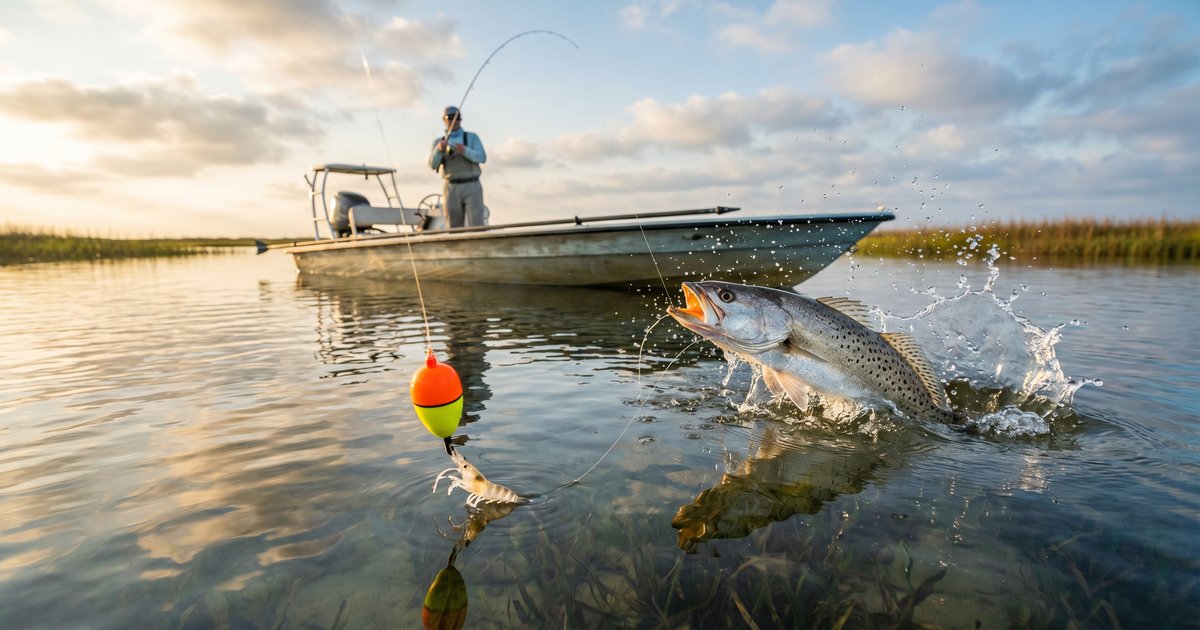
If there's a more reliable spring seatrout presentation than a popping cork above a soft plastic, I haven't found it. It's one of those setups that looks almost too simple to work as well as it does — which is exactly why visiting anglers sometimes pass over it in favor of something that feels more sophisticated.
The popping cork serves three distinct functions:
- Suspends your bait at a precise depth above the grass
- Creates noise and surface disturbance that mimics a feeding fish or injured shrimp
- Acts as a strike indicator — when that cork yanks under, you know
Setting Up the Rig
The basic popping cork setup is straightforward to build:
- Cork: Rattling style (Cajun Thunder or similar) — the rattle adds meaningful attraction in stained water
- Leader: 18–24 inches of 20–25 lb fluorocarbon from cork to hook
- Hook: 1/0 or 2/0 wide-gap hook, or a ⅛ to ¼ oz jig head
- Bait: 3–4 inch soft plastic paddle tail or shrimp imitation
Leader length matters more than most people realize. In clear water, use the full 24 inches. In murky or stained water — common after rain or extended wind events — you can drop to 18 inches and trout will still find it reliably. The shorter leader also reduces tangling during the cast.
Field observation: I've seen anglers fish leaders as short as 10 inches in very shallow water over thick grass. It works in a pinch, but you sacrifice action on the bait. The 18–24 inch range covers 90% of situations you'll actually encounter.
Working the Cork
The pop-pause cadence is everything. Here's the sequence:
- Cast past your target — pothole edge, grass transition, or current seam
- Let everything settle for 2–3 seconds
- Two or three sharp rod-tip pops — wrist snaps, not big sweeping pulls
- Pause for 3–5 seconds
- Repeat
The pause is where most bites happen. The noise pulls the fish in; the pause gives them time to commit. The most common rookie mistake is working the cork too fast and never letting the bait hang in front of a fish long enough to eat it. Slow everything down, especially in cold or post-front conditions when fish are lethargic and won't chase.
Soft Plastics for Seatrout: What to Throw and When
Popping corks are a go-to, but there are plenty of situations where fishing unweighted or lightly weighted soft plastics on their own makes more sense — particularly when fish are very shallow, water is calm, or you're covering water trying to locate active fish before committing to one spot.
Best Soft Plastic Styles for Specks
Paddle tails (3–4 inch) are the most versatile option on the flat. Fish them on a ⅛ oz jig head and you can work them from the surface film down to 4–5 feet. The tail vibration produces low-frequency pressure waves that trout can detect on their lateral line even in off-color water — an important advantage on days when visibility is limited.
Shrimp imitations are natural fits for spring. Shrimp migrations through Gulf estuaries peak in spring, and specks have spent months keying on them. A realistic shrimp soft plastic under a popping cork is about as close to a natural presentation as you can offer without using live bait.
Soft plastic twitchbaits and jerkbaits shine in clear, calm conditions when fish are visually oriented. Work them with a twitch-twitch-pause retrieve and you'll draw explosive surface strikes during low-light windows — early morning especially.
Color Selection
Color gets overthought. Keep the decision simple:
- Clear to lightly stained water: Natural colors — white, pearl, clear with silver flake, light green
- Stained or murky water: High-contrast — chartreuse, pink, red/chartreuse combos
- Early morning and late afternoon: Darker colors (root beer, dark purple) create a strong silhouette in low light
- Bright midday: Lighter naturals that blend with the flat's overall palette
Field observation: Chartreuse-tailed soft plastics are the single most consistent all-around color I've seen produce on the Texas and Louisiana coast. If someone tells you there's a magic color — there isn't. But if I had to pick one to fish exclusively, chartreuse is it.
Jig Head Weight and Retrieve
Match your jig head weight to depth and current:
- Shallow flats (1–3 ft), minimal current: ⅛ oz
- Moderate depth (3–5 ft) or light current: ¼ oz
- Deeper channels or stronger current: ⅜ oz
The standard retrieve for specks is a slow drag with occasional twitches — lift it off the bottom, let it fall, repeat. Unlike bass, which often respond well to an aggressive or erratic presentation, seatrout typically prefer a slower, more deliberate retrieve, especially early in spring when water temperatures haven't fully come up yet.
Tides, Pressure, and Timing: When to Be on the Water
This is where I see the most consistent mistakes from anglers fishing the Gulf Coast without local knowledge. Getting the when right matters just as much as the where or the how.
Tide and Current
Seatrout feed with tidal movement. A dead slack tide on a flat often means slow, scattered fishing regardless of how good everything else looks. The two most productive windows are:
- First two hours of incoming tide: Baitfish and shrimp push onto the flat, trout follow
- Last two hours of outgoing tide: Water funnels through cuts and channels, concentrating bait in predictable spots
When the tide is moving, position yourself at a current seam — the line where moving water meets slower water — and cast into the faster current, letting your bait swing through naturally into the slack zone. If you've nymphed a river, you already understand the concept. The fish hold in the same spots a stream trout would hold: just out of the main current, where they can intercept whatever washes by without burning much energy.
Check NOAA Tides and Currents for your specific bay system before you go. Tide times can vary by 30–60 minutes depending on which bay or pass you're fishing relative to the nearest prediction station.
Barometric Pressure
Here's another thing my buddy got wrong on that April trip: he'd driven down the day after a cold front pushed through. Barometric pressure was high and still climbing, and the front had dropped both air and water temps noticeably.
Seatrout — like most predatory fish — feed most aggressively when barometric pressure is either steady or falling. Standard atmospheric pressure is 1013.25 hPa, and experienced anglers consistently notice that readings above 1020 hPa, especially following a sharp post-frontal rise, tend to slow the bite significantly.
I check HookCast's weather forecast before planning any Gulf trip to track the 48-hour pressure trend around my target fishing window. A stable or slowly falling barometer paired with overcast skies is, in my experience, the single best weather combination for seatrout on spring flats.
Time of Day
Spring seatrout follow a consistent daily rhythm:
- First light to 9 AM: Best overall bite — fish are shallow and actively feeding, topwater and light jigs shine
- Midday: Fish push slightly deeper into grass and become less aggressive; slow your retrieve and work structure more carefully
- Late afternoon (3–6 PM): Second feeding window, especially on an incoming evening tide
If you can only fish one window, early morning on an incoming tide is the answer every time.
Kayak Tactics for Grass Flats
Since I'm approaching this from a kayak perspective, a few things I've learned that are specific to fishing flats from a low-profile, non-motorized platform.
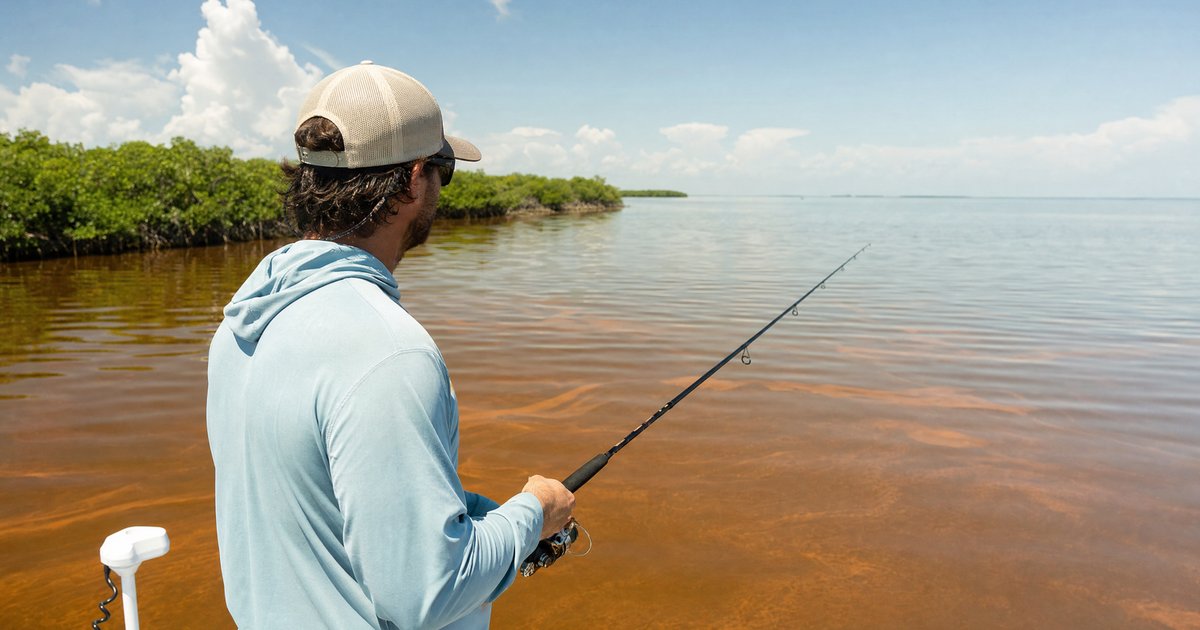
The kayak has genuine advantages here that a bay boat can't match. You can access water that's too skinny for most powered boats — back-corner flats, narrow tidal drains, potholes tight against the marsh edge. Specks in those areas see dramatically less pressure, and it shows in how they respond.
Approach angle matters. Paddle across the wind rather than directly into it to keep your drift controlled and your presentation moving along a grass edge rather than straight through it. In a kayak, you can hover at the edge of a pothole field and make repeated precise casts without constantly repositioning.
Anchor or stake out when you find fish. A stake-out pole — or a simple kayak anchor — stops your drift the moment you're on productive water. I've burned through plenty of good spots by drifting right through them instead of stopping to work them properly.
Stealth is a real advantage. You can't slam a livewell lid from a kayak, and you're not pushing a trolling motor wake 15 feet ahead of your presentation. In 18 inches of crystal-clear water, that difference is significant. I've made catches at distances that would have been impossible to approach quietly from a larger boat.
One last note for wade fishers: shuffle your feet when wading Gulf Coast flats. Stingrays bury themselves in sand and grass, and a shuffle disturbs them before you step directly on one. Not optional advice.
Regulations and Responsible Handling
Check your state's current regulations before you go. Texas, Louisiana, Florida, Alabama, and Mississippi all maintain different size and bag limits for spotted seatrout, and those limits change periodically. Texas Parks and Wildlife, the Florida Fish and Wildlife Conservation Commission, and Louisiana Wildlife and Fisheries each publish up-to-date regulation pages online. Don't assume last year's limits still apply.
A few handling notes, particularly during the spring pre-spawn window:
- Wet your hands before handling any fish you plan to release
- Keep fish horizontal during photos — holding them vertically by the jaw can damage internal organs
- Skip extended hero shots for fish you're releasing
- Handle with care regardless of depth, especially early-spring fish that may be temperature-stressed
Spring is a critical feeding period before spawning. Practicing selective harvest — keeping a reasonable meal and releasing the rest, particularly larger females — helps sustain the fishery through the seasons that follow.
Quick Reference: Spotted Seatrout Spring Checklist
Before you go:
- [ ] Check tide charts (incoming tide = best opportunity)
- [ ] Check barometric pressure trend (stable or falling preferred)
- [ ] Verify current state regulations for size and bag limits
- [ ] Water temp target: 65–75°F for peak spring activity
Rig setup:
- [ ] Rattling popping cork + 18–24" fluorocarbon leader
- [ ] ⅛–¼ oz jig heads
- [ ] 3–4" paddle tails or shrimp imitations (chartreuse, white, or natural)
- [ ] 15–20 lb braided mainline for sensitivity and casting distance
On the water:
- [ ] Target grass edges, potholes, and current seams
- [ ] Work popping cork with pop-pop-pause cadence
- [ ] Slow your retrieve in cooler water
- [ ] Position for tidal current flow before casting
- [ ] Shuffle feet when wading
Safety:
- [ ] Sun protection (hat, SPF clothing, sunscreen)
- [ ] PFD if kayaking
- [ ] Tell someone where you're fishing and when you'll be back
- [ ] Shuffle feet on sandy and grassy flats
FAQ
What is the best bait for spotted seatrout?
Soft plastic paddle tails and shrimp imitations on jig heads are among the most consistent producers for spotted seatrout, especially when fished under a popping cork. Live shrimp also work very well, but artificial soft plastics in 3–4 inch sizes give you more versatility across different water depths and conditions. Chartreuse, white, and natural shrimp colors are reliable starting points for color selection.
When is the best time to fish for spotted seatrout in spring?
Early morning during the first two hours of an incoming tide is consistently the top window for spring seatrout. Water temperatures in the 65–75°F range trigger aggressive pre-spawn feeding behavior, making March through May prime time along most of the Gulf Coast. A stable or slowly falling barometer adds considerably to those already-favorable conditions.
How deep should a popping cork be set for seatrout on grass flats?
Set your cork so the soft plastic rides 18–24 inches below the surface, which typically keeps the bait just above the grass canopy on most spring flats. In very shallow water — 12 to 18 inches of depth — you can shorten the leader to 12–15 inches. The goal is to keep your bait visible and moving without it snagging constantly in the grass.
Do spotted seatrout bite after a cold front?
Seatrout fishing typically slows significantly in the 24–48 hours after a cold front passes, especially when it brings a sharp rise in barometric pressure and a noticeable drop in water temperature. Fishing during the front's approach — when pressure is falling — or waiting 2–3 days for conditions to stabilize generally produces better results than targeting fish immediately after a front pushes through.
What size spotted seatrout should I keep?
Size and bag limits vary by state, so always verify current regulations with your state wildlife agency before keeping fish. Across most Gulf Coast states, minimum size limits generally fall in the 13–15 inch range with daily bag limits of 5–10 fish, but those numbers shift, so check before you go. Releasing larger breeding females during the spring pre-spawn period is a responsible practice that meaningfully supports long-term population health.