Surf Fishing for Beginners: Reading the Beach, Right Gear & Best Times
My first surf fishing trip was a disaster.
I drove four hours to a stretch of North Carolina coastline, rigged up a cut bait rig, and spent the next four hours watching pelicans eat better than I did. Two hundred yards down the beach, another angler was pulling red drum out of the water every twenty minutes. Same beach. Same bait. Completely different result.
The difference wasn't luck. He knew how to read the water.
I come from freshwater — bass, walleye, smallmouth in Ozark streams — but surf fishing has pulled me to the coast more than I expected. And here's the thing: the fundamentals aren't as foreign as they look. You're still chasing fish that are chasing food. You're still looking for structure, current breaks, and feeding windows. The vocabulary is different. The gear scales up. But the thinking is the same game.
This guide is for anglers who want to fish the surf without burning a road trip on a dead beach. We'll cover how to read the shoreline, what gear actually matters, and how to time your trip around tides and weather so you're in the right place when the bite turns on.
How to Read a Surf Fishing Beach
This is the step most beginners skip. They find a public beach access, walk to the water, and cast as far as they can. That's the mistake. Distance isn't the strategy. Location is.
Spot the Troughs and Sandbars
Waves don't break randomly — they break when the bottom rises sharply, usually over a sandbar. Between that sandbar and the shoreline sits a trough: a deeper channel of water running parallel to the beach. Fish cruise these troughs because the sandbars funnel baitfish directly into them.
Stand at the water's edge and train your eye to look for:
- Dark green or blue-green water — deeper water, likely a trough
- Lighter, foamy, churning water — shallower water breaking over a bar
- A calmer strip of water beyond the first break — the deeper trough beyond the outer bar
That dark water is where you want your bait. Many beginners overthrow the fish entirely by casting past the outer bar. The trough is often closer than it looks.
Find the Cuts
Cuts — also called rip channels or holes — are breaks in a sandbar where water drains back out to sea. They're natural fish highways. Baitfish, crabs, and sand fleas get swept through these gaps, and predators like red drum, striped bass, pompano, and whiting line up to intercept them.
How to spot a cut:
- Look for a gap in the wave break — where the surf isn't crashing, the water is deeper
- Watch for a slightly different color or texture in the water, often a brownish streak from disturbed bottom sediment
- Look for foam or floating debris moving seaward — that's the outflow
Field observation: My best surf sessions have come from fishing the edge of a cut rather than casting directly into it. Fish often hold on the downcurrent side, picking off whatever gets flushed through.
Structure, Points, and Inlets
Natural structure concentrates fish everywhere, whether you're fishing a mountain stream or the Atlantic surf. In the surf zone, look for:
- Rock jetties and piers — current eddies form on the downcurrent side and hold fish
- Points of land extending into the water — these deflect current and create ambush zones
- Inlets where rivers or bays drain into the ocean — among the most productive spots on any coast, particularly during active tidal movement
If you're fishing near an inlet, check tide charts before you go. Tidal flow through an inlet can shift from dead calm to ripping in under an hour, and that transition window is often when the bite fires hardest.
Surf Fishing Gear That Actually Makes Sense
You don't need to spend $800 on a surf setup to catch fish. I've seen anglers pull limits of whiting on $60 combo rigs from a big-box store. That said, having gear suited to the conditions matters more than having expensive gear.
Rods and Reels
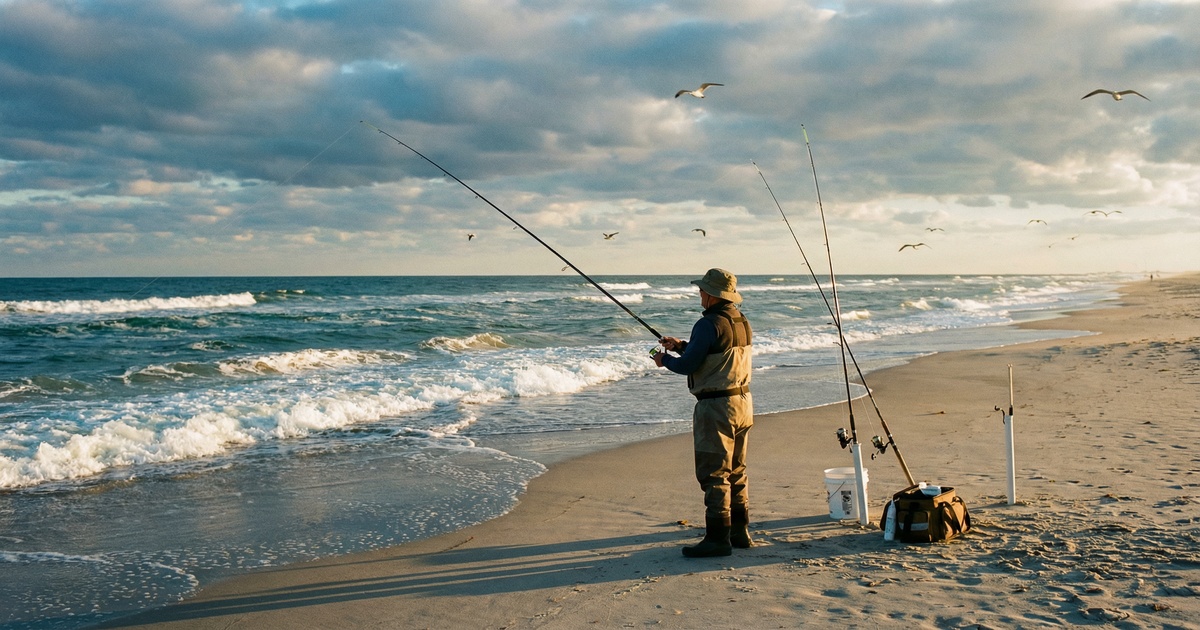
Surf rods run long — typically 9 to 12 feet — to carry your cast over the breaking waves and out to the trough. A 10-foot medium-heavy rod handles most situations on the East and Gulf Coasts.
For reels, a spinning reel in the 4000–6000 size range handles the salt and sand environment better than a baitcaster for most surf work. Shimano, Daiwa, and Penn all offer solid options without breaking the budget.
| Target Species | Rod Length | Line Weight | Rig Type |
|---|---|---|---|
| Whiting / Pompano | 9–10 ft medium | 10–15 lb mono | Pompano rig |
| Red Drum | 10–12 ft medium-heavy | 20–30 lb braid | Fish finder rig |
| Striped Bass | 10–12 ft heavy | 30–50 lb braid | Pyramid sinker |
| Sharks (small) | 12 ft heavy | 50–80 lb braid | Circle hook, heavy leader |
Line and Leaders
For general surf fishing, 20–30 lb braided line is the practical choice. Braid has minimal stretch — important for detecting bites at distance — and its thin diameter cuts through current more cleanly than monofilament at the same strength. Tie a shock leader of 3 to 5 feet of 30–50 lb monofilament to the end of your braid. The mono absorbs the energy of the cast and resists abrasion from shells and structure.
Fluorocarbon leaders are worth adding in clear water when targeting finicky species like pompano and sheepshead.
Sinkers and Rigs
The surf has current, and your sinker needs to hold bottom — otherwise your bait drifts out of the strike zone. Two shapes do most of the work:
- Pyramid sinkers — the standard choice for most surf conditions. Flat faces dig into sandy bottoms and hold against current. Use 2–4 oz in calm to moderate surf, 6–8 oz when waves or longshore current are heavy.
- Sputnik sinkers — wire arms grip the sand and hold better in loose or shifting bottom, or under strong lateral current.
Basic rigs worth knowing:
- High-low rig (two hooks staggered above the sinker) — versatile for whiting, croakers, and smaller drum
- Fish finder rig (sinker slides on the main line above a swivel) — lets a big fish pick up bait without feeling resistance; the go-to for red drum
- Pompano rig — a pre-tied spreader rig with small hooks and colorful beads that works consistently along the trough
Bait
Match the bait to the beach. Here's a practical breakdown:
- Sand fleas (mole crabs) — the single best all-around surf bait on most US beaches. Pompano and permit can't resist them. Rake your own at low tide in the wet wash zone along the swash.
- Cut mullet or menhaden — the top choice for red drum and bluefish. Fresh bait outperforms frozen when you can get it.
- Shrimp (fresh or frozen) — versatile and widely available; catches a broad range of species
- Bloodworms and sandworms — highly effective for striped bass and surf perch on Northeast beaches
- Squid — durable in rough surf, stays on the hook well, and attracts flounder and sheepshead
Practical tip: On an unfamiliar beach, spend five minutes watching what other surf anglers are using and catching before you rig up. That observation is worth more than an hour of experimenting on your own.
Best Times to Surf Fish
Timing is where most beginners leave fish on the beach. Surf fishing has clear windows when the bite is active — and long flat stretches when it isn't. Understanding tides, time of day, and weather lets you plan around the bite instead of hoping for it.
Tides: The Single Biggest Factor
Tides drive baitfish movement, and baitfish movement controls where game fish are feeding. Tides on the US Atlantic coast are semi-diurnal — two high tides and two low tides per day. Gulf Coast tides are mostly diurnal (one high, one low) and much smaller in range.
The best fishing happens during moving water:
- Incoming tide — water flooding over the flats and through cuts carries baitfish shoreward. Fish move shallow to intercept them.
- Outgoing tide — water draining back through cuts flushes bait to waiting predators. This can be as productive as incoming, particularly for red drum and striped bass staging at cut edges.
- The two hours before and after high tide — water is moving, the trough is full, and fish are actively feeding.
Avoid dead low tide if you can help it. The trough shallows out, fish pull back to deeper water, and bites slow noticeably. It's not a hard rule — fish can still be caught — but the odds drop.
Time of Day
- Dawn through the first two hours after sunrise — the most reliable window on most beaches. Light is low, baitfish are active near the surface, and predators feed aggressively before the sun climbs.
- Dusk into dark — redfish and striped bass patrol actively after sunset. Night surf fishing is underrated and often overlooked by beginners.
- Midday — generally slower, especially in summer. Fish move deeper to escape heat and direct sunlight. Worth fishing if a moving tide happens to fall at midday, but don't plan a trip around it.
Weather and Barometric Pressure
This is where my freshwater instincts carry over directly. I check barometric pressure before every trip — not just wind and air temperature.
Standard atmospheric pressure sits at 1013.25 hPa. When pressure is rising in the wake of a front, fish feed actively. When a low-pressure system is moving in, you'll often see a brief feeding frenzy just ahead of it — followed by a slowdown that can last 12–24 hours after the front passes. I've watched this pattern play out dozens of times in freshwater, and it holds true in the surf.
Before my last Outer Banks trip, I pulled up a weather dashboard to check the pressure trend. A weak front had cleared two days earlier, pressure was steady and rising, and the morning bite was one of the better surf sessions I can remember.
Wind direction also shapes the bite:
- Onshore winds (blowing from sea toward land) — chop up the surface, stir baitfish and crabs off the bottom, and generally improve surf fishing conditions
- Offshore winds — flatten the surf, clear the water, and often slow the bite
- Strong northerly winds in fall along the Atlantic coast — can trigger significant striper runs along the beachfront
Seasonal Patterns by Region
| Region | Best Season | Target Species |
|---|---|---|
| Northeast (ME–VA) | Sept–Nov (fall run) | Striped bass, bluefish |
| Southeast (NC–FL) | Oct–May | Red drum, pompano, whiting |
| Gulf Coast | Nov–Apr | Redfish, pompano, speckled trout |
| Southern California | Year-round / Summer peaks | Corbina, barred surfperch |
| Pacific Northwest | Summer–Fall | Surf perch, halibut |
Safety, Surf Awareness, and Beach Etiquette
The beach is not a passive environment. A few things worth knowing before you go.
Rip Currents
Rip currents are fast-moving channels of water flowing from shore back out to sea — the same cuts you're fishing, viewed from the opposite direction. They account for the majority of beach lifeguard rescues annually. Stay aware:
- Never wade into a cut you can't see the bottom of
- If you're caught in a rip current while wading, swim parallel to shore — fighting it head-on is exhausting and ineffective
- Watch your footing on wet rocks and jetties, especially in surge
Surf Etiquette
- Give other anglers space — 30 yards is a reasonable minimum between setups
- If someone is working a productive cut, don't crowd it
- Pack out everything you brought in — monofilament, bait containers, packaging, all of it
- Circle hooks are required in many coastal fisheries for certain species. Check your state's regulations before you go.
Essential Gear Checklist for Your First Surf Trip
Rods & Reels
- [ ] 9–12 ft spinning rod (medium to medium-heavy)
- [ ] 4000–6000 size spinning reel
- [ ] 20–30 lb braided main line + 40 lb mono shock leader
Terminal Tackle
- [ ] Pyramid sinkers (2 oz, 3 oz, 4 oz)
- [ ] High-low rigs and/or fish finder rigs
- [ ] Assorted circle hooks (2/0 to 5/0)
- [ ] Swivels and snap swivels
Bait
- [ ] Sand fleas (rake them on-site or pick up at a local tackle shop)
- [ ] Fresh or frozen shrimp
- [ ] Cut mullet or menhaden for larger fish
Field Gear
- [ ] Rod spike or sand spike
- [ ] 5-gallon bucket or tackle bag
- [ ] Long-nose pliers and dehooking tool
- [ ] Cooler with ice for keeper fish
- [ ] Sunscreen, polarized sunglasses, hat
- [ ] State saltwater fishing license (requirements vary — check before you go)
Before You Leave Home
- [ ] Tide times for your target beach
- [ ] Barometric pressure trend (rising is best)
- [ ] Wind speed and direction
- [ ] Local fishing reports or regional surf fishing groups
The angler who was catching red drum while I sat there empty-handed wasn't working harder. He was set up in a cut, fishing the incoming tide at first light. Once I understood that, the surf stopped being a mystery and started being a system I could actually work.
You don't need to master every detail before your first trip. Pick a beach, check your tides, find a cut, and put bait in the right water. The rest comes with time on the beach.
FAQ
What is the best time of day to go surf fishing?
Early morning — roughly an hour before sunrise through two hours after — is consistently the most productive window. Fish feed actively in low light and competition from other anglers is minimal. Evening into dark is a close second, particularly for red drum and striped bass. Pair either window with a moving tide and you've stacked the odds considerably in your favor.
What gear do I need to start surf fishing as a beginner?
A 10-foot medium-heavy spinning rod paired with a 4000–6000 size spinning reel, spooled with 20–30 lb braided line and a monofilament shock leader, covers most surf fishing situations. Add pyramid sinkers, a basic high-low or fish finder rig, circle hooks in assorted sizes, and some fresh shrimp or sand fleas, and you're ready to fish. Expensive gear isn't a prerequisite for catching fish from the surf.
How do tides affect surf fishing?
Tides control water movement through the beach, which directly drives baitfish activity and where game fish are holding. Moving water — incoming or outgoing — is almost always better than slack tide. The two hours on either side of high tide tend to produce the most consistent bites, while dead low tide usually slows things down as fish pull back to deeper water.
What is a rip current and how does it relate to surf fishing?
A rip current is a fast-moving channel of water flowing from shore back out to sea, typically forming through gaps — cuts — in sandbars. These same cuts are prime fishing spots because they funnel baitfish out to waiting predators. While cuts are productive from shore, anglers should never wade into fast, deep cuts and should stay alert to rip current hazards, particularly in rough conditions.
What bait works best for surf fishing?
Sand fleas (mole crabs) are among the most effective all-around surf baits on the Atlantic and Gulf Coasts, particularly for pompano, whiting, and permit. Fresh or frozen shrimp is versatile and catches a wide range of species. Cut mullet or menhaden works well for red drum and bluefish. Matching your bait to the species common to your specific beach and the current season will consistently outperform using a single bait everywhere.