标题:Wind Direction and Bass Fishing: Why a Southwest Wind Fires Up the Bite
Wind Direction and Bass Fishing: Why a Southwest Wind Fires Up the Bite
It was a Tuesday morning in late May, and I almost didn't go. The wind was already blowing 15 mph out of the southwest before I even loaded the kayak. My buddy called to bail, said it was too choppy. I went anyway.
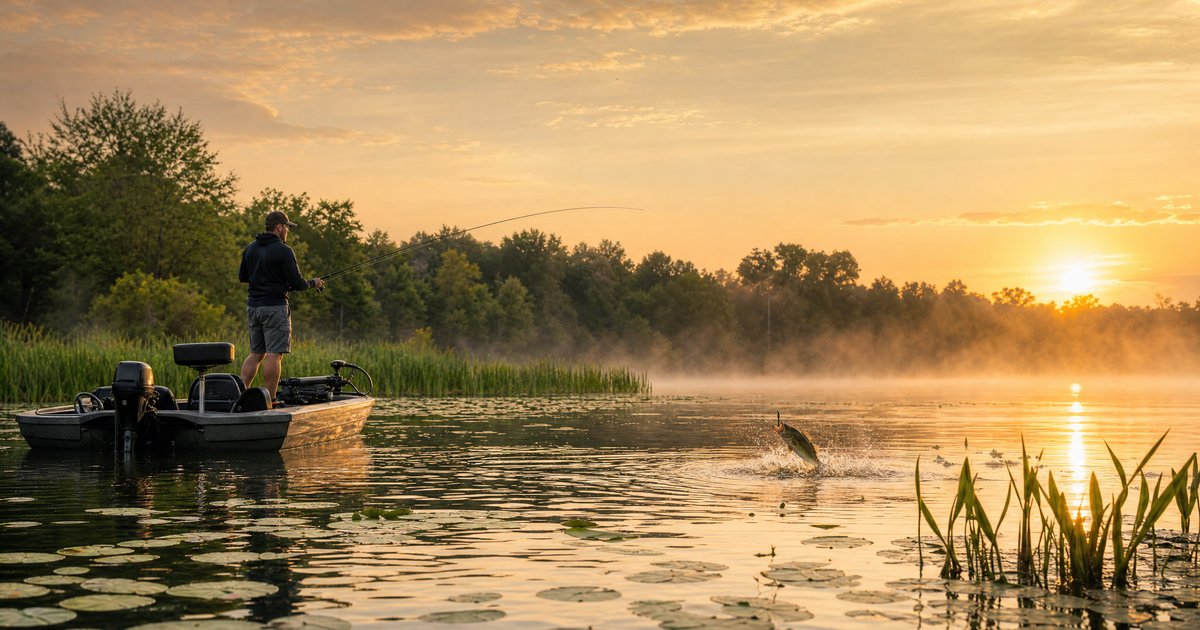
By 10 a.m. I'd put seven bass in the net — including a 4.2-pounder that ate a buzzbait right off a wind-blown point. Meanwhile I got three texts from guys on other lakes saying the bite was "dead."
That's not luck. That's understanding what southwest wind actually does to bass behavior — and positioning yourself to take advantage of it.
Wind direction is one of the most underused pieces of weather data for freshwater bass anglers. Most people check wind speed (usually to decide whether to stay home) and ignore direction completely. That's a mistake. The direction your wind is coming from tells you where the warm water is moving, where baitfish will stack up, and which banks are about to go off.
Let me break it down.
Why Wind Direction Actually Matters for Bass
Wind doesn't just make casting harder. It physically moves water — and when water moves, everything in it moves with it. Baitfish get pushed. Oxygen gets mixed through the water column. Surface temperatures shift. Bass, being ambush predators wired by millions of years of evolution, respond to those changes fast.
Wind-Driven Current and Bass Feeding Behavior
Here's the basic physics: sustained wind across a body of water creates surface current. That current piles warmer, oxygen-rich surface water against the downwind shoreline, while cooler, deeper water gets pulled up on the upwind side — a process called wind-driven upwelling.
On a calm day in summer, a lake might be thermally stratified — warm on top, cold below — with bass sitting in a fairly narrow zone. Introduce a good southwest wind and you start mixing that column. Oxygen levels improve. Water temperatures on the windward shoreline drop slightly as cooler water rises. The leeward (downwind) bank gets a pile-up of warmer surface water, suspended plankton, and the baitfish that follow it.
Bass are built for exactly this scenario. They follow the bait, use the chop for cover, and feed aggressively when conditions align.
Largemouth bass are opportunistic apex predators in their ecosystem, meaning they're highly responsive to shifts in prey availability — exactly what happens when wind concentrates baitfish along a shoreline.
Wind Chop as Cover
One thing I've noticed in eight years of kayak fishing that I didn't fully appreciate early on: wave chop on the surface breaks up light penetration. Bass that would normally push deeper in clear water on a calm day will move shallower when that surface is choppy. The reduced visibility gives them confidence to sit in ambush positions closer to the bank — which puts them right where your lures can reach them.
I've caught far more fish in 10–15 mph wind chop off the right bank than I have on dead-calm mornings fishing the same exact structure. The conditions that seem annoying are often the conditions the bass love.
Why the Southwest Wind Is the Best Wind for Bass Fishing
Not all wind directions are created equal. In the Midwest and across most of the continental United States, a southwest wind has a reputation among serious bass anglers for firing up the bite like few other conditions. Here's why.
It Brings Warm Air — and Warming Water
In North America, prevailing weather systems generally move from west to east. A southwest wind means you're pulling air from the south and southwest — warmer air. That matters a lot in spring and fall, when water temperatures are transitioning and a few degrees can make a massive difference in bass activity.
In early spring, a two-day southwest wind can warm the back end of a shallow cove by 3–5 degrees. That small jump can be the difference between bass sitting dormant on a nearby flat and bass moving into the shallows to feed — or spawn. In fall, a southwest wind during a cooling trend can stall the temperature drop and keep bass feeding in the shallows longer than expected.
It Typically Precedes a Cold Front — Before the Pressure Drops
This is the piece that most anglers miss. Southwest winds don't just bring warmth — they often signal the leading edge of an approaching weather system. And that period, right before a cold front moves through and barometric pressure tanks, is often some of the best bass fishing of the year.
Barometric pressure plays a huge role in bass activity. When pressure is falling — which happens in the 12–24 hours before a cold front arrives — bass tend to go on a feeding binge. It's not entirely clear why (there are competing theories about swim bladders and pressure sensitivity), but the pattern is consistent enough that experienced tournament anglers plan around it.
A southwest wind often means you're in that pre-front window. The bite is on. Take advantage of it.
You can check current barometric pressure trends on HookCast to see exactly where you are in that pressure cycle before you head out. It takes about 30 seconds and it'll tell you whether the front is still building or already through.
Warm-Side Bank: Your Target Zone
When wind blows from the southwest, the northeast banks of a lake are the downwind, leeward shorelines. That's where warm, baitfish-laden surface water is getting pushed. That's your target.
In my experience on Ozark impoundments and Midwest reservoirs, the northeast-facing coves and points light up first during a sustained southwest blow. I've learned to run right past the protected southwest-facing banks (calm water, zero wind activity) and head straight for the choppy northeast side. That's where the fish are set up.
How to Read a Lake Under Southwest Wind Conditions
Knowing why southwest wind helps is one thing. Knowing where to fish under those conditions is where you put fish in the boat. Here's how I think through it.
Downwind Points and Shorelines
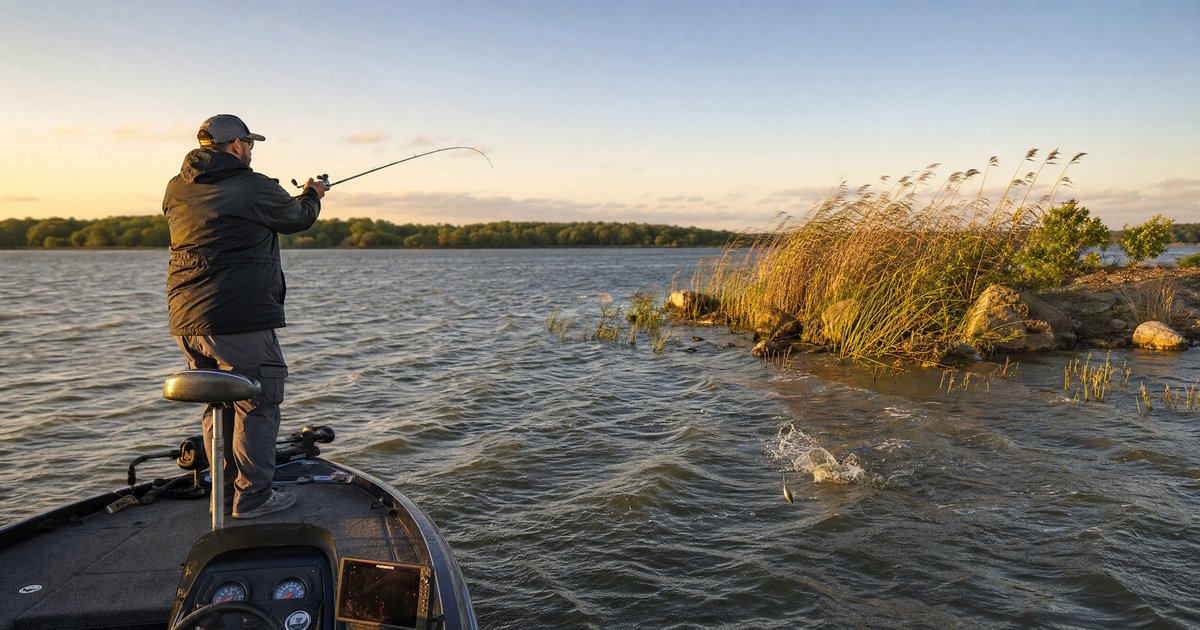
Wind-blown points — specifically the ones getting hit by the southwest chop — are gold. Baitfish get pushed against these points and have nowhere easy to escape. A bass sitting on the tip or the upwind face of that point doesn't have to work hard to eat.
Target the actual tip of the point and the first 30–50 feet of the downwind bank on either side. Work fast-moving reaction baits first: a spinnerbait with a willow-leaf blade is my go-to in this scenario. The flash matches the panicked movement of baitfish getting pushed around in current. Chatterbaits and squarebills also shine here.
Wind-Swept Shallow Flats
Shallow flats on the downwind (northeast) side of a lake are another sweet spot. The surface current carries plankton and small baitfish onto these flats, and bass follow. In summer I keep my kayak in 3–6 feet of water on these flats and cover water fast with a buzzbait or popping frog when the chop is rolling through.
One field observation from last season on Table Rock Lake in Missouri: I fished a flat that's dead in calm conditions — maybe one bite per hour. On a southwest wind day in early June, I had a non-stop bite for three straight hours on that same flat. The bass were scattered across the whole thing, not stacked on structure. Wind had activated the entire zone.
The Upwind Bank: Don't Write It Off Completely
Here's a counterintuitive note: the upwind (southwest-facing) bank isn't totally dead. Yes, the bait concentration is lower — but the upwelling of cooler, oxygenated water can attract bass during summer heat. If you're fishing a hot August day with a southwest breeze, the west-facing points where cooler water is being pulled up can hold bass seeking thermal relief.
The pattern is less reliable than the downwind bite, but it's worth a few casts if you're exploring.
Wind Direction Comparison: How Other Directions Stack Up
To really understand why southwest wind stands out, it helps to compare it against the others.
| Wind Direction | Typical Fishing Impact | Bass Behavior |
|---|---|---|
| Southwest | Usually excellent | Active, feeding aggressively |
| South | Good to excellent | Active, especially pre-spawn and summer |
| Southeast | Moderate | Somewhat active, warmer water influence |
| Northwest | Poor to fair | Post-front shutdown, cooling water |
| North | Poor | Cold front associated, bass sluggish |
| Northeast | Poor to fair | Often cold and stable, inconsistent |
| East | Generally poor | Old fishing proverb holds true here |
| West | Moderate | Neutral, depends on season |
The old saying — "wind from the east, fish bite the least; wind from the west, fish bite the best" — has more truth to it than most modern anglers give it credit for. East winds in particular are often associated with post-frontal conditions and stable high pressure, which tends to shut bass down.
A Note on Wind Speed
Direction matters, but so does speed. There's a useful range to keep in mind.
- 0–5 mph: Calm water, great for sight fishing and topwater in low-light conditions, tough in bright sun
- 10–15 mph: The sweet spot — enough chop to activate the downwind bank without making boat control a nightmare
- 20+ mph: Can still produce fish on a kayak if you're careful, but you're also fighting the water. In my kayak, 20+ from the southwest means I'm fishing protected coves or pulling the plug for safety
Field observation: My best wind-day bass fishing consistently happens in 12–18 mph southwest winds. Enough chop to push bait, not so much that I'm fighting whitecaps on open water.
Adjusting Your Presentation in Southwest Wind Conditions
The bite is on — now what are you throwing?
Fast-Moving Reaction Baits First
When bass are activated by wind-driven bait movement, they're not studying your lure. They're reacting. Lead with:
- Spinnerbait (3/8 to 1/2 oz, white or chartreuse with willow blade)
- Chatterbait / vibrating jig — incredible in 2–4 feet of water on wind-blown flats
- Squarebill crankbait — deflect it off any structure in the chop
- Lipless crankbait — rip it through scattered grass on windswept flats
Topwater When the Conditions Allow
If the chop isn't too severe and there's any low-light window — early morning or evening on that southwest breeze — topwater is absolutely worth trying. A walking bait like a Zara Spook or a buzzbait can get crushed in choppy conditions because the surface disturbance masks the lure's action and gives bass less time to scrutinize it.
Slow Down if the Reaction Bite Stalls
If you've worked the windy bank with fast stuff and the bite dries up, or the chop forces you to a more sheltered area, slow down. A Texas-rigged soft plastic worked slowly along the bottom of a wind-blown point often produces the follow-up fish after the initial reaction bite. The bass that didn't commit to the spinnerbait will sometimes eat a Senko sitting still on the bottom.
Boat Control and Kayak-Specific Tips
Fishing a kayak in wind requires some adjustment. A few things I've learned the hard way:
- Use the wind to your advantage for drift fishing. Let the southwest wind push you along a downwind bank with your trolling motor or a drift sock slowing the pace.
- Anchor when you need precision. A stake-out pole or small anchor keeps you locked on a productive point without fighting the breeze.
- Cast into the wind occasionally. Your lure landing in the chop looks natural — like a baitfish struggling in current.
- Check your HookCast weather forecast before launch to see if that southwest wind is supposed to hold all morning or die by 9 a.m. An early wind shift changes everything.
Seasonal Adjustments: Southwest Wind Isn't Always the Same
The southwest wind effect is real year-round, but it plays out differently depending on the season.
Spring (Pre-Spawn and Spawn)
This is when the southwest wind does its most dramatic work. Bass are responding intensely to water temperature as they move toward spawning. A southwest wind warming shallow coves can trigger staging bass to move up earlier than expected.
Target: Back ends of coves, transitions from hard bottom to soft, any emerging vegetation on the downwind bank. Fish are preparing to spawn — handle them carefully if you're practicing catch-and-release, and always wet your hands before touching fish to protect their slime coat.
Summer
The thermocline is established. The southwest wind's role shifts more toward concentrating baitfish on windward banks and mixing oxygen into the upper water column.
Target: Windblown points in 4–8 feet of water, any submerged structure on the downwind flat. Early morning topwater in the chop before the sun gets high.
Fall
One of my favorite times to fish a southwest wind. Bass are stacking up on baitfish in the shallows before winter. A warm southwest wind during the fall transition keeps fish in the shallows when they might otherwise push out.
Target: Downwind shad-spawn areas, laydowns and dock edges on the northeast bank, shallow humps getting wind.
Winter
Even in winter, a multi-day southwest wind can warm shallow water enough to pull fish up. USGS stream gauges can be useful here if you're river fishing — a warm southwest wind can raise water temperatures a degree or two in a stretch of river, which is significant in January.
Target: Dark-bottomed, shallow, wind-exposed coves that absorb heat. Fish slow with a hair jig or blade bait on adjacent deep structure.
Quick-Reference: Southwest Wind Bass Fishing Checklist
Before you head out:
- [ ] Confirm wind is truly from the southwest — not just listed as "SW" but veering. Check the hourly forecast.
- [ ] Check barometric pressure trend on HookCast — falling pressure + SW wind = prime window.
- [ ] Identify downwind (northeast) banks on your map before launching.
- [ ] Rig up reaction baits first — spinnerbait, chatterbait, squarebill.
- [ ] Have a slower follow-up bait ready — Texas rig, Senko, jig.
- [ ] Note water temp on downwind banks — warm water = bass activity.
- [ ] Adjust for season — spring and fall require different depth targets than summer.
- [ ] Watch for wind shifts — a shift to the northwest means a front is arriving; get your casts in fast.
- [ ] Practice safe boat handling — 15+ mph wind on open water requires extra caution in a kayak.
- [ ] Handle bass responsibly — quick photo, wet hands, release headfirst into the water.
FAQ
What is the best wind direction for bass fishing?
Southwest wind is widely considered the best wind direction for bass fishing across most of North America. It brings warmer air and water temperatures, pushes baitfish onto downwind shorelines, and often arrives ahead of cold fronts when barometric pressure is falling — a window when bass feed aggressively. South and southeast winds can also produce solid fishing for similar reasons.
Does wind direction really affect bass fishing that much?
Yes, wind direction has a measurable effect on bass activity because it controls where warm water, oxygen, and baitfish concentrate in a lake. Wind-driven surface current pushes warmer, bait-rich water against the downwind shoreline, and bass follow that food source. Wind chop also reduces light penetration, which makes bass more willing to feed shallow during daylight hours.
Why is an east wind bad for bass fishing?
An east wind in North America typically signals post-frontal conditions with rising barometric pressure and stable, cold air following a weather system. Bass tend to go inactive after cold fronts pass — their metabolism slows, they drop deeper, and they become finicky feeders. The east wind itself isn't the direct cause, but it's a consistent indicator of those tough post-front conditions.
How does southwest wind affect where bass are positioned in a lake?
A sustained southwest wind pushes warm surface water toward the northeast banks of a lake. Baitfish stack up on those downwind shores, and bass position on wind-blown points and shallow flats adjacent to where bait is concentrating. The upwind southwest-facing banks tend to be slower, though in summer heat they can hold bass seeking the cooler water that upwells on the windward side.
Should I fish on windy days or wait for calm conditions?
In most cases, moderate wind — especially from the southwest at 10–18 mph — produces better bass fishing than dead-calm conditions, particularly in clear-water lakes. Calm days are better suited for finesse techniques, sight fishing, or early-morning topwater. Wind days call for reaction baits on downwind banks. Safety is always the exception: if wind is creating dangerous whitecaps or you're in a kayak on open water, wait it out.