Experienced anglers know a dirty secret that beginners rarely appreciate: the weather you can feel rarely matters as much as the atmospheric pressure you cannot see. Barometric pressure — the weight of the air column pressing down on the water's surface — directly influences fish behavior, making it one of the most powerful fishing weather variables you can track.
What Is Barometric Pressure?
Barometric pressure is measured in inches of mercury (inHg) or millibars (mb). At sea level, standard atmospheric pressure is approximately 29.92 inHg (1013.25 mb). Weather systems cause pressure to rise and fall constantly, and fish — particularly bony fish with swim bladders — feel these changes acutely.
A fish's swim bladder acts like an internal barometer. As pressure drops, dissolved gases expand slightly within the swim bladder, causing discomfort. Fish respond by moving deeper to compensate, reducing their feeding activity. When pressure rises or stabilizes, fish return to comfortable depths and resume normal feeding patterns.
High Pressure: Stable but Slow
A high-pressure system (above 30.20 inHg) typically brings clear skies, calm winds, and stable weather — conditions that look beautiful for a day on the water but often produce tough fishing. Fish tend to:
- Move to deeper water to avoid bright light
- Feed less aggressively during midday
- Congregate near cover and structure
Best tactic: Fish deep structure early in the morning or late in the afternoon when light levels are low. Use finesse presentations: lighter line, smaller lures, slower retrieves. Drop shot rigs and shaky head jigs excel under these conditions.
Low Pressure: Active Feeding Before the Storm
A falling barometer (dropping below 29.60 inHg) signals an incoming storm system. Paradoxically, this is often the best time to fish. In the hours before a cold front arrives:
- Fish go on aggressive feeding binges, sensing that weather is about to deteriorate
- They move shallower and become less selective
- Topwater lures, crankbaits, and aggressive presentations often outperform finesse techniques
Best tactic: Get on the water 6–12 hours before a frontal system arrives. Fish quickly and cover water. This is when you can catch the most fish in the shortest amount of time. Use faster retrieves and larger profile lures.
The Pressure Drop Zone: 29.60–29.80 inHg
This transitional zone is where fish behavior becomes unpredictable. Pressure is falling but hasn't yet bottomed out. Some days the bite turns on immediately; other days fish go partially lockjawed. Pay attention to the rate of change — a rapid drop of more than 0.10 inHg per hour is more disruptive than a slow, gradual decline.
After the Front: The Tough Bite
A rising barometer after a cold front passes is notoriously difficult fishing weather. Pressure rises sharply, water clears, and fish move deep and become lockjawed. Many experienced anglers simply take this time off. If you must fish post-front:
- Target the deepest available structure
- Slow down dramatically — dead-stick presentations, worm nose hooks with no weight
- Focus on rock piles, points, and underwater humps that hold temperature
It typically takes 2–3 days after a front for fish to return to pre-front activity levels.
Optimal Pressure Range for Fishing
Based on data from tens of thousands of fishing trips, the sweet spot for productive fishing weather is:
- 29.70 – 30.40 inHg with stable or slowly rising pressure
- Slow, gradual pressure changes (less than 0.05 inHg/hour) signal comfortable, stable conditions
- Fish are active at all water depths and less selective about presentations
How to Track Pressure in the Field
You don't need an expensive weather station. Here are practical tools:
- HookCast app — Shows real-time pressure with hourly trend arrows and fishing score calculations
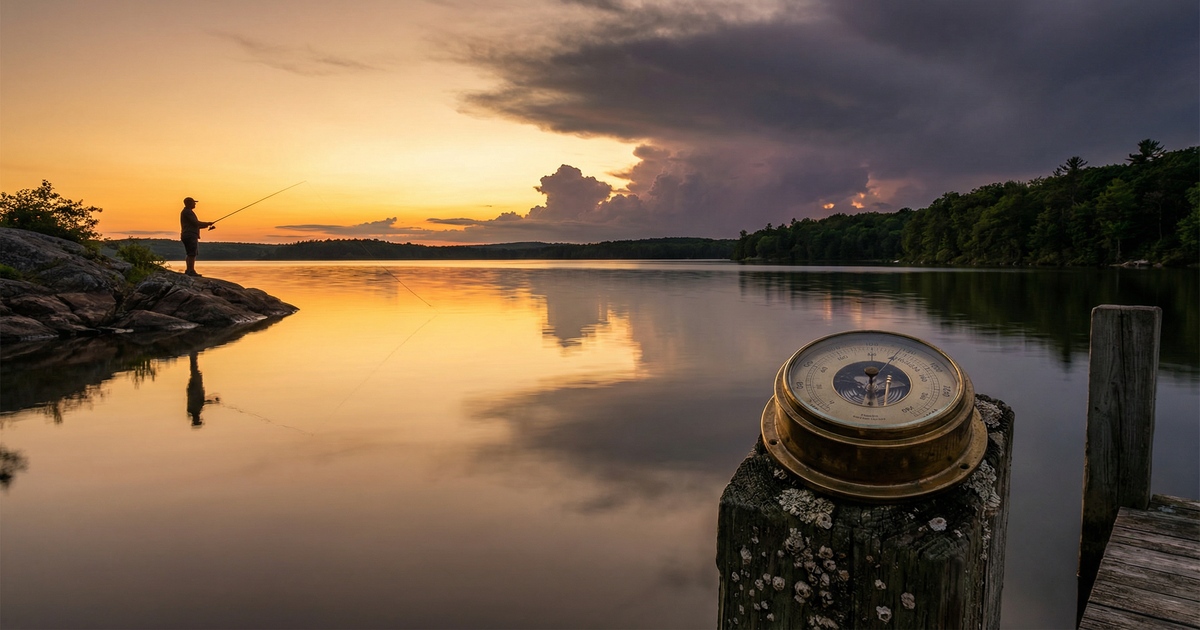
- Dedicated barometer — A quality analog or digital barometer mounted at your fishing spot gives hyperlocal readings
- Weather service barometric data — Most weather APIs include current and historical pressure
Watch the trend more than the absolute number. Rising, falling, or steady matters more than whether you're at 29.80 or 30.10.
Species-Specific Pressure Sensitivity
Not all fish respond equally:
- Bass (largemouth & smallmouth): Highly pressure-sensitive. Lockjaw sets in quickly after a cold front.
- Crappie: Moderate sensitivity. Often still catchable under post-front conditions with very slow vertical presentations.
- Catfish: Less sensitive to pressure; more influenced by water temperature and current.
- Saltwater species (redfish, snook, flounder): Responsive to pressure but somewhat buffered by tidal influences.
- Trout: Highly active during stable to slowly rising pressure; avoid post-front days.
Putting It All Together
The most productive fishing weather formula: stable or slowly rising pressure + overcast skies + mild temperatures + incoming or outgoing tide (for coastal fishing). This combination keeps fish comfortable, reduces light penetration, and triggers natural feeding instincts.
Use HookCast's fishing score to see how current barometric pressure, combined with tides and solunar data, creates a composite rating for any location. Stop guessing — start fishing with the pressure on your side.
FAQ
What is the best barometric pressure for fishing?
The best fishing typically occurs when the barometer is falling, particularly in the range of 29.60–29.80 inHg and below. The hours before a cold front arrives — when pressure is actively dropping — often trigger aggressive feeding binges that produce the most action. Stable, moderate pressure is also decent for fishing, while high pressure above 30.20 inHg and rapidly rising pressure after a front tend to produce the toughest conditions.
How do fish actually sense changes in barometric pressure?
Most bony fish have a swim bladder, an internal gas-filled organ used to control buoyancy. When atmospheric pressure drops, the gases inside the swim bladder expand slightly, causing discomfort. Fish instinctively respond by moving deeper to compensate. When pressure rises or stabilizes, they return to comfortable depths and resume normal feeding behavior, essentially using the swim bladder as a built-in barometer.
How fast does barometric pressure need to change to affect fish behavior?
The rate of change matters as much as the actual pressure reading. A rapid drop of more than 0.10 inHg per hour tends to be more disruptive to fish behavior than a slow, gradual decline over many hours. Sudden, dramatic swings — in either direction — are generally more impactful than slow, steady trends.
Should I bother fishing after a cold front passes?
Post-front fishing is widely considered the most challenging scenario. Pressure rises sharply, skies clear, and fish typically move deep and become reluctant to bite. Many experienced anglers choose to sit these periods out entirely. If you do fish post-front, focus on deep structure, use finesse presentations with lighter line and smaller lures, and target low-light windows early in the morning or late in the evening.
What tools can I use to track barometric pressure before a fishing trip?
A dedicated barometer or weather station is the most accurate option, as it lets you monitor real-time pressure trends from your location. Most modern smartphone weather apps also display barometric pressure and trend arrows indicating whether pressure is rising or falling. For fishing purposes, tracking the direction and rate of change over several hours is more useful than any single pressure reading on its own.