Best 2-Hour Tide Windows for Coastal Fishing (By Species and Region)
It's 5:45 AM. You're rigged up, coffee in hand, standing on a dark beach that looks absolutely perfect — nice cut in the sandbar, clean water pushing in from the south, scattered mullet flickering near the surface. You make fifty casts over the next two hours. Nothing.
Then you pack up, drive home, and your buddy texts you at 9 AM: "Dude, the red drum were stacked. Where'd you go?"
That's not bad luck. That's tide timing.
I've watched this play out hundreds of times guiding on the Outer Banks. The fish were there. The bait was there. But the water hadn't done what it needed to do yet — and when it did, the bite window opened and closed in about ninety minutes. If you weren't in position, you missed it entirely.
Understanding tide windows is the single biggest unlock for coastal anglers who feel like they're doing everything right but still getting skunked. Let me break it down by species and region so you can stop guessing and start planning.
Why a 2-Hour Window? The Science Behind the Bite
Tides don't flip a switch. What they do is create a sequence of conditions — current speed, water clarity, bait movement, and water temperature — that converge for a limited time before dissipating.
The two-hour window is a rough but reliable framework built around the phases of tidal movement that concentrate bait and trigger predator feeding:
- One hour before the tide change: Current is at or near maximum flow. Baitfish get pushed against structure, into cuts, or up over flats. Predators stage and feed aggressively.
- At the tide change: Flow slows, then stops. This "slack" period is brief — often 15 to 30 minutes — and can either kill the bite or extend it depending on species.
- One hour after the tide change: New current begins, often flushing fresh baitfish or oxygenated water into a zone. A second, shorter feeding flurry frequently follows.
That two-hour stretch — one hour before through one hour after — is where the majority of coastal bites happen. Everything outside that window is setting up or winding down.
Field observation: On incoming tides along the Carolina coast, I've clocked the most productive 45-minute slot as roughly 30 minutes before high tide. The water is moving fast enough to push bait, but there's still enough depth over the flats to keep fish comfortable and active.
What determines which tide change — incoming or outgoing — matters most depends entirely on the species you're targeting and where you're fishing. Let's get specific.
Striped Bass: The Outgoing Tide Specialists
Stripers are ambush predators. They don't want to chase. They want to sit in a seam of slower water while the current delivers dinner to them.
The outgoing tide consistently produces better striper fishing up and down the Atlantic coast, from the Outer Banks to Maine, for one primary reason: structure funneling.
As water drains off flats, through inlets, and out of estuaries, baitfish — menhaden, herring, sand eels — get swept along with it. Stripers position themselves at the edges of these flows: in eddies behind jetty rocks, at the mouth of tidal creeks, on the downcurrent side of sandbars.
Best Windows by Sub-Region
Northeast (Maine to Long Island):
- Target: Last two hours of outgoing through tidal rivers and inlets
- Prime spots: Inlet mouths, jetty ends, river bends where current breaks
- Notes: Spring tides (new and full moon) amplify the flow dramatically. On those days, condense your window — the fish stack tight and bite hard, then shut off
Mid-Atlantic (NJ to Virginia):
- Target: One hour before to one hour after outgoing slack
- Prime spots: Delaware Bay tributaries, Chesapeake mouth structure, Virginia Beach jetties
- Notes: Outgoing water carries warmer surface temp water from the bay in fall — that's often what triggers the striper migration push south
Outer Banks / Southeast:
- Stripers here are mostly a fall-through-early-spring species; target outgoing tide on new and full moon phases in Oregon Inlet and Hatteras Inlet
Pro tip: On an outgoing tide, don't fish the inlet mouth itself — fish the corner. The current creates a soft pocket of slower water just off the main flow. Stripers hold right there, waiting for bait to swing into the seam.
Red Drum: Incoming Tide, Shallow Flats, Every Time
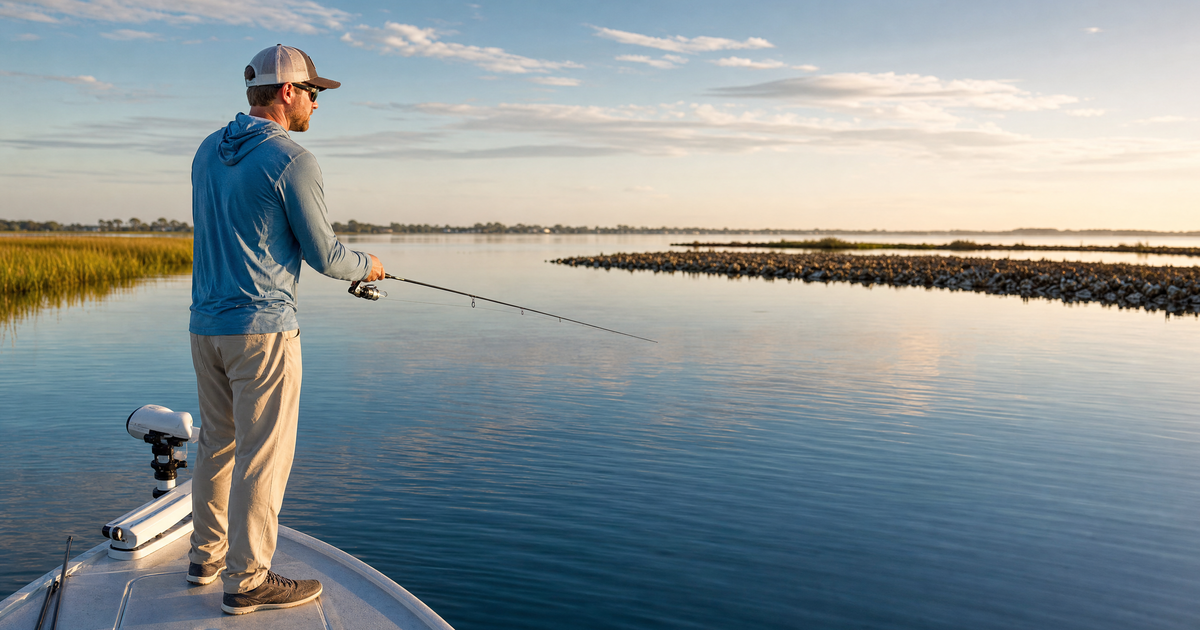
If stripers are outgoing tide fish, red drum are the opposite. Reds are hunters that push up onto shallow flats as the tide fills in, actively rooting out crabs, shrimp, and mullet in water that's sometimes barely knee-deep.
The magic window for red drum is the first 60 to 90 minutes of incoming tide, specifically on flats adjacent to deeper holding water.
Here's the mental model: redfish sit in deeper troughs and channels at low tide, waiting. As water rises and covers the adjacent grass flats or sand flats, they move in — first the big fish, then the schools. By mid-incoming, the flat is full. By high tide, they've dispersed and the bite slows.
Best Windows by Region
Southeast Atlantic (Carolinas, Georgia):
- Target: First 90 minutes of incoming on shallow grass flats and near marsh edges
- Prime time: Early morning incoming tides in fall are nearly perfect — cooler temps and rising water
- Notes: Look for mullet pushing ahead of incoming water. Where the mullet go, the redfish follow
Gulf Coast (Florida Panhandle to Texas):
- Target: Full incoming tide cycle, but peak action in the middle two hours
- Prime spots: Spartina marsh edges, oyster bars, mangrove shorelines
- Notes: Gulf tides are diurnal (one high, one low per day) rather than semidiurnal, which changes the math. On some days you only get one shot
Northeast Florida / Indian River Lagoon:
- Target: Outgoing around cuts and passes — reds funnel out of lagoon systems chasing bait through narrow channels
- This is an exception to the incoming tide rule and catches many anglers off guard
Field observation: I've sight-fished reds tailing in six inches of water on a Carolina flat during a strong incoming tide. You can literally see their tails breaking the surface. That's a 20-minute window before the water gets too deep and they settle down and stop giving themselves away.
Bluefish and Spanish Mackerel: Current Equals Chaos (That's Good)
These two species share a trait that makes them easier to pattern than redfish or stripers: they're pelagic, aggressive, and they follow bait. Full stop.
For bluefish and Spanish mackerel, the best tide windows are less about staging and more about bait concentration. Any tide phase that pushes menhaden, glass minnows, or finger mullet into a tight area will trigger a feeding blitz.
The Windows That Work
| Tide Phase | Why It Works | What to Look For |
|---|---|---|
| Max incoming current | Pushes bait toward shore structure | Slicks, nervous water near bars |
| Outgoing through inlets | Flushes bait from estuaries to open surf | Birds diving near inlet mouths |
| Tide rip formation | Colliding currents trap baitfish | Visible foam lines, color changes |
For bluefish on the surf, I target the two hours around high tide when the wave action and tide push bait over sandbars. Blues often patrol just behind the first or second sandbar, and when bait gets trapped between the bar and the beach, the blitz starts.
For Spanish mackerel, pier fishing during a strong incoming tide is highly productive from the Carolinas south through Florida. The current aligns the bait along the structure, the mackerel follow, and you're positioned right above them.
Pro tip: When you see birds working a rip line, the tide created that. Converging currents trap baitfish on the surface. Get ahead of the drift and work a spoon or a Gotcha plug through the foam line. That window typically lasts 20 to 40 minutes before current patterns shift.
Flounder and Sheepshead: The Structure and Patience Game
These two are different from the roaming predators above. Flounder and sheepshead are structure-dependent, and their tide windows are about current speed, not high or low water itself.
Flounder: The Sweet Spot is Moderate Current
Flounder lay flat on the bottom and ambush from below. They can't effectively hunt in screaming current, and they don't bother when the water is dead slack. They feed best in moderate current — which typically happens during the first and last 45 minutes of each tidal phase.
- Incoming tide: Fish the upcurrent edge of structure — drop-offs, channel ledges, the foot of jetty rocks
- Outgoing tide: Fish the mouths of creeks and cuts where flounder stack up to ambush funneling bait
Gigging and doormat flounder: The biggest flounder often feed during outgoing low-light tides in fall. They move into shallow flat areas at night and retreat to structure as daylight and tide dictate.
Sheepshead: Slack Tide and Structure
Sheepshead are barnacle and crustacean pickers. They work the surface of pilings, rocks, and shell beds. Fast current actually pushes them off structure — too much water movement makes feeding difficult.
Their best windows are within 30 minutes of slack tide — both high slack and low slack. During this brief pause, they move freely around structure and feed more aggressively.
I always check HookCast's tide chart before targeting sheepshead around jetties so I know exactly when to expect that slack window. It's a narrow target — plan the rest of your setup around it.
Regional Quick Reference: Your 2-Hour Windows at a Glance
These aren't rules — they're starting points. Water temperature, bait presence, and lunar phase all layer on top of this framework.
Northeast Coast (MA to NY):
- Stripers → Outgoing, last 2 hours
- Bluefish → Max current, any phase
- Fluke (Summer Flounder) → Moderate incoming, channel edges
Mid-Atlantic (NJ to VA):
- Stripers → Outgoing through inlets, 1 hr before to 1 hr after turn
- Bluefish → High tide surf, 1 hr either side
- Red Drum → Incoming, first 90 min on flats
Southeast Atlantic (NC to FL):
- Red Drum → Incoming, first 90 min; outgoing at cuts in FL
- Flounder → Moderate current, outgoing creek mouths
- Spanish Mackerel → Strong incoming at piers and inlets
- Sheepshead → Slack tide, within 30 min
Gulf Coast (FL to TX):
- Redfish → Mid-incoming on flats; diurnal tide means one shot
- Speckled Trout → Outgoing, grass flat edges, early AM
- Flounder → Outgoing cuts and passes, low light
How to Use This Before Your Next Trip
You don't need to memorize every combination above. You need a simple pre-trip process.
Before you go:
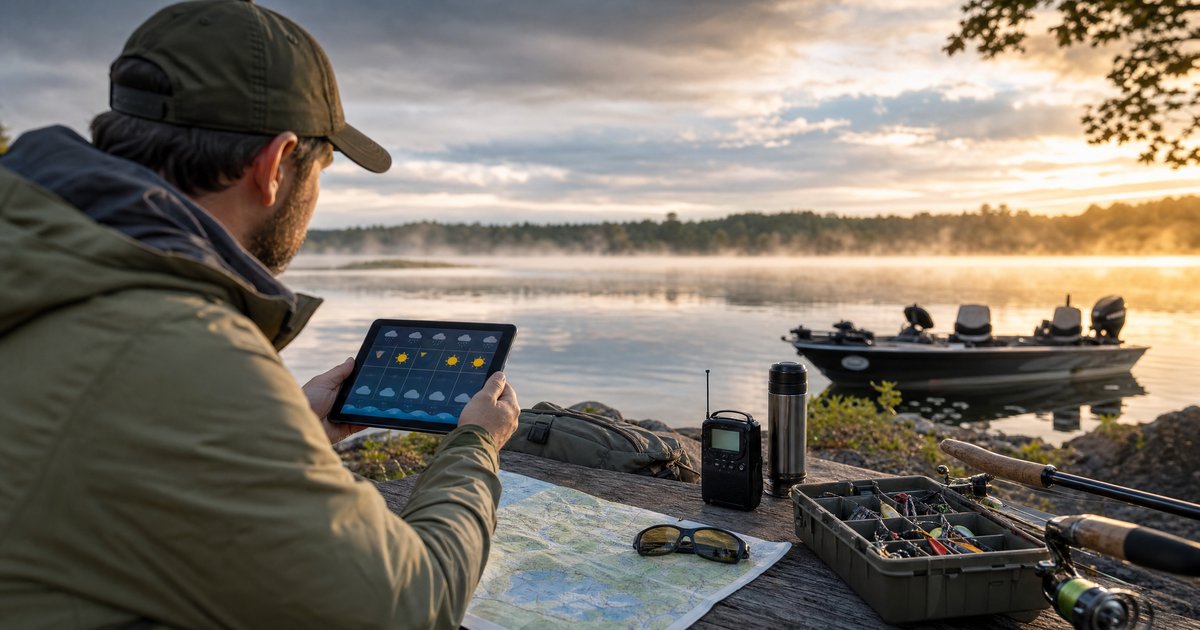
- Pull up HookCast and check the tide chart for your specific location — not the nearest town, your specific spot
- Identify your two-hour target window based on species
- Cross-reference with solunar peak times (the overlap of solunar peak and tidal movement is where the magic concentrates)
- Check wind direction — a headwind into an incoming tide stacks bait against beach structure; a tailwind on outgoing can push bait away from your position
At the water:
- Get there 30 minutes before your window opens
- Rig and scout while the tide builds — watch for baitfish movement, nervous water, current seams
- Fish hard during the window, then reassess — sometimes a second window opens an hour later
- If the bite dies before your window should close, look for a current shift, a cloud that passed, or bait that relocated
Key takeaways:
- Stripers → outgoing, max flow, structure funnels
- Red drum → incoming, first 90 min, shallow flats
- Bluefish / Spanish mackerel → max current, follow the bait and birds
- Flounder → moderate current, upcurrent structure edges
- Sheepshead → slack tide, tight to structure
- The 2-hour window (1 hr before through 1 hr after tide change) captures the majority of productive coastal fishing time
- Lunar phase amplifies everything — new and full moon tides hit harder and fish more aggressively
- Overlap of solunar peak + tidal movement = your absolute best windows
Most anglers spend time fishing. Smart anglers spend time fishing at the right moment. The tide doesn't care how long you've been standing there — it only cares whether you were in the right place when it made its move.
FAQ
What exactly is a "tide window" and why does it only last about two hours?
A tide window is the concentrated period of time when tidal conditions — current speed, water clarity, bait movement, and water temperature — align to trigger active feeding in predator fish. It typically spans about two hours because that's how long the most productive phases of tidal movement last: roughly one hour before a tide change when current is at peak flow and bait gets pushed against structure, and one hour after when fresh current begins and a second feeding flurry often follows. Outside that window, conditions are either building toward or winding down from the sweet spot.
Does it matter whether I fish the incoming or outgoing tide?
Absolutely — and the answer depends on the species you're targeting and your specific location. Striped bass, for example, tend to favor outgoing tides because receding water funnels bait through structure in predictable ways. Other species may strongly prefer incoming tides, particularly when feeding on flats where rising water pushes bait up and over shallow areas. Matching the right tide direction to your target species is just as important as being there during the two-hour window itself.
How do I find out when the tide change will happen at my specific fishing spot?
NOAA publishes free tide prediction tables at tidesandcurrents.noaa.gov for thousands of stations along the U.S. coastline. For spots between official stations, most fishing apps like Tides Near Me, Fishbrain, or Navionics will calculate adjusted local tide times. Keep in mind that tide charts show predictions — wind, barometric pressure, and heavy rainfall can shift actual tide timing by 30 minutes or more, so always factor in current conditions.
What if I can only fish during slack tide? Is it even worth going?
Slack tide — the brief 15 to 30 minute pause between tidal flows — is generally the slowest period for most coastal species, but it's not always a washout. Some species, particularly flounder and certain inshore species in deeper holes, remain active during slack. The more productive strategy is to plan your arrival so you're already in position and fishing as the tide begins moving again, catching that second feeding window in the hour after the change rather than sitting through the dead period.
Can I use tide windows for surf fishing, or does this mainly apply to inshore and estuary fishing?
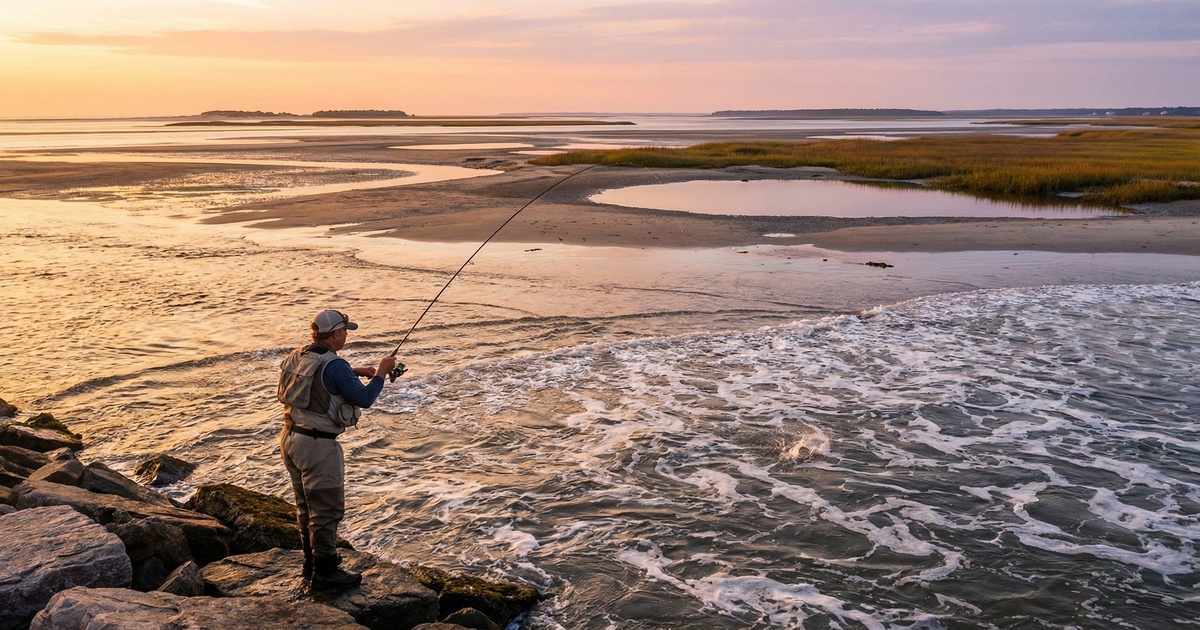
Tide windows apply directly to surf fishing — in many ways they matter even more from the beach because you have less ability to reposition quickly when conditions shift. Cuts in sandbars, troughs, and nearshore structure all activate and deactivate with tidal flow just like inshore spots do. The key difference is that surf anglers need to read how the tide interacts with local beach topography, since the same tide stage can produce completely different current patterns depending on sandbar configuration and beach angle.