Foggy & Overcast Conditions: Why Fish Bite Better and How to Capitalize
It's 6:30 a.m. and I can't see the end of my dock. Fog so thick you could cut it with a filet knife. My phone buzzes — a buddy texting to cancel because "conditions look terrible."
I told him he was making a mistake.
By 9 a.m. that morning, I'd already put two solid redfish in the box and missed a snook that would've made a grown man cry. The fog burned off around 10, and just like clockwork, the bite slowed down.
That wasn't a coincidence. That was a pattern I've seen repeat itself more times than I can count across fifteen years of running charters on the Gulf Coast. Overcast and foggy conditions genuinely do produce better fishing — and once you understand why, you'll stop dreading the gray days and start hunting them.
Why Low Light Conditions Fire Up the Bite
Let's start with the biology, because this isn't superstition — there are real reasons fish behave differently when the sun goes behind the clouds.
Light Penetration and the Predator-Prey Dynamic
Most gamefish are visual hunters. Redfish, bass, stripers, trout — they locate prey using their lateral line and their eyes. Here's the thing: their prey fish are also using their eyes to spot predators and escape.
On a bright, sunny day with clear water, baitfish can see threats coming from a much greater distance. That gives them reaction time to dart away. Under overcast skies, light penetration drops significantly, which compresses the visual range for both predator and prey — but predators have the edge because of their lateral line. They can still detect movement and vibration through the water column when baitfish can't see far enough to react in time.
Think of it like this: a bluefish chasing a pilchard in full sun is like a lion chasing a gazelle across an open plain. The same bluefish on an overcast morning is hunting in the fog — and the pilchard doesn't see it coming until it's too late.
UV Levels, Fish Eyes, and Photosensitivity
Many species of fish — particularly salmonids and reef species — have eyes that are highly sensitive to ultraviolet light. On bright days, intense UV exposure can actually cause discomfort and drive fish deeper or into heavier cover. NOAA Fisheries has documented light-avoidance behavior in multiple species, noting that fish adjust depth and positioning in response to light intensity.
Overcast clouds act like a massive natural diffuser. UV intensity drops, glare disappears, and fish that were previously holding tight to shade or structure get comfortable moving into open water and shallower flats to feed. That redfish or bass that was buried under a dock overhang at noon on a sunny day? On an overcast morning, he's cruising the flat in 18 inches of water looking for a meal.
Temperature Stability and Feeding Windows
Direct sunlight heats shallow water fast, especially in summer. That thermal stress pushes fish off the flats and into deeper, cooler water — or shuts the bite down completely. Overcast conditions moderate that thermal swing and keep shallow water temperatures stable for longer periods throughout the day.
In my experience fishing Tampa Bay and Charlotte Harbor, the difference between a 2-hour morning bite window on a sunny summer day versus a 5-6 hour active bite period on an overcast day is dramatic. The fish simply aren't under thermal stress, so they don't retreat.
Fog Specifically: What's Different About It
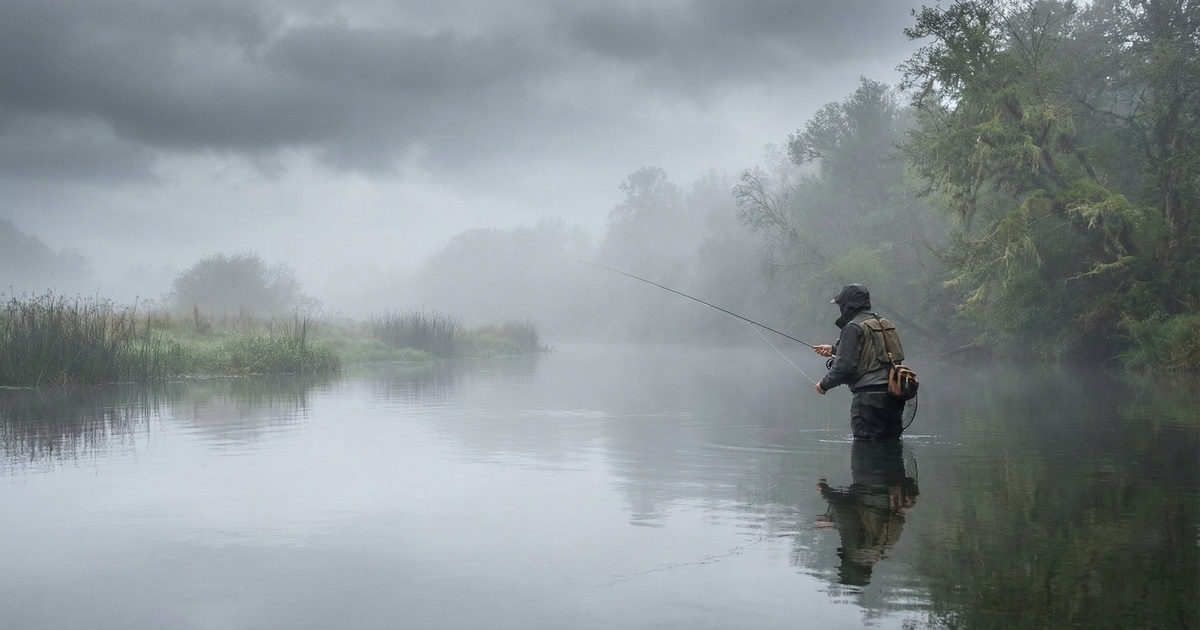
Overcast is one thing. Dense fog is its own beast — and honestly, it might be the single best fishing condition I've ever experienced, safety considerations aside.
How Fog Affects Fish Behavior Above the Waterline
Fog indicates a specific set of atmospheric conditions: water vapor near saturation, calm winds, and typically stable barometric pressure. That barometric stability is key. Fish are sensitive to pressure changes — particularly rapid drops or rises associated with incoming fronts. When pressure is steady and fog is present, fish aren't experiencing that pressure-change stress. They're in a comfortable, stable environment.
Field observation: On foggy mornings in the Everglades, I've watched snook stacked on points and channel edges feeding aggressively for hours. The second the fog burns off and direct sun hits the water, you can almost watch them slide back under the mangroves. It's like flipping a switch.
Surface Disturbance and Noise
Foggy conditions almost always come with flat, calm water. That's a double edge — the fish are spooky without wind chop to break up surface visibility, but calm water makes topwater presentations irresistible to aggressive feeders. Bass exploding on a Zara Spook in glassy, fog-covered water is one of the better things this sport has to offer.
Boat Traffic and Fishing Pressure
I'll be blunt: most casual anglers stay home on foggy mornings. That's free real estate for you. Spots that get hammered on weekends sit untouched when visibility drops to 100 yards. Reduced boat traffic means less pressure, less noise, less prop wash disturbing structure — all things that contribute to a better bite.
Gear and Tackle Adjustments for Overcast and Foggy Days
You can't just show up with your sunny-day setup and expect to maximize overcast conditions. A few tactical shifts make a real difference.
Color Selection
This is where I see anglers leave fish on the table. Conventional wisdom says "natural colors on clear days, brighter colors on dark days." That's mostly right, but it's more nuanced than that.
Under overcast skies, go with:
- Chartreuse — high contrast, visible in reduced light, triggers reaction strikes
- White/pearl — mimics baitfish flash in low light
- Black — creates maximum silhouette contrast against a grey sky when fishing topwater
- Dark green/pumpkin (for freshwater) — natural but visible under diffused light
Avoid or minimize:
- Chrome/silver lures that rely on flash from direct sunlight
- Heavily transparent soft plastics that depend on light refraction to look alive
For live bait, none of this matters — live bait is live bait regardless of sky condition.
Presentation Speed and Zone
On overcast days, fish are generally more active and willing to move to a lure. Speed up your retrieve. This is counterintuitive for guys who've been trained to slow down when fishing is tough, but on genuinely overcast days, the bite isn't tough — it's actually turned on. Burn that swimbait. Rip that jerkbait. Let the topwater walk fast.
| Condition | Retrieve Speed | Target Depth | Best Technique |
|---|---|---|---|
| Full sun, clear | Slow to medium | Deeper/shaded | Finesse, bottom contact |
| Overcast | Medium to fast | Shallow/mid-column | Reaction baits, topwater |
| Foggy/calm | Variable | Shallow (actively feeding) | Topwater, swim baits |
| Pre-storm overcast | Aggressive/fast | All depths | Anything that moves |
Topwater: The Overcast Angler's Best Friend
If you're not throwing topwater on overcast mornings, you're missing the best show in fishing. Reduced light means fish aren't looking up and seeing an angler's silhouette or detecting surface disturbance as easily. They're comfortable sitting higher in the water column, which makes explosive topwater strikes dramatically more common.
Check current conditions on HookCast before you rig up — if the cloud cover is solid and winds are calm, tie on a walking bait or a popper before you even consider anything else.
Species-Specific Behavior and Where to Find Them
The overcast advantage isn't universal in the same way across all species. Here's how I've seen different fish respond.
Inshore: Redfish, Snook, Trout
These three species respond extremely well to overcast conditions. Redfish, which are primarily a sight-feeding fish on the flats, will push into water so shallow you'd normally think it was impossible on a bright day. I've seen tailing reds in 8 inches of water under heavy cloud cover that would never show themselves in that zone on a sunny afternoon.
Snook move away from their dock and bridge structure and hunt more open water edges under overcast skies. Target transitions — where hard bottom meets grass, where clean water meets stained water, mouths of creeks.
Speckled trout tend to suspend higher in the water column. If you're bouncing a jig off the bottom on an overcast day and not getting bites, reel up two or three turns. They're often feeding mid-column.
Use HookCast's tide charts to layer tidal movement on top of cloud cover — an incoming tide combined with overcast skies on a flat is about as good as inshore fishing gets.
Bass: Largemouth and Smallmouth
Largemouth bass go on the prowl under overcast conditions. This is well-documented by tournament anglers — a cloudy tournament day often produces more consistent limits than a bluebird day, even if the bluebird day might produce one or two bigger fish off a specific pattern.
Where to look:
- Largemouth: Shallow grass edges, transition banks, docks (but the fish move away from the shaded spots and into open water)
- Smallmouth: Rocky points, gravel bars, main lake humps — they come shallower and are more aggressive
Reaction baits dominate: squarebill crankbaits, spinnerbaits, chatterbaits, and buzzbaits. This is not a finesse day.
Offshore: Mahi, Kings, and Pelagics
This is where it gets interesting. Offshore, overcast conditions affect things differently because you're dealing with deeper water and fish that relate more to structure and current than to ambient light.
That said, mahi are heavily influenced by light. They love to hold under floating debris and weedlines, and on overcast days, they'll roam more actively rather than staying pinned to a specific piece of floating structure. Cover more ground on gray days offshore.
Kingfish and Spanish mackerel — these guys seem almost indifferent to sky condition, but reduced surface glare on overcast days makes it easier to spot bait schools and birds from a distance, which is how you find kings anyway.
For grouper, the main variable offshore isn't sky cover — it's current and tide. NOAA tidal predictions for your offshore area will do more for your grouper game than watching clouds.
How to Read an Overcast Sky: Not All Gray Days Are Equal
This is the part most articles skip, and it matters. "Overcast" covers a lot of ground.
High Thin Clouds vs. Low Heavy Overcast
A milky, high-pressure overcast with thin clouds that softens light but doesn't block it entirely is different from a solid gray ceiling at 1,500 feet. Both are good fishing. But the high thin overcast is arguably the sweet spot — light is diffused, UV is reduced, fish are comfortable, but there's enough ambient light that color visibility in the water column is still good.
A low, heavy overcast pushing toward rain can be excellent or can be a sign of a dropping barometer and incoming front — which shuts the bite down. This is why checking the trend matters more than checking the current reading. Pull up a weather radar and look at the pressure trend.
Pre-Front vs. Post-Front Overcast
Pre-front overcast (the clouds rolling in ahead of a cold front) often produces incredible fishing for a window of 4-12 hours. Fish seem to sense the change coming and feed aggressively. Some of the most violent topwater sessions I've had happened in the 3 hours before a front hit.
Post-front overcast is a different story entirely. Clear, bluebird skies with cold northwest wind? That's the famous "bluebird skies equal tough fishing" scenario. But sometimes fronts leave a thin gray layer lingering for a day before clearing. That transitional post-front overcast can be productive once pressure stabilizes — usually 24-36 hours after the front passes.
If you want to track where pressure is in the cycle, check current pressure trends on HookCast before making the call on whether that gray sky is working for you or against you.
Safety First: Fishing in Fog
I'd be a bad captain if I didn't address this directly. Fog fishing is productive fishing — but it kills people. Every year, anglers get run over in fog, run aground, or get lost on large bodies of water.
Non-negotiable fog safety:
- GPS/chartplotter running at all times — don't rely on memory or landmarks you can't see
- VHF radio on and monitoring channel 16 if you're on coastal or navigable water
- Running lights on — even in daylight, fog requires navigation lights under USCG regulations
- Sound signal device — horn or whistle; required equipment and actively useful in fog
- Go slow — no fishing bite is worth getting T-boned by a boat whose operator can't see either
- File a float plan — let someone know where you're going and when to expect you back
Fog on a small inland lake with no boat traffic is a very different safety environment than fog on Tampa Bay or the Chesapeake. Know your water.
Quick-Reference Takeaways
Before you head out on the next gray, foggy morning, run through this list:
Conditions checklist:
- [ ] Is cloud cover high and stable, or a dropping barometer front approaching?
- [ ] Check pressure trend — stable pressure with overcast = prime conditions
- [ ] Wind calm? Prioritize topwater presentations
- [ ] How long has fog been present? Extended fog = stable conditions = fish are active
Gear checklist:
- [ ] Tie on chartreuse, white, or black — leave chrome at home
- [ ] Have a topwater rigged and ready
- [ ] Speed up your retrieve compared to sunny-day defaults
- [ ] If inshore, cross-reference tide stage with cloud cover for optimal flat selection
Species-specific reminders:
- [ ] Redfish: go shallow, they're on the flat
- [ ] Snook: work open water transitions, not just structure
- [ ] Trout: fish mid-column, not just the bottom
- [ ] Bass: reaction baits, shallow cover
- [ ] Mahi offshore: cover more ground along weedlines
Safety checklist (fog):
- [ ] GPS chartplotter active
- [ ] Running lights on
- [ ] VHF monitoring channel 16
- [ ] Horn/sound device accessible
- [ ] Float plan left with someone onshore
The gray days aren't bad days. They're just days most anglers don't understand. Now you do.
FAQ
Does fishing improve on overcast days compared to sunny days?
Generally, yes — overcast conditions reduce light penetration and UV levels, which encourages fish to leave shaded cover and feed more actively in open water and shallow areas. Predators gain an advantage over prey fish whose visual escape response is reduced in low light. Most experienced anglers find overcast days produce more consistent action, even if bluebird days occasionally produce a single standout fish on a specific pattern.
Is fog good for fishing?
Fog is typically excellent for fishing, for several reasons. It usually accompanies calm winds, flat water, and stable barometric pressure — all conditions that encourage active feeding. Fog also reduces boat traffic, meaning less pressure on your spots. The main caveat is safety: always run GPS navigation, keep your running lights on, and slow down significantly when operating a boat in fog.
What lure colors work best on cloudy and overcast days?
Chartreuse, white/pearl, and solid black are the most effective colors under overcast skies. Chartreuse provides high contrast in reduced light and triggers reaction strikes; white mimics the flash of baitfish when sunlight isn't creating natural reflection; black creates maximum silhouette contrast on the surface for topwater presentations. Chrome and heavily transparent plastics that rely on direct sunlight for their action are less effective on gray days.
Why do fish bite better before a storm on overcast days?
In the hours before a front or storm arrives, barometric pressure begins to drop and fish often feed aggressively — likely as a behavioral response to the coming pressure change. This pre-front feeding window can be some of the best action of the year. The key is to recognize the difference between a stable overcast (good, fish are comfortable) and a pre-front overcast with dropping pressure (excellent short window, then it shuts down when the front hits).
What species respond best to overcast and foggy conditions?
Inshore, redfish, snook, and speckled trout all respond strongly to overcast conditions by moving into shallower, more open water to feed. Largemouth and smallmouth bass become much more aggressive on cloudy days and respond well to fast reaction baits. Offshore, mahi-mahi roam more actively under overcast skies rather than staying pinned to floating structure. Most predatory species benefit from reduced light conditions, though the specific behavioral change varies by species and habitat.