Fishing Low Tide Flats: How to Find Fish When the Water Drops
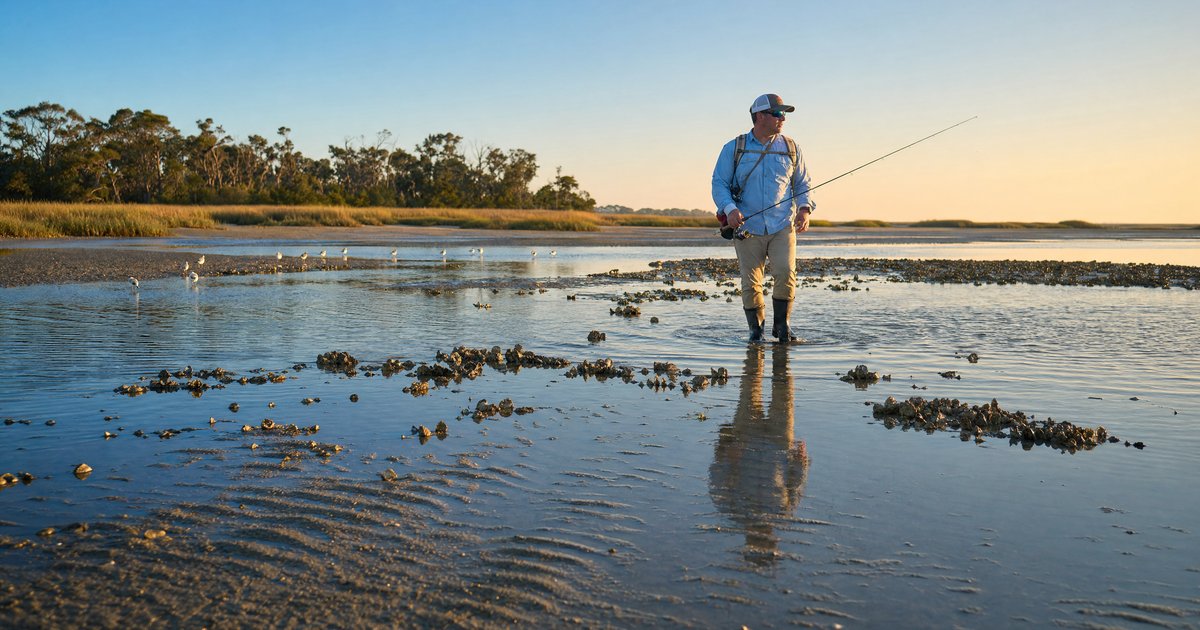
You pull up to the boat ramp at first light, and the flat you crushed last week looks like a parking lot. Shin-deep water, exposed mud, birds picking around in the shallows. Your buddy says "let's just come back at high tide." You almost agree.
But here's the thing—that exact scenario is one of the best setups in inshore fishing if you know how to read it.
Low tide doesn't kill the bite. It moves it. And once you understand where fish go when the water drops, you'll start looking at those exposed flats completely differently.
I'm a freshwater guy by trade—kayak bass and walleye in the Midwest mostly—but I've spent enough time chasing redfish and flounder on Gulf Coast flats to learn this lesson the hard way. The anglers who consistently catch fish during low tide aren't just lucky. They're reading the water.
Why Low Tide Actually Concentrates Fish
Before you can fish low tide effectively, you need to understand what's actually happening below the surface.
Tides are driven by the gravitational pull of the moon and sun. On most of the US coast, you'll experience two high tides and two low tides roughly every 24 hours—though tide patterns vary significantly between the Gulf Coast (which often sees just one high and one low per day) and the Atlantic or Pacific coasts. You can check exact tide timing and magnitude for your area using NOAA tidal predictions.
When water drops off a flat, it doesn't just disappear. It drains into deeper areas—channels, cuts, potholes, creek mouths. Fish that were spread across several acres of shallow grass suddenly have nowhere to go except those deeper pockets. Baitfish get funneled. Crabs and shrimp get pushed off the flat. And predators follow.
Field note: Think of a low tide flat like a kitchen drain. Everything gets pulled toward the lowest exit point. That exit point is almost always where you want to be.
This is the core principle: low tide compresses the food chain into predictable locations. Instead of searching a wide-open flat, you're targeting specific edges, holes, and drains. It's actually easier to find fish during low tide once you know what to look for.
According to NOAA Fisheries, species like red drum and spotted seatrout rely heavily on estuarine tidal flats for feeding, and their movement patterns shift significantly with tidal cycles. The fish are still there—they've just relocated.
Reading the Flat: What to Look For Before You Cast
Most anglers make the mistake of standing at the water's edge during low tide and just seeing less water. The guys catching fish are reading the structure that low tide reveals.
Exposed Structure Is Your Map
Low tide is one of the best scouting tools you have. Oyster bars, grass edges, submerged rock piles, and channel edges that are invisible at high water become obvious when the tide drops. I always spend a few minutes at the lowest point of the tide studying the flat—not fishing it—so I know exactly where to position when the water comes back up.
Take notes or drop waypoints on your GPS or phone. That pothole you can see in the mud at dead low tide? At high water, it's a prime ambush spot sitting 18 inches deeper than surrounding grass. Fish will hold there.
Key Low Tide Features to Target
- Tidal creeks and drains—Water leaving the flat has to go somewhere. Any cut or channel that drains a flat is a natural fish highway.
- Deeper potholes—Depressions in grass flats that hold extra water when the surrounding flat goes dry. Redfish and trout park here.
- Oyster bars—Both the structure itself and the deeper water on the shaded or current side.
- Channel edges—The hard drop from flat to channel is where ambush predators stack up.
- Grass bed transitions—The edge where thick grass meets open sand or mud concentrates crabs and shrimp, which concentrates fish.
Reading the Current
Current matters just as much as depth. During the falling tide, water moves off the flat in a predictable direction. Fish face into that current and wait for food to wash off the grass. Position yourself upcurrent of the structure you're targeting and work your presentation naturally with the flow. Fighting the current with your lure presentation is one of the most common mistakes I see.
Before heading out, I always pull up tide charts to see not just when low tide hits, but how fast the tide is dropping. A slow, gradual drop behaves very differently than a fast-moving tidal drain.
Best Species to Target During Low Tide (And How to Find Them)
Different species use low tide differently. Here's a breakdown of the main targets on US coastal flats.
Redfish (Red Drum)
Redfish are arguably the best low-tide flat fish in the country. They're built for shallow water—that downturned mouth and flat belly tell you everything. During low tide, they push into drains, potholes, and channel edges.
The classic tailing redfish scenario happens during low tide. When reds root around in shallow water feeding on crabs and shrimp, their tails break the surface. This is one of the most exciting things in fishing, and it happens most often when water on the flat is between 6 and 18 inches deep.
Best approaches:
- Weedless gold spoons in shallow grass
- Soft plastic shrimp rigs (DOA, Z-Man, Matrix)
- Topwater plugs in early morning when tails are showing
- Cast ahead of moving fish, not on top of them
Pro tip: If you see a redfish tail, mark a point about 3–4 feet ahead of where it last appeared and put your lure there. Leading the fish is everything.
Spotted Seatrout
Trout are less aggressive about shallow water than reds. During low tide, they typically stage on the edge of the flat rather than pushing all the way in. Look for them on channel drops, deeper grass lines, and the mouths of tidal creeks where current brings bait.
Early morning during a falling tide is a prime window—trout feed aggressively in low light conditions with moving current.
Best approaches:
- Paddle tail soft plastics under a popping cork
- Suspending hard baits like a MirrOlure or Corky
- Walk-the-dog topwaters at first light
Flounder
Flounder are ambush specialists and low tide is their time to shine. They sit on the bottom waiting for baitfish to get funneled past—usually right at structure transitions. Target the downcurrent side of oyster bars, the edges of tidal drains, and any sand-to-mud transition zone.
Best approaches:
- Gulp shrimp or swimming mullet on a jig head, dragged slowly
- Live finger mullet if regulations allow (check local rules)
- Work structure very slowly—flounder won't chase
Snook (Gulf and South Florida)
In South Florida and along the Gulf Coast down through the Keys, snook use tidal flats and mangrove edges aggressively during low tide. They stack up in the cuts and drains that empty the backcountry flats, essentially setting up in a feeding lane. If you're fishing the Everglades coast or Charlotte Harbor area, this is one of the most productive low-tide patterns you'll find.
Check fishing forecast for Tampa Bay before heading out—snook timing in that region is heavily influenced by both tides and water temperature.
Best approaches:
- Live pinfish or pilchards in drain cuts
- Swim jigs and flukes worked through mangrove edges
- Topwater at low light
Timing Low Tide Right: The Windows That Matter
Not all low tides fish the same. Timing and conditions determine whether you're in a feeding frenzy or staring at empty water.
The Falling Tide vs. Dead Low
There's a big difference between a falling tide and dead low tide. The falling tide—especially the last hour and a half before low—is typically the most active feeding window. Fish are actively moving with the draining water, following baitfish, and positioning at predictable structure.
Dead low is often slow. Fish are staged and waiting. Sometimes you'll find them stacked tight in a deep pocket, but movement usually dies. This is the time to scout and reposition.
Best Tidal Windows at a Glance
| Phase | Fish Behavior | Strategy |
|---|---|---|
| Early falling tide | Bait moving off flat, fish starting to stage | Follow baitfish toward edges |
| Late falling tide (last 90 min) | Aggressive feeding, fish stacked at structure | Target drains, potholes, channel edges |
| Dead low | Staged fish, minimal movement | Tight presentations at depth pockets |
| Early rising tide | Fish begin moving back onto flat | Work edges, let them come to you |
Moon Phase Matters
Solunar periods—those daily windows tied to the moon's position—overlap with tidal patterns in interesting ways. A solunar major period that aligns with a falling tide is about as good as it gets for inshore action. I've had my best low-tide sessions when the two line up, and I've also fished perfect-looking tidal conditions during a dead solunar period and barely gotten a bite. It's not a guarantee, but it's a real factor worth tracking.
Gear and Rigging for Shallow, Low-Tide Conditions
Fishing low-tide flats requires some adjustments from your standard inshore setup. The water is thin, the fish are often visible, and noise or boat shadow can spook everything in an instant.
Approach and Stealth
This is where kayak fishing has a massive advantage, and honestly, it's one of the reasons I started spending more time on coastal flats. A kayak lets you get into water that's 8–10 inches deep without making a sound. Poling skiffs do the same job, but at a higher cost.
Regardless of how you're getting around, low tide demands a quiet approach:
- Kill the motor well before your target area and drift or pole in.
- Wind direction matters as much as current—approach from downwind when possible.
- Wear dull-colored clothes—you're eye level with fish in thin water.
- Wear polarized sunglasses—this isn't optional on flats. Copper lenses for low light, gray for bright midday.
Rod, Reel, and Line
For most low-tide flat fishing:
- 7' to 7'6" medium or medium-light spinning rod—gives casting distance without overpowering light presentations.
- 2500–3000 size spinning reel.
- 20–30 lb braided main line with a 20–25 lb fluorocarbon leader, roughly 18–24 inches.
Braid gives you sensitivity and casting distance in shallow water. A fluorocarbon leader handles abrasion from oysters and grass, and it's less visible to fish.
Lures That Work on Low-Tide Flats
You don't need a tackle room full of product. The short list:
- Weedless gold spoon (1/4 to 1/2 oz)—The most versatile shallow flat lure I've fished. Burns over grass, kills it on exposed potholes.
- Soft plastic paddle tail (3–4 inch) on a 1/8 oz jig head—Works everything from trout to flounder to reds.
- Popping cork rig—Classic inshore setup that covers water and imitates feeding commotion.
- Topwater walk-the-dog plug—Early morning on low-light falling tides. Hard to beat when conditions are right.
What to Do When the Flat Goes Dry: Adjusting Your Plan
Sometimes you show up and the flat is just gone. Too much wind-driven tide drop, a bigger-than-expected low, or a cold front that pushed water offshore—it happens. Here's how to adapt.
Go Deep on the Adjacent Channel
If the flat is unfishable, the channel bordering it almost always holds fish. Everything that lived on that flat is now staged in 3–6 feet of water along the channel edge. Work the bottom with heavier jig heads, slow your retrieve, and think about the same bait species that were on the flat.
Target Mangrove Shorelines
Mangroves provide structure, shade, and cover that fish retreat to during extreme low tides. Fish tight to the roots with weedless presentations. Don't cast to the middle of the opening—throw into the roots and pull the lure out.
Consider a Different Area
Tidal variation isn't uniform across a coast. A spot three miles away might have a foot more water at low tide depending on geography, inlet size, and local funneling effects. NOAA tidal predictions breaks down predictions by individual stations, so if you have a few spots in your rotation, you can compare how dramatically different the low tide will be at each one before you make the drive.
Low Tide Flat Fishing: Quick-Reference Checklist
Before your next trip to the flats during low tide, run through this:
Before You Go
- [ ] Check tide timing—target the last 90 minutes of falling tide
- [ ] Confirm solunar period alignment (nice bonus, not required)
- [ ] Check barometric pressure trend—stable or rising pressure after a front is best
- [ ] Review local regulations, size limits, and bag limits for target species
On the Water
- [ ] Approach quietly—kill motor or paddle in
- [ ] Polarized glasses on—always
- [ ] Identify drains, potholes, and channel edges first, before casting
- [ ] Position upcurrent of your target structure
- [ ] Work lure with the current, not against it
If the Bite Dies
- [ ] Check whether dead low hit—reposition at channel edge
- [ ] Watch for bird activity (birds picking shrimp = fish below)
- [ ] Downsize your presentation
- [ ] Move—don't wait out a dead zone
Ethics and Safety
- [ ] Handle fish quickly with wet hands—especially reds and trout in summer heat
- [ ] Use a lip gripper for toothy species but support the body
- [ ] Watch for oyster cuts on bare feet or ankles—wade carefully
- [ ] Let your fishing partner or someone at home know your float plan
Low tide fishing rewards the angler who takes time to understand what's actually happening beneath the surface. The flat that looks empty at low water is just a map. You're reading it.
FAQ
Where do fish go during low tide?
During low tide, fish move off the exposed flat and concentrate in deeper adjacent areas—tidal drains, channel edges, potholes, and the mouths of tidal creeks. Rather than spreading across a wide flat, they stack up in a smaller number of predictable spots, which actually makes them easier to locate if you know the structure.
Is low tide good or bad for fishing?
Low tide is often excellent for fishing, particularly the last hour to ninety minutes of the falling tide when fish are actively moving and feeding. Dead low water can be slower, but fish are still findable in deeper holding areas. The falling tide phase generally produces more aggressive bites than the period right at the bottom of the tide.
What is the best lure for fishing low tide flats?
A weedless gold spoon in the 1/4 to 1/2 oz range is one of the most versatile lures for shallow tidal flats, covering water efficiently over grass and working well around structure. Soft plastic paddle tails on a light jig head and popping cork rigs are also top producers for redfish, trout, and flounder in low-tide conditions.
How do I find redfish during low tide?
Redfish during low tide concentrate in tidal drains, potholes in grass flats, and along channel edges adjacent to the flat. Watch for tailing fish in water that's 6 to 18 inches deep—when reds feed in ultra-shallow water, their tails often break the surface. Cast ahead of the fish rather than directly at it, and use weedless lures to navigate the grass.
What time of day is best for low tide flat fishing?
Early morning during a falling tide is generally the most productive combination—low light plus active tidal movement triggers aggressive feeding in most inshore species. However, the specific tide timing matters more than the time of day; a late afternoon falling tide with overlapping solunar activity can fish just as well. Check your local tide chart to identify when the last 90 minutes of the falling tide occurs before planning your trip.