Jigging Techniques for Saltwater: Vertical Jigs, Slow Pitch, and Speed Jigging
I'd never touched a metal jig in my life until a buddy dragged me on a charter out of Oregon Inlet, North Carolina a few years back. I showed up thinking I'd just wing it — I mean, how different could it be from working a blade bait on a Missouri reservoir?
Pretty different, as it turns out.
I spent the first hour bouncing my jig off the bottom like I was fishing for crappie. The guy next to me was pulling up amberjack and false albacore like it was nothing. Same jig, same depth. Completely different result. That trip started a serious rabbit hole into saltwater jigging that I'm still deep in today.
Here's what I've figured out — and what I wish someone had explained before I wasted half a charter.
Why Saltwater Jigging Is Different from What You Know
If you come from a freshwater background like me, you already understand the general idea of jigging. Work the lure, trigger a reaction. But saltwater jigging operates on a different scale — in terms of depth, current, target species, and the physical demands on your gear and your body.
Saltwater jigging typically falls into three distinct categories: vertical jigging, slow pitch jigging, and speed jigging. These aren't just variations on the same theme. They're almost entirely different disciplines that match different conditions, species, and water depths.
Before diving into technique, understand this: saltwater fish relate to structure, current seams, and bait concentrations in ways that freshwater fish do too. The difference is the scale of water you're covering and the influence of tides. Tidal movement is everything inshore and nearshore. Check the tide charts for your area before heading out — dropping a jig on a dead-slack tide in 100 feet of water is usually an exercise in frustration.
NOAA Fisheries tracks the behavior and distribution of most target species along the coastal US, which is worth a bookmark if you want to understand seasonal windows and habitat preferences for the fish you're chasing.
Vertical Jigging: The Foundation
Vertical jigging is exactly what it sounds like — you're dropping a weighted metal jig straight down below the boat and working it up and down through the water column. It's the most straightforward of the three methods and a solid starting point if you're new to saltwater jigs.
When Vertical Jigging Works
This technique shines in a few specific scenarios:
- Deep structure: Rocky bottoms, wrecks, ledges, and humps in 60–300+ feet of water
- Tight bait balls: When fish are stacked under birds or marking on the sonar in a specific depth range
- Slow current windows: During tide transitions when the current isn't sweeping your jig sideways
The core idea is depth control. You want the jig to stay vertical — or close to it — the whole time. If your jig is sweeping at a 45-degree angle because of current, you've either got too light of a jig or too much water movement for a vertical presentation.
How to Work a Vertical Jig
Drop the jig to the bottom or to the target depth on your sonar. Then use a combination of rod lifts and reel speed to create action. The most common retrieve is a one-two lift and drop: lift the rod tip sharply 12–18 inches, reel down to take up slack, let the jig flutter on the fall, then repeat.
The drop is where most strikes happen. Saltwater predators — amberjack, grouper, yellowtail snapper, stripers — key in on that flutter. Don't rush the drop. Let the jig work.
Jig selection for vertical work:
| Jig Weight | Depth Range | Common Use |
|---|---|---|
| 1–3 oz | Inshore, 20–60 ft | Flounder, redfish, stripers |
| 4–6 oz | Nearshore, 60–150 ft | Amberjack, cobia, grouper |
| 8–16 oz | Offshore, 150–300+ ft | Tilefish, deep grouper, AJ |
Weight isn't just about depth — it's about current. A 4 oz jig in heavy current might fish like a 2 oz jig in calm conditions. When in doubt, go heavier to maintain that vertical presentation.
Field note: I've found that when fish are stacked tight to the bottom on a wreck, a butterfly-style jig (asymmetrical, wider flutter) outperforms a standard knife-style jig. The erratic fall mimics a dying baitfish more convincingly.
Slow Pitch Jigging: The Finesse Game
If vertical jigging is the workhorse, slow pitch jigging is the finesse move. It came out of Japan in the early 2000s and has been spreading through the US saltwater community for about the last decade. The principle is built around a specialized rod, matched reel, and a deliberate semi-slack presentation that lets the jig do the work.
The Philosophy Behind Slow Pitch
Standard jigging is angler-driven. You're actively working the rod to create action. Slow pitch flips that — you're using the rod's parabolic bend and the jig's own design to generate a natural, rolling, falling action. The rod loads, you pause, the jig spirals and flutters on the fall. It's almost meditative compared to speed jigging.
This is why the rod matters enormously in slow pitch. A standard heavy jigging rod won't cut it. Legitimate slow pitch rods are rated in increments (like "2/5" meaning it fully bends under a 2 oz load but can lift 5 oz) and have a very specific tip sensitivity and butt stiffness ratio. They're not cheap — expect to pay $150–$400+ for a quality dedicated stick.
How to Execute the Slow Pitch Method
The cadence is roughly: half-turn crank → rod lift → controlled drop → pause. You're pitching slack into the line on the drop, which allows the jig to spiral and roll freely. Strikes can come so softly during the fall that you barely feel them — the rod often loads itself.
Best target species for slow pitch:
- Amberjack along the Atlantic and Gulf
- Snapper species (vermilion, yellowtail, mangrove)
- Flounder in deeper nearshore structure
- Lingcod and rockfish along the Pacific coast
Slow pitch excels in moderate current with fish that are in a neutral or negative feeding mood. When fish are lethargic — post-front, mid-tide, cold water — this subtle presentation often draws strikes that aggressive jigging won't.
Pro tip: Watch the line on the fall. Even with a slack-line drop, a strike will show as the line twitching sideways or going slack faster than expected. Set the hook with a smooth sideways rod sweep, not a hard upward jerk — these hook sets are often mid-water, and too sharp a set can pull the hook.
Jig Shapes for Slow Pitch
Not all jigs work for slow pitch. The technique requires center-balanced or rear-weighted jigs that flutter and roll during free fall. Look for these profiles:
- Long flutter jigs (thin, tapered, often 150–300g)
- Center-balanced oval jigs for wider side-to-side roll
- Avoid knife-style jigs with top-only weighting — they drop nose-first and kill the flutter
Speed Jigging: High Energy, High Reward
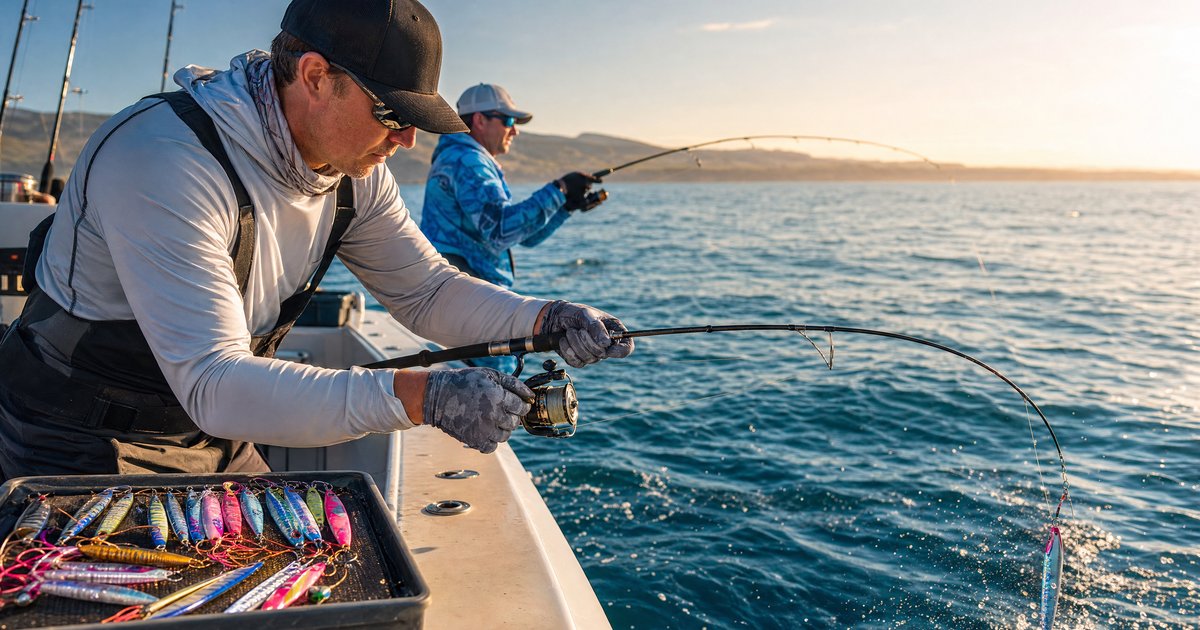
Speed jigging is the opposite end of the spectrum. It's physically demanding, rod-punishing, and flat-out effective when pelagic fish are in a feeding frenzy. The technique involves rapidly cranking the reel while simultaneously pumping the rod in short, aggressive strokes — basically burning the jig up through the water column as fast as possible.
When to Use Speed Jigging
Speed jigging is built for targeting fast, aggressive pelagic predators in the mid-water column:
- Kingfish (king mackerel)
- Mahi-mahi
- False albacore and bonito
- Wahoo (especially on the drop or with a quick flutter pause)
- Bluefish during blitzes
The trigger here is pure reaction — you're mimicking a fleeing baitfish. These species don't need a perfectly natural presentation. They need something that runs and looks like it's trying to escape.
The Speed Jigging Retrieve
There's no single formula, but the most common speed jig retrieve looks like this:
- Drop to target depth or just above where fish are marking on the sonar
- Engage the reel and begin a rapid high-speed crank (think fast-retrieve reel, 6:1 or higher)
- Simultaneously pump the rod in short 12–18 inch strokes
- When you hit the surface without a strike, drop back down and repeat
- Pause briefly every 5–7 cranks — that pause often triggers the hit
The pause-and-flutter is where wahoo in particular will nail the jig. Without it, some fish will follow without committing.
Gear considerations for speed jigging:
- High-speed reel: A 6:1 or 7:1 gear ratio is the floor. Some anglers use 8:1 for surface-oriented fish
- Braided line: 50–80 lb braid is standard. Low stretch gives you hook-setting power at depth
- Fluorocarbon leader: 60–100 lb for toothy species. Shorter leaders (3–4 feet) for better jig action
- Assist hooks: Single or double assist hooks up top, and optionally a rear treble for smaller species
Safety note: If you're targeting pelagics offshore on a charter or private vessel, always check the NOAA marine forecast for your departure port before heading out. Conditions can shift fast 20+ miles offshore. This isn't something to eyeball from the dock.
Matching Your Jigging Style to Conditions
This is the part that took me the longest to figure out — it's not about having one technique nailed down, it's about reading conditions and picking the right tool.
Using Tides and Current to Your Advantage
Tidal movement is the single biggest factor in jig selection and technique outside of species targeting. Moving water activates fish. Slack tide can kill a bite that was red-hot 30 minutes earlier.
General rule of thumb from experience:
- Incoming tide, building current → Speed jigging and vertical jigging both productive. Fish are feeding actively
- Peak current → Go heavier on vertical jigs to maintain depth. Slow pitch is difficult to execute well
- Outgoing tide, moderate current → Good window for slow pitch. Fish often suspend mid-column chasing bait being pushed by current
- Slack tide → Toughest window. Drop to the bottom, slow pitch, or take a break
NOAA's tidal predictions give you precise tide data for your port. I cross-reference this with HookCast's tide charts to dial in the best two-to-three-hour window of the day.
Barometric Pressure and Deep-Water Jigging
This is something most freshwater anglers already think about, but it applies offshore too. Standard atmospheric pressure sits around 1013.25 hPa according to NOAA. A falling barometer ahead of a front pushes shallow-water fish off structure and often suppresses inshore feeding. Deepwater species like grouper and snapper are less affected by pressure swings — they're below the thermocline and don't experience the same surface-level changes.
Check current pressure trends on HookCast if you're planning an inshore trip and debating whether to go vertical jigging in deeper nearshore water or work the shallows. A 12–24 hour falling pressure window is usually better for heading out to deeper structure.
Quick Reference: Which Technique for Which Situation
| Condition | Best Technique | Notes |
|---|---|---|
| Active fish marking mid-column | Speed jigging | Fast retrieve, pause every 5–7 cranks |
| Fish tight to bottom structure | Vertical jigging | Flutter jigs, work the bottom 20 ft |
| Neutral bite, moderate current | Slow pitch | Let the jig work on the fall |
| Heavy current | Heavy vertical jig | Go heavier to stay vertical |
| Slack tide | Slow pitch or pause | Patience and subtle action |
| Pelagic blitz on surface | Speed jigging | Match the hatch on jig size if possible |
Gear Basics Without Breaking the Budget
I'm not going to tell you to go buy a $600 slow pitch setup on your first saltwater jigging trip. Start simpler.
Entry-level setup for vertical and speed jigging:
- Rod: A medium-heavy to heavy 5'6"–6' conventional or spinning jigging rod rated for 80–150g jigs. Shimano, Penn, and Daiwa all have solid options in the $80–$150 range
- Reel: Conventional reels excel for vertical jigging; a spinning setup works for speed jigging. Penn Battle or Daiwa BG in the 4000–6000 size handles most nearshore jigging
- Line: 40–65 lb braid. Don't use mono for jigging — the stretch kills your sensitivity and hook sets
- Leader: 40–80 lb fluorocarbon, 4–6 feet
- Jigs: Start with a variety pack of butterfly and knife jigs in 3–6 oz. Once you know what the conditions demand, you can specialize
Once you're hooked — and you will be — then invest in a dedicated slow pitch setup. But start with the basics and learn to read what the fish and conditions are telling you first.
Always check local saltwater regulations before your trip. Most coastal states require a saltwater fishing license, and many target species like grouper, snapper, and amberjack have size limits, bag limits, and seasonal closures that vary by state and federal waters. The NOAA Fisheries regional offices are a good starting point, but verify with your state fish and wildlife agency directly.
Key Takeaways
- Vertical jigging is about depth control and structure fishing. Work the jig on the drop and let the flutter do the triggering
- Slow pitch jigging is a finesse technique that lets the jig flutter freely on a semi-slack line. It requires specialized gear but excels on neutral fish
- Speed jigging is aggressive and reaction-based. It's built for pelagic species during active feeds
- Tidal current drives which technique is practical — match your jig weight to the current, not just the depth
- A falling barometer pushes inshore fish off structure; deepwater species are more stable under pressure changes
- Start with a solid mid-range conventional or spinning jigging setup before investing in specialty slow pitch gear
- Always verify regulations, size limits, and seasonal closures before targeting species in federal or state waters
FAQ
What is the difference between slow pitch jigging and regular vertical jigging?
Vertical jigging relies on the angler actively working the rod with sharp lifts and controlled drops to generate action. Slow pitch jigging uses a specially designed parabolic rod and a deliberate half-crank cadence to create slack in the line, allowing the jig to spiral and flutter naturally on the fall. Slow pitch is generally more effective on neutral or pressured fish, while vertical jigging is more direct and versatile across different depths and current conditions.
What weight jig should I use for saltwater jigging?
Jig weight depends on both depth and current strength. For inshore and shallow nearshore fishing in 20–60 feet, 1–3 oz jigs are usually sufficient. For nearshore depths of 60–150 feet, 4–6 oz is a common range. Offshore deepwater jigging in 150–300+ feet typically requires 8–16 oz. In strong current, you'll often need to go heavier than the depth alone would suggest to keep your jig fishing vertically.
What saltwater species can you target with metal jigs?
Metal jigs are effective on a wide range of saltwater species. Vertically jigged butterfly and knife jigs work well for amberjack, grouper, snapper, cobia, and flounder. Speed jigging targets pelagic species like king mackerel, mahi-mahi, wahoo, false albacore, and bluefish. Slow pitch jigging produces amberjack, multiple snapper species, lingcod, and rockfish, particularly when fish are in a neutral feeding mood.
Do I need a special rod for slow pitch jigging?
Yes — a dedicated slow pitch jigging rod makes a significant difference. These rods have a specific parabolic taper that loads under jig weight and snaps back to generate the jig's flutter action. Using a standard heavy jigging rod for slow pitch produces poor jig action and limits effectiveness. Quality slow pitch rods run $150–$400+, so it's worth learning vertical jigging fundamentals first before investing in specialty gear.
How does tide affect saltwater jigging success?
Tidal movement directly controls how active fish are and how well your jig fishes. Moving water — whether incoming or outgoing tide — typically triggers feeding and makes fish more responsive to jigs. Slack tide, the window around high or low tide when current stops, is generally the hardest window to fish. During peak current, heavier jigs are needed to maintain a vertical presentation. Planning your jigging around the two to three hours of strongest tidal movement each day generally produces the best results.