Spring Shad Run on the East Coast: What Every Angler Needs to Know
Every April, I get the same call from a buddy of mine up in Connecticut. "Jake, the shad are in the river. Get up here." And every year I think about making that trip — because the American shad run is genuinely one of the coolest fishing events in this country, and most anglers south of the Mason-Dixon have no idea it's happening.
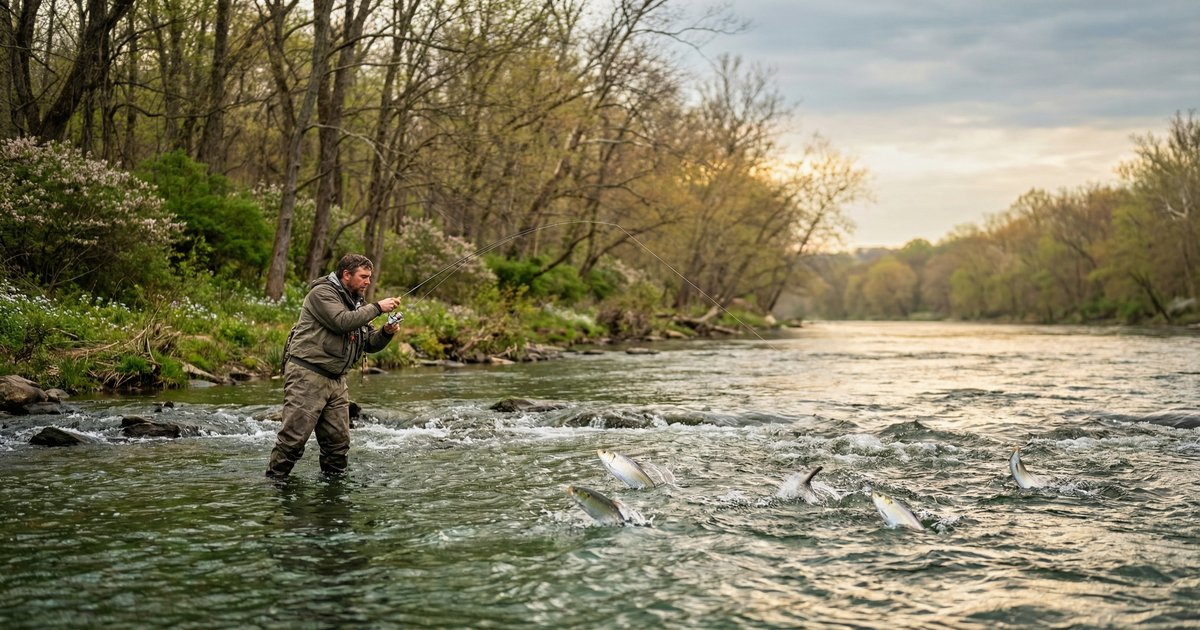
Up and down the East Coast, from Georgia to Maine, millions of American shad leave the Atlantic Ocean and push into freshwater rivers to spawn. They've been doing it since before the country existed. George Washington fished for them on the Potomac. The runs were so thick in colonial times that people reportedly scooped them out with baskets.
Those days are gone, obviously. But the run still happens every spring, and in rivers with good restoration programs, it's legitimately impressive. If you've never targeted shad, you're missing out on a fish that fights like a small tarpon and hits like it has a personal grudge against your lure.
Here's everything you need to know to intercept them.
What Is the American Shad Run (and Why Should You Care)?
American shad (Alosa sapidissima) are anadromous fish — they're born in freshwater, spend most of their lives in the Atlantic, and return to their birth rivers to spawn. According to NOAA Fisheries, shad are the largest member of the herring family in North America, typically running 3 to 5 pounds, with trophy fish pushing 7 or 8.
That might not sound massive. But shad are pound-for-pound some of the hardest-fighting fish you'll catch in a river. They cartwheeled out of the water before largemouth bass made it fashionable. Fly fishermen love them. Light tackle guys love them. They're called the "poor man's tarpon" for a reason.
The spawn-run typically kicks off in Georgia and the Carolinas in late February and March, then moves progressively north as water temperatures climb. By May and early June, fish are pushing into New England rivers. The whole migration is driven by water temperature — shad start entering rivers when temps hit approximately 50-55°F and are most active between 55-65°F.
The Decline and Comeback
Shad runs were devastated by dams, pollution, and overfishing through the 19th and 20th centuries. Many rivers lost their runs entirely. The good news is that significant restoration work — dam removals, fish ladders, and stocking programs — has brought shad back to rivers that hadn't seen a real run in decades.
The Connecticut River, which flows through Massachusetts and Connecticut before reaching Long Island Sound, is the best example. It once supported one of the largest shad runs in the country, collapsed, and has been steadily recovering. The Delaware River has seen similar improvements. These aren't peak colonial numbers, but they're real, fishable runs.
The Migration Timeline: Georgia to Maine
One of the most useful things to understand about the shad run is that it's not a single event — it's a rolling progression up the coast. Miss it in Virginia? You might catch it two weeks later in New Jersey.
Here's an approximate timeline based on field experience and historical run data:
| Region | States | Typical Run Window |
|---|---|---|
| Deep South | Georgia, South Carolina | Late February – Mid March |
| Mid-Atlantic South | North Carolina, Virginia | Mid March – April |
| Chesapeake / Delaware | Maryland, Delaware, Pennsylvania | April – Early May |
| New York / New Jersey | Hudson, Delaware Rivers | Late April – Mid May |
| Southern New England | Connecticut, Rhode Island | Early May – Late May |
| Northern New England | Massachusetts, New Hampshire, Maine | Mid May – June |
These windows shift depending on the year. A cold winter that keeps water temperatures low can push the whole run back two to three weeks. A warm spring can accelerate it. Before you make the drive, check water temperatures and fishing conditions on HookCast for your target river — the difference between 48°F and 55°F is the difference between nothing and a feeding blitz.
Key Rivers by Region
Southeast:
- Altamaha River (Georgia) — one of the southernmost consistent shad runs
- Cape Fear River (North Carolina) — a traditional shad fishery with local tournaments
Mid-Atlantic:
- James River (Virginia) — excellent urban fishery near Richmond
- Potomac River (Maryland/Virginia) — historic shad water; Little Falls and Chain Bridge are classic spots
- Delaware River — runs through Pennsylvania, New Jersey, and Delaware; strong restoration success
Northeast:
- Hudson River (New York) — shad staging in the lower river, running up through Poughkeepsie
- Connecticut River — arguably the most famous shad river on the coast; Holyoke Dam fish ladder has documented run counts going back decades
- Merrimack River (New Hampshire/Massachusetts) — recovering nicely after dam modifications
For real-time stream conditions and flow rates on these rivers, USGS stream gauges are indispensable. High, muddy water after heavy rain kills the bite. You want clear, moderate flows.
Reading the Water: Where Shad Stack Up in Rivers
Shad are moving fish. They're not sitting on a ledge waiting for your bait like a channel cat — they're on a mission upstream, and your job is to figure out where they're pausing to rest and feed.
Current Seams and Breaks
Shad use the current like a highway, but they don't fight hard current when they don't have to. Look for:
- Current seams — where fast water meets slow water; shad cruise the edge
- Eddies behind bridge pilings or large rocks — resting zones where fish stack
- Tail-outs of pools — the downstream end of a deep pool where current begins to accelerate; shad often hold just upstream of this
- Holes immediately below dams or fish ladders — this is where fish concentrate when they can't get further upstream
The pool-below-the-dam scenario is almost always the most productive and the easiest to identify. If there's a dam on a shad river, fish the water within a quarter mile downstream. Shad pile up, and the bite can be ridiculous.
Water Clarity
Shad fishing in off-color water is brutal. They're visual, reaction-based feeders in this context, and if they can't see your offering, you're wasting time. Ideal visibility is 18 inches or better. Clear water with good flow is the sweet spot.
After a hard rain, I've given up on shad rivers for 3-4 days waiting for clarity to come back. Doesn't matter how good the run is — if the water looks like chocolate milk, fish something else.
Depth
Most productive shad fishing happens in 6 to 15 feet of water. They're a mid-column fish during the run — not hugging the bottom, not surface crashing. Adjust your presentation accordingly.
Gear, Tackle, and Technique
Shad fishing doesn't require specialized gear, but there are right and wrong approaches. Here's what actually works.
Rod and Reel
A 6- to 7-foot light to medium-light spinning rod is the standard setup. You want enough backbone to work darts through current, but enough sensitivity to feel the soft pickups shad sometimes make. A 2500 to 3000 series reel spooled with 6- to 10-pound monofilament or 10-pound braid with a fluorocarbon leader is versatile across all the main techniques.
Fly fishing for shad is phenomenal — a 5 or 6-weight rod handles them well — but I'll keep the focus on conventional tackle since that's what most folks are working with.
The Main Lures
Shad darts are the classic presentation and for good reason. They're small, weighted jig heads — typically 1/8 to 1/4 ounce — with a short, tapered body and a bucktail or feather tail. They've been catching shad for over a century. Red and white, chartreuse, yellow — all produce. If you're new to shad fishing, start here.
I'll fish two darts on the same leader sometimes — a tandem rig — because shad are schooling fish. When one hits, there are often more behind it. A tandem setup has saved some otherwise slow days.
Small spoons are another consistent producer, especially when fish are scattered. A 1/4-ounce flutter spoon in gold or silver covers water fast and triggers reaction strikes.
Inline spinners like a small Mepps or Panther Martin are classic on shad rivers in the Northeast and produce well in moderate current.
Soft plastics — small paddle tails and curly tails on 1/8-ounce jig heads — are increasingly popular, particularly in clearer, slower water.
Technique
Shad fishing in rivers is mostly about the drift. You're casting quartering upstream or perpendicular to the current, letting the lure swing down and across the seam, then retrieving with a slow, steady pump. Vary your retrieve speed until you find the pattern — sometimes they want the lure barely moving, sometimes a faster swing triggers the hit.
In deep holes below dams, a vertical jig presentation can be deadly. Drop straight down, hop the dart, feel for the weight of a fish.
With fly gear, a weighted streamer on a sink-tip line swung through the current column is the textbook method. Clouser minnows in white and chartreuse are a top producer.
Weather, Water Temperature, and Timing Your Trip
Shad are more predictable than most fish once you understand the temperature component. But weather still matters significantly.
Water Temperature Is Everything
I mentioned the 50-55°F threshold for river entry, but within the run, fish feeding activity also tracks temperature. The best bites, in my experience and based on what I hear from guides running these rivers, typically happen when temps are climbing — not stable, not dropping, but on the rise.
A sustained period of warm, sunny days in May can turn a trickle of fish into a full-on run. A cold snap will slow things down considerably.
USGS stream monitoring stations track water temperature on most major shad rivers in real time. Worth bookmarking before a trip.
Barometric Pressure
Standard atmospheric pressure runs around 1013.25 hPa per NOAA. For shad, pressure matters less than it does for many other species — these fish are on a biological imperative, not responding to feeding triggers the way a largemouth does. But a sharp pressure drop ahead of a cold front can temporarily kill the bite as fish go deep and become lethargic. Give it 24 hours after a front passes and conditions often improve.
Best Times of Day
Early morning and late evening are productive, same as most fishing. But shad are known for strong midday bites, particularly in cooler spring conditions when sunlight warms the water column slightly. Don't sleep through a May morning and think the bite is done — check the current and depth, adjust, and you might hit fish at noon.
Pull up HookCast's fishing forecast for the Connecticut River area if you're targeting New England shad — the barometric trend and temperature data will tell you a lot about what to expect before you load the truck.
Regulations, Roe, and the Table Quality Question
Know Your Regs
Shad regulations vary significantly by state and river system. Some rivers have catch-and-release-only rules. Others allow harvest with size and bag limits. A few rivers have temporary closures during peak spawn to protect the run.
Before you fish:
- Check your state's freshwater fishing regulations
- Confirm whether the specific river or section you're targeting has special rules
- Some river systems have tribal fishing rights that affect access
There's no shortcut here — look it up for your specific location before you go.
The Roe Question
Female shad are heavily targeted in some regions not for the fight but for the roe. Shad roe — the egg sac from a ripe female — is a genuine regional delicacy in the Mid-Atlantic and Southeast. Pan-fried in bacon fat, it's something people make special trips for. In states where harvest is legal, female fish with roe are prized above all else.
If you're keeping fish, know that male and female shad look similar — the females tend to be larger and rounder in the belly during spawn. Learning to identify roe-bearing females takes a trip or two.
Eating the Fish Itself
Here's the honest truth about shad as table fare: they're excellent in flavor and notoriously miserable to fillet due to an insane number of Y-bones running through the meat. People have been dealing with this for centuries. Traditional methods include slow-roasting or smoking, which dissolves the bones. It's not a Tuesday night weeknight dinner situation. Catch-and-release is a perfectly reasonable choice for most anglers.
Quick-Reference Takeaways
Before your trip:
- ✅ Confirm water temperature is in the 50-65°F range on your target river (USGS gauges)
- ✅ Check streamflow — you want moderate, clear water, not post-rain flood conditions
- ✅ Verify local regulations for your specific river section
- ✅ Check the barometric trend — stable or rising pressure after a front is ideal
- ✅ Identify your target structure: pools below dams, current seams, bridge eddy lines
On the water:
- ✅ Start with a 1/8 to 1/4 oz shad dart in chartreuse or red/white
- ✅ Fish 6-15 feet, mid-column — not on the bottom
- ✅ Cast quartering upstream, swing the lure through current seams
- ✅ Vary retrieve speed until fish respond
- ✅ If fishing below a dam, try vertical jigging in the deep hole
Migration timing cheat sheet:
- Georgia/Carolinas: late February–March
- Virginia/Maryland: mid-March–April
- Delaware/Pennsylvania: April–early May
- New York/New Jersey: late April–mid May
- Connecticut/Rhode Island: early–late May
- Massachusetts/Maine: mid May–June
FAQ
What is the American shad run and when does it happen?
The American shad run is an annual spawning migration in which adult shad leave the Atlantic Ocean and enter East Coast rivers to reproduce. It runs from late February in Georgia through June in Maine, with the timing in each region driven primarily by water temperature — fish typically begin entering rivers when temps reach 50-55°F. It's a rolling event that progresses northward over several months.
What are the best rivers for shad fishing on the East Coast?
The Connecticut River, Delaware River, Hudson River, Potomac River, and James River are among the most productive and accessible shad rivers on the East Coast. The Connecticut River near Holyoke, Massachusetts has one of the most documented runs in the region. The Delaware and James rivers also offer excellent urban and suburban access points for anglers in the Mid-Atlantic.
What tackle and lures work best for American shad?
A light to medium-light 6-7 foot spinning rod with 6-10 pound line is standard. The most productive lure is a shad dart — a small 1/8 to 1/4 ounce weighted jig — in chartreuse, red/white, or yellow. Small inline spinners, flutter spoons, and soft plastics on light jig heads also produce well. The key technique is casting quartering upstream and swinging the lure through current seams at a depth of 6-15 feet.
Are American shad good to eat?
American shad have excellent flavor but are notorious for an unusually dense network of Y-bones throughout the flesh, making them difficult to fillet conventionally. Traditional preparation methods like slow-roasting or extended smoking dissolve the bones and make the fish more enjoyable to eat. Female shad roe is considered a regional delicacy in the Mid-Atlantic and Southeast and is often valued more highly than the fish itself.
How does weather affect the shad run and the bite quality?
Water temperature is the primary driver — shad push upriver as temps climb through the 50-65°F range, and a warm spring accelerates the run while a late cold snap delays it. Air pressure and weather fronts matter on a day-to-day basis: a sharp pressure drop ahead of a cold front can temporarily shut down feeding activity. Generally, stable or rising pressure after a front has passed produces the best action. Muddy, high water after heavy rain also kills the bite until clarity returns.