Fishing the First Warm Rain of Spring: Why It Triggers the Best Bite of the Year
Two springs ago, I pulled into the parking lot at a local reservoir about an hour before a warm front pushed through. The forecast showed rain — not a cold, miserable April drizzle, but a genuine warm rain, with temps climbing into the mid-60s. I almost didn't go. My gear was already in the kayak from the weekend, so I figured I'd give it a shot.
Four hours later, I'd caught and released more largemouth bass than I had in the previous three trips combined. Every single bite came within two hours of the rain starting.
That wasn't luck. That was timing — and understanding why warm spring rain matters more than almost any other single weather event of the year.
If you've ever driven two hours to a lake and gotten absolutely nothing, then heard somebody else say "you should've been here yesterday when it rained," this article is for you. Let's break down exactly what's happening underwater when that first real warm rain hits, and how to put yourself in position to make the most of it.
Why Warm Rain Is Different From Cold Rain
Not all rain is created equal, and this is where a lot of anglers go wrong. They figure rain is rain — maybe the fish like it, maybe they don't. But water temperature and rain temperature are two entirely different things depending on the season, and fish feel that difference immediately.
The Temperature Equation
In early spring, most Midwestern and Northern lakes are still sitting in the low 40s to low 50s. Fish metabolism is sluggish. Bass, walleye, and panfish are all moving slow, feeding opportunistically rather than aggressively. They're not in pre-spawn mode yet — they're just waiting.
Then a warm front rolls in. Rain falling through 65-degree air carries heat energy with it. When that rain hits the surface of a 48-degree lake, it begins warming the shallows and upper water column faster than the deeper water. This sets off a chain reaction.
Here's a simple breakdown of what changes:
| Condition | Cold Rain (Early March) | Warm Rain (Late March–April) |
|---|---|---|
| Rain temp vs. water | Rain is colder than water | Rain is warmer than water |
| Surface layer effect | Cools and stratifies | Warms and destabilizes |
| Fish response | Activity decreases | Activity increases |
| Best technique | Slow, deep presentations | Shallow, reaction baits |
| Barometric pressure | Often dropping (suppresses bite) | Rising or steady (encourages bite) |
Runoff Changes Everything
Beyond temperature, warm rain creates runoff — and runoff carries food. Earthworms, insects, larvae, and organic matter get washed off banks, fields, and shoreline vegetation into the water. Fish have evolved over millions of years to associate this kind of runoff event with easy calories.
According to USGS water resource data, even modest rainfall events can dramatically spike turbidity and nutrient flow into lakes and streams within hours. From a fish's perspective, that murky runoff plume coming off a bank or creek channel is basically a dinner bell.
Bass, in particular, use their lateral line — the sensory system running along their sides — to detect vibration and movement in low-visibility water. Warm rain plus runoff equals muddy water plus food washing in, and that puts bass sitting right at the edge of that turbidity plume, ambushing anything that comes through.
The Biological Trigger: Why Fish Get Aggressive
This isn't just about comfort or food availability. The first warm rain of spring often coincides with, or accelerates, spawning preparation — and that changes fish behavior in a fundamental way.
Pre-Spawn Mode Activation
Largemouth and smallmouth bass begin moving toward spawning behavior when water temps consistently reach the 55–65°F range, though this varies by latitude and the specific body of water. Bass spawning behavior is primarily triggered by water temperature and photoperiod — the length of daylight hours — but weather events that rapidly warm shallow water can compress the timeline and push fish that were holding in 15 feet of water into 5 feet almost overnight.
When that happens:
- Males move shallow first, scouting and staging near potential spawning areas
- Females begin feeding aggressively to build energy reserves before the spawn
- Both sexes become highly territorial and more willing to strike out of aggression, not just hunger
This is why the first warm rain bite can feel almost too easy. Fish that were lethargic 48 hours ago suddenly want to fight everything in the shallows.
Walleye React Differently — But Just as Predictably
In the Great Lakes tributaries and reservoirs I fish for walleye in early spring, the warm rain response is more about river flow and spawning migration than temperature alone. Walleye run rivers to spawn, and they use rising water levels as a cue to move upstream.
A warm rain that raises a river's flow by even a few inches can trigger walleye movement that was stalled for days. I've watched a gauge on a smallmouth stream go from 1.8 feet to 2.3 feet after a half-inch of rain, and the bite that night was absolutely on fire.
Field observation: In my experience fishing Ozark streams and Missouri River backwaters, walleye and sauger stack up at the mouths of tributaries right when flows start climbing — not at peak flood, but during the rise. Hit it on the way up and you've got something special.
Reading the Weather Window: When Exactly to Be on the Water
Timing is everything. The warm rain event itself is the trigger, but the actual bite window is more specific than "while it's raining."
Before the Rain: The Pressure Drop
Before a warm front arrives, barometric pressure typically drops. Standard atmospheric pressure sits at 1013.25 hPa per NOAA's atmospheric standards, and the hours immediately preceding a pressure drop can produce excellent fishing because fish seem to sense the change and feed ahead of it.
Before committing to a trip, I always pull up HookCast to check the barometric trend — not just the current reading, but whether pressure is falling, stable, or rising. If it's been dropping for 6 to 12 hours and rain is imminent, that pre-front window is worth hitting.
The pre-front window: Three to six hours before the warm rain arrives, fish activity often spikes. This is arguably the single best time to be on the water during a warm front event.
During the Rain: The Transition Bite
Here's what surprises most anglers — the bite during the actual rainfall can be hit or miss, depending on intensity.
- Light to moderate warm rain: Often keeps fish active. Reduced light penetration at the surface breaks down fish wariness in the shallows. Runoff starts carrying food in. This is solid fishing time.
- Heavy downpours: Can temporarily shut down the bite as turbulence and rapid temperature changes overwhelm the system. It's not great for kayak fishing safety either — more on that below.
The sweet spot during rain is usually the first 30 to 90 minutes, before heavy runoff muddies the water beyond where fish can track your lure.
After the Rain: The Warming Window
This is the phase most anglers miss because they pack up and go home when the rain stops.
After a warm rain event, the sun often breaks through and rapidly heats that already-warmed surface layer. Shallow water temperatures can rise 3 to 5 degrees in a matter of hours on a calm, sunny afternoon following a warm rain. This is when the bite transitions from steady to absolutely on fire.
Here's a rough timeline to plan around:
Day 1 — Rain Day
- Morning (pre-front): Good — rising activity, falling pressure
- Midday/afternoon (during rain): Moderate — light rain is fishable, heavy rain toughens it
- Evening (rain tapering): Good — fish are active, water is refreshed
Day 2 — Post-Rain
- Morning: Very good — shallows have warmed, baitfish pushed shallow
- Midday: Excellent — sun warming the flats, fish in full pre-spawn aggression
- Evening: Excellent — the best overall window of the entire event
Where to Fish After a Warm Spring Rain
Location during a warm rain event isn't random. Fish are moving with purpose, and there are specific types of water that consistently produce.
Shallow Flats Near Dark Bottom
Dark bottom — mud, decomposing vegetation — absorbs heat faster than sand or rock. After a warm rain, south-facing shallow flats with dark mud bottom warm up faster than anywhere else on the lake. Find these spots and you'll often find bass stacked up, basking and feeding.
From my kayak, I'll work a main lake flat in 2 to 4 feet of water, especially if there's sparse vegetation emerging or last year's dead weed mat nearby. Bass hold tight to that cover and ambush anything that passes.
Creek Channel Mouths and Drains
Runoff has to go somewhere — and it pours into the lake through creek arms, drainage ditches, and inlet channels. These areas get a double benefit: warmer water coming in and food washing down. Fish pile up at the transition zone where clearer lake water meets the murky runoff.
In dirty-water situations, stay on the edge of the turbidity plume, not in the middle of it. Bass and walleye sit just outside the stained water and pick off baitfish getting disoriented in the murk.
Rocky Banks and Riprap
Rock holds heat. After a warm rain, riprap banks, rocky points, and gravel shorelines warm up quickly and retain that heat. Early spring crawfish become active around rock structure at exactly this time — and bass know it.
If I have a choice between a muddy flat and a south-facing riprap bank after a warm rain, I'll usually hit the riprap first in the morning, then move to the flat as the afternoon sun warms it up.
River and Stream Scenarios
For river anglers, warm rain means rising water — and rising water means moving current and displaced fish. Key spots to target:
- Eddies behind current breaks — fish hold here out of the main flow and pick off food swept past them
- Tributary mouths — where smaller streams meet the main channel
- Inside bends — shallower water that warms faster and collects sediment and baitfish
Keep an eye on USGS stream gauges for your local river. Rivers can rise to dangerous levels fast in heavy rain. Know the gauge height before you launch and have a plan if it climbs unexpectedly while you're on the water.
Lure Selection and Presentation for This Specific Bite
The warm spring rain bite has some specific characteristics that should shape your tackle choices.
Reaction Baits First
Fish are active and aggressive. Lead with baits that cover water efficiently:
- Spinnerbaits (3/8 to 1/2 oz): Blade vibration lets fish track the bait through off-color water. White or chartreuse skirts with a gold or Colorado blade are my go-to in stained conditions.
- Shallow running crankbaits: A square-bill like a Strike King KVD 1.5 deflecting off bottom in 2 to 3 feet of water is deadly during this bite.
- Swimbait on a jig head: Slow-rolled through runoff plumes at creek mouths. Match the hatch if you're seeing shad or small perch in the area.
Slow Down When Needed
If the bite stalls mid-day or the water turns heavily stained:
- Texas-rigged soft plastic — a creature bait or Senko-style worm worked slowly along the bottom near transitions
- Jig and craw — excellent when bass are holding tight to structure in dirty water
- Marabou or soft plastic jig for walleye — worked slow near bottom in river eddies
A Quick Lure Color Guide for Stained Water
| Water Color | Top Lure Colors |
|---|---|
| Light stain (visibility 2+ ft) | Natural shad, green pumpkin, watermelon |
| Moderate stain (1–2 ft visibility) | Chartreuse/white, orange, brown/orange |
| Heavy stain (under 1 ft visibility) | All-black, dark blue/black, bright chartreuse |
Safety First: Warm Rain Doesn't Mean Safe Rain
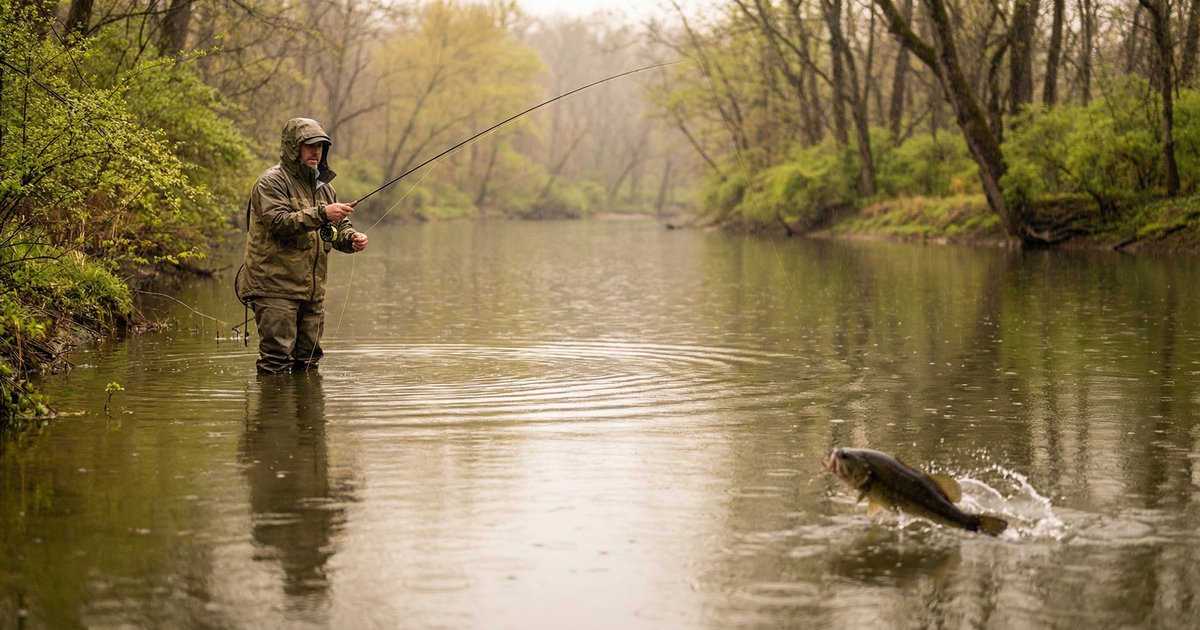
I fish in rain from my kayak regularly. But there are conditions I won't go out in, and warm spring rain can come with serious hazards that are easy to underestimate.
Watch for:
- Lightning. If there's any thunder in the forecast, stay off the water. Full stop. A kayak paddle is effectively a lightning rod, and open water gives you nowhere to shelter.
- Rising rivers. What starts as a fishable two-foot rise can become dangerous flooding within hours. Check gauge levels before you launch and monitor them throughout the trip if you're on moving water.
- Hypothermia risk. Even if air temps are in the 60s, water temps in the low 50s will incapacitate you fast if you capsize. Wear a PFD, keep a dry set of clothes in a dry bag, and always tell someone where you're going and when to expect you back.
- Wind on open water. Warm fronts can drag strong winds in behind them. On big reservoirs or exposed lakes, conditions can turn dangerous quickly.
Warm rain is exciting — but no fish is worth that risk. Dress for the water temperature, not the air temperature, wear your life jacket, and use common sense about when to call it.
Handling Fish Responsibly During the Pre-Spawn
One more thing worth saying clearly: this warm rain bite often coincides with pre-spawn and spawning bass. These are the fish that produce next year's population.
If you're catching bass during the spawn:
- Minimize handling time — aim for 30 seconds or less out of the water
- Wet your hands before touching fish to protect their slime coat
- Hold fish horizontally — vertical holds by the jaw stress the spine, especially on larger females
- Return fish to the exact spot where you caught them — displaced spawning fish often abandon their beds
- Consider barbless hooks during peak spawn — they release faster and cause less injury
The fishing this time of year is genuinely special. A little care goes a long way toward keeping it that way for the next angler who comes along.
Key Takeaways: Quick Reference for Your Next Trip
Before you head out, run through this checklist:
- [ ] Check the forecast — Look for warm rain with air temps running 10 or more degrees above current water temp
- [ ] Monitor barometric pressure — HookCast's weather tool shows pressure trends; the pre-front drop is your best fishing window
- [ ] Plan your timing — Pre-front and post-rain Day 2 morning are the peak windows
- [ ] Target the right water — Dark-bottom flats, riprap banks, creek mouths, and tributary inlets
- [ ] Start with reaction baits — Spinnerbaits and crankbaits first; slow down only if the bite stalls
- [ ] Match colors to visibility — Chartreuse and dark patterns in stained water; natural colors in clearer water
- [ ] Check stream gauges — USGS National Water Dashboard before any river trips
- [ ] Wear your PFD — Especially in cold water, no exceptions
- [ ] Handle fish carefully — Pre-spawn bass need to make it back to the beds
The first warm rain of spring is one of those rare windows where everything lines up at once — biology, water temperature, food availability, and raw fish aggression. Miss it and you'll be hearing about it for weeks. Catch it right and it's the kind of day you'll still be talking about at the boat ramp years later.
Get out there.
FAQ
Does rain actually help fishing in the spring?
Yes — specifically warm rain does. When rain falls through air that's significantly warmer than the lake surface, it raises water temperature in the shallows and triggers feeding behavior in bass, walleye, and other freshwater species. Warm rain also washes insects, worms, and organic matter into the water, creating easy feeding opportunities that fish respond to quickly. Cold rain in early spring has the opposite effect, often suppressing the bite by chilling already-cold surface water and slowing metabolism further.
What is the best time to fish before or after a spring rain?
The two best windows are the three to six hours before a warm front arrives — when barometric pressure is dropping and fish feed aggressively ahead of the system — and the morning of Day 2 after the rain, when shallow water has warmed significantly and fish are in full pre-spawn aggression mode. The period during the rain itself can also be productive in light to moderate rainfall, but heavy downpours often slow the bite temporarily until conditions stabilize.
What lures work best for bass fishing in warm spring rain?
Reaction baits excel during and after warm rain because fish are active and covering ground aggressively. Start with spinnerbaits in the 3/8 to 1/2 oz range — white or chartreuse in stained water — or a square-bill crankbait worked through 2 to 4 feet of water along shallow flats and riprap banks. If the water turns heavily stained and the bite slows, drop down to a Texas-rigged creature bait or a jig-and-craw fished slowly near cover and depth transitions.
How does barometric pressure affect spring fishing around rain events?
Barometric pressure directly influences fish behavior. As pressure drops ahead of an incoming warm front, fish often feed actively — this pre-storm window is consistently one of the best times to be on the water. During heavy rain, pressure can fluctuate. After a warm front passes and pressure stabilizes or begins rising again, fishing typically improves, especially as shallow water warms in the following day's sunshine. Standard atmospheric pressure is 1013.25 hPa, and even modest swings of 10 to 15 hPa can shift fish behavior noticeably.
Is it safe to fish from a kayak in the rain?
Light to moderate rain is generally manageable for kayak fishing with the right preparation — wear a PFD at all times, bring a dry bag with spare clothes, and keep a close eye on conditions. However, if there's any lightning in the forecast, get off the water immediately. On rivers, check USGS stream gauges before launching and watch for rapid rises that can make conditions dangerous fast. Even when air temps feel comfortable in the 60s, spring water temps in the 40s and 50s pose a serious hypothermia risk if you capsize, so cold-water safety gear is not optional — it's the price of admission.