Redfish on the Flats: Sight Fishing, Tide Timing, and Gold Spoon Tactics
The first time I ever watched a redfish tail, I completely blew it.
I was standing on the bow of a friend's skiff somewhere along the Louisiana marsh, heart hammering, gold spoon in hand — and I threw it right on top of the fish's head. The redfish bolted. My buddy didn't say a word. He just slowly shook his head like he'd seen it a hundred times before.
That was my introduction to sight fishing the flats, and honestly? I was hooked harder than the fish I'd just spooked. There's something about spotting a fish before you cast — watching it move, reading its behavior, making a presentation that requires real precision — that turns fishing into something closer to hunting. It's addictive in a way that sitting over a drop shot in 30 feet of water just isn't.
Since that first trip, I've made a point of getting down to the Gulf Coast every spring. I'm still a freshwater guy at heart — more comfortable in a kayak on an Ozark stream than poling a skiff — but redfish on the flats have a way of pulling you back. This guide is what I wish someone had handed me before that first humbling morning. Whether you're planning your first redfish trip or trying to figure out why you keep blowing shots at tailing fish, here's what actually matters.
Why Spring Is Prime Time for Redfish on the Flats
Spring is when the flats really come alive. Water temperatures along the Gulf Coast climb back into the mid-60s to low 70s°F range — right in the sweet spot for redfish to push up onto shallow flats and feed aggressively before the summer heat pushes them back into deeper, more oxygen-rich water.
Red drum (Sciaenops ocellatus) are opportunistic feeders that move seasonally based on water temperature and prey availability. In spring, both align perfectly on shallow grass flats, oyster bars, and sandy potholes across Florida, Texas, Louisiana, and the rest of the northern Gulf Coast.
A few things make spring specifically good:
- Baitfish are active. Mullet, menhaden, and fiddler crabs are moving shallow, and redfish follow.
- Water clarity is often at its best. Lower wind and less algae bloom than summer means you can actually see fish.
- Fish are feeding hard. Post-winter metabolism ramps up. Redfish aren't picky — they're stacking calories.
- Tailing fish become common. As water warms and fish push into super-shallow water to root for crabs and shrimp, you'll start seeing those iconic tails waving above the surface.
For anyone planning a Gulf Coast trip, pull up a fishing forecast for Tampa or your target area before you go. Spring weather can be variable — a cold front in March can shut down a flat that was on fire the day before.
Reading the Flats: Water, Structure, and Where Fish Actually Are
Before you ever think about presentation, you need to know where to look. The flats aren't uniform — there's a reason guides spend years learning specific systems.
Grass Flats and Potholes
Seagrass meadows are the foundation of the inshore food web. They hold crabs, shrimp, and small baitfish — which means they hold redfish. But not all grass is equal.
Look for potholes — sandy clearings within the grass. These are ambush points. A redfish will sit at the edge of a pothole, using the grass as cover, and dart out to eat anything that crosses the sandy bottom. When you're poling or paddling across a flat, potholes are where your eyes should be.
Oyster Bars and Shell Edges
Oyster bars are redfish magnets, especially on moving tides. The shells concentrate bait, the edges create current seams, and the structure gives fish somewhere to pin prey against. In my experience on the Gulf side of Florida, some of the most consistent redfish I've ever seen were stacked on submerged shell edges during the first two hours of a falling tide.
Drains and Cuts
When the tide starts dropping, water has to go somewhere. Tidal drains — small channels that cut through a flat and funnel water back to deeper areas — are where redfish stack up to ambush bait washing through. This is one of those spots where you don't have to find the fish. You just have to get there before the tide drops too far and wait.
Tide Timing: The Single Biggest Variable in Flat Fishing Success
I'll be direct about this: tide is the most important factor in redfish flat fishing. More than moon phase, more than bait selection, more than anything else — timing your wade or float around the tidal movement will make or break your day.
The Basics of Tidal Movement
Tides along the Gulf Coast are complex. The northern Gulf of Mexico experiences primarily diurnal tides (one high and one low per day) in some areas, while other regions see semi-diurnal patterns. This is different from the Atlantic Coast, and it affects how you plan your day.
NOAA's tidal predictions are the most accurate free tool available. Bookmark it. Use it. Cross-reference it with your specific launch point.
Before any redfish trip, I'm also checking tide charts for my area on HookCast to visualize the full tidal cycle for the day and see how it lines up with sunrise and solunar peaks. Having that information in one place before I launch saves real time.
When to Be on the Water
Incoming tide is often considered the best time to fish the flats, and for good reason. As water rises, redfish push up onto the flat to access areas that were dry or too shallow to access at low tide. They're actively moving and feeding, which means they're more aggressive and easier to find.
The last two hours of a falling tide can be just as productive. Redfish concentrate in deeper potholes, along edges, and in drains as water pulls off the flat. The fish are there — sometimes in numbers — and they're not going anywhere.
Dead low tide is the hardest time to fish the flats. The water is off. Fish have moved. Unless you know specific deeper holes or channels, this is a good time to eat lunch and study the flat for the next push.
Field note: One pattern I've noticed fishing around Tampa Bay and the Nature Coast — redfish push furthest into the shallowest backcountry grass on spring high tides that coincide with full or new moons. Those extreme high water events are when you find tailing fish literally in ankle-deep water. Be there for that window.
Barometric Pressure and Cold Fronts
Gulf Coast anglers who've been at it a while will tell you the same thing: the day before a cold front is usually spectacular, and the two days after can be rough. Barometric pressure (standard atmospheric pressure is 1013.25 hPa per NOAA) dropping ahead of a front triggers aggressive feeding. Once that front passes and pressure spikes, fish tend to go lockjaw on the flat.
Spring along the Gulf has a lot of frontal passages — sometimes every week in March and early April. Plan around them when you can.
Sight Fishing Basics: How to Spot and Approach Tailing Redfish
This is where the game gets fun, and also where most people struggle at first. Sight fishing is a skill. It takes time to develop, and there's no shortcut.
The Gear You Need to See Fish
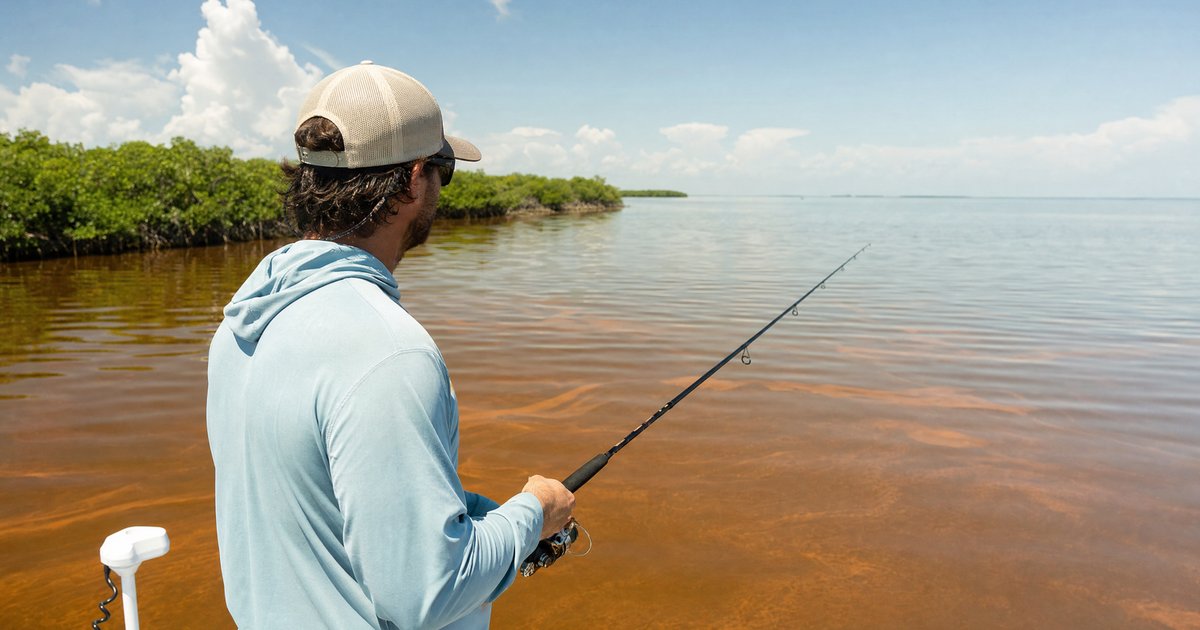
Polarized sunglasses are non-negotiable. Not just any polarized lens — quality matters. Amber or copper lenses are excellent in low-light conditions and for cutting through tannin-stained water. Gray lenses work better on bright days over clear water. I've fished with guys in $15 drug store glasses and watched them miss fish that were obvious to me. It's not vanity — it's a tool.
Elevated position helps. Standing on a kayak or the bow of a skiff puts your eyes higher and lets you see fish at distance before they detect you. Even a few extra feet of height dramatically improves your ability to spot subtle shapes and movement.
What You're Actually Looking For
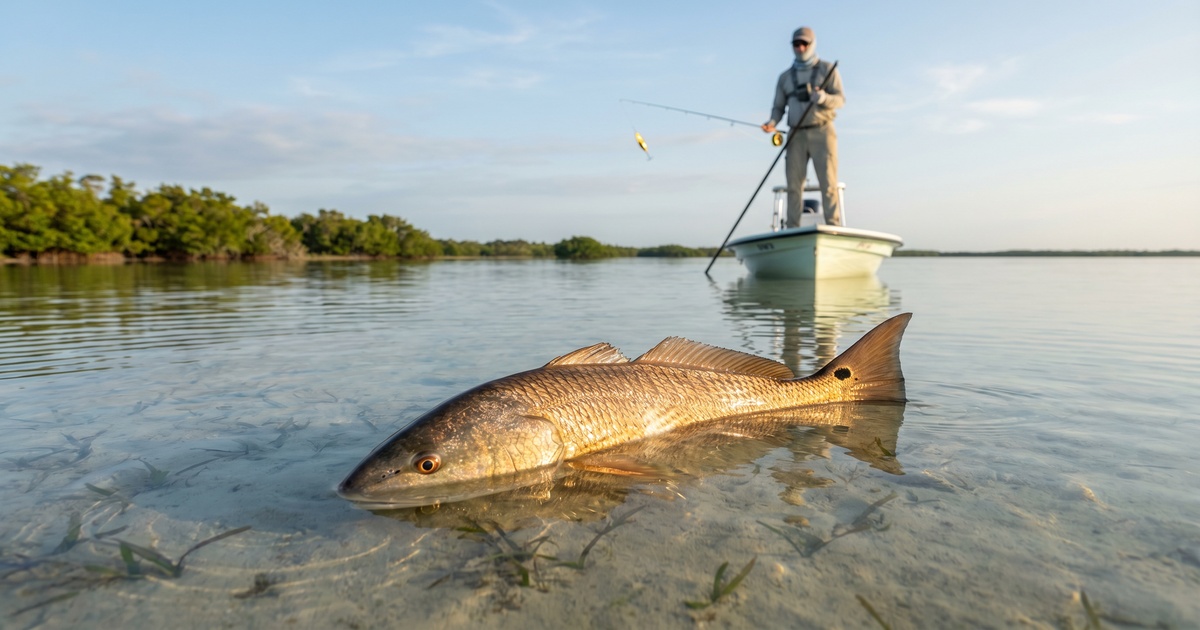
Tailing fish are the easiest to spot — that coppery tail waving above the surface while a fish roots in the mud or grass. But you won't always see tails. Other signs:
- Nervous water — a subtle ripple or push on an otherwise calm surface
- Mud puffs — cloudy, sediment-stirred water behind a rooting fish
- Wakes — a V-shaped disturbance moving across a flat
- Shapes — dark, elongated forms against a sandy bottom or in shallow water
Learn to look through the water, not at it. Your brain needs time to calibrate to what a fish looks like versus a stingray, a dark grass patch, or a shadow.
How to Approach Without Spooking Fish
In clear, shallow water, redfish spook easily. A few hard rules:
- Move slowly. Whether you're poling, paddling, or wading, slow down by at least half.
- Stay low. Crouch in the kayak. Fish in shallow water can see above the waterline — your silhouette against the sky is a threat signal.
- Watch the wind. Try to approach with the sun at your back (better visibility) and from a position where your shadow doesn't cross the fish.
- Wade carefully. If you're wading, shuffle your feet along the bottom to avoid crunching shell or kicking up sudden puffs. Move like you're trying not to wake someone up.
- Keep your distance. Most beginners get too close. A 40-foot cast to a tailing redfish in calm, shallow water is totally manageable. Fifty feet is even better.
Gold Spoon Tactics: Why This Lure Works and How to Fish It
If there's one lure synonymous with redfish on the flats, it's the gold spoon. There's a reason it's been in every serious inshore angler's box for decades — it flat-out catches fish.
Why Gold Spoons Work for Redfish
The wobbling, flashing action of a gold spoon mimics a distressed baitfish or a crab tumbling through the water column. The gold finish catches light even in murky conditions. And the profile is small enough to look natural but large enough to register as a meal worth chasing.
Classic options like the Johnson Silver Minnow in gold (weedless, great for grass) and the Nemire Red Ripper have stood the test of time. You don't need anything fancy. A 1/2 oz to 3/4 oz weedless gold spoon is the right tool for most flat conditions.
Presentation: The Cast and the Retrieve
Where you land the cast matters more than anything else. The cardinal rule of sight fishing:
- Cast 3 to 6 feet in front of the fish's path — not on top of it.
- Lead the fish. You want the lure to enter its field of view naturally, as if the baitfish was already there.
- For a tailing fish with its nose down in the mud, cast slightly to the side and let the spoon hit the water gently, then give it a twitch.
Retrieve: Let the spoon sink for a beat after it hits the water, then begin a slow to medium retrieve with occasional pauses. The wobble does the work. You don't need to rip it. When a redfish is following, slow down. When it turns away, one sharp pop often triggers a reaction strike.
Pro tip: In super-shallow water over grass, count the spoon down for just a second before your retrieve starts. If you're ticking grass constantly, you're too deep. If you're burning it at the surface without wobble, you're too fast. Find that middle zone where the spoon is riding just above the grass with a consistent, visible wobble — that's the money retrieve.
Other Proven Lures for Sight Fishing Redfish
Gold spoons are the go-to, but there are situations where other presentations shine:
| Lure Type | Best Conditions | Technique |
|---|---|---|
| Gold spoon (weedless) | Grass flats, stained water | Slow-medium steady retrieve |
| Weedless soft plastic (shrimp/crab) | Clear water, spooky fish | Dead drift, subtle twitch |
| Topwater (popper or walk-the-dog) | Low light, active feeding fish | Aggressive surface action |
| Weedless jig (1/4 oz) | Oyster bars, shell edges | Slow hop along bottom |
Regulations, Ethics, and Handling Redfish Properly
Redfish populations along the Gulf Coast have made a remarkable recovery over the past few decades thanks to strict management and a shift in angler culture. That comeback is worth protecting.
Always check current regulations before you fish. Size and bag limits vary by state — and sometimes by specific bay system. In Texas and Florida especially, regulations have changed over the years. Check your state fish and wildlife agency directly:
- Florida: Check FWC regulations
- Texas: Check Texas Parks & Wildlife
- Louisiana, Alabama, Mississippi: Verify with your respective state agency
Slot limits matter. Most Gulf states protect redfish with a slot limit — fish outside that slot (usually approximately 18–27 inches in Florida, for example) must be released. These regulations exist for a reason. The large breeders in the "overslot" category are critical to population health.
Proper handling for release:
- Wet your hands before touching the fish
- Keep the fish in the water as much as possible
- If you must hold it, support the body horizontally — don't lip-hang a heavy redfish vertically for extended periods
- Revive the fish in the water before releasing — hold it facing into any current until it swims away on its own
- On hot days especially, minimize air exposure
Redfish are resilient, but shallow flats in July heat can stress fish quickly. Spring fishing is generally lower stress, but the same care applies.
Quick-Reference Checklist: Redfish on the Flats
Before you go:
- [ ] Check tide chart (aim for incoming tide or last two hours of falling)
- [ ] Check barometric pressure trend — stable or rising after a front is tough
- [ ] Verify current state regulations and license
- [ ] Polarized sunglasses packed (amber/copper lens for most conditions)
- [ ] Gold spoon (weedless, 1/2 – 3/4 oz) in the box
- [ ] Backup soft plastics and topwater for clear water or spooky fish
On the water:
- [ ] Move slowly, stay low
- [ ] Look for tails, wakes, nervous water, mud puffs
- [ ] Lead the fish — cast 3–6 feet ahead of its direction of travel
- [ ] Let the spoon sink before starting retrieve
- [ ] Wet hands before handling any fish
Weather/conditions:
- [ ] Wind under 15 mph — essential for sight fishing
- [ ] Overcast days can be tougher for visibility (but fish are less spooked)
- [ ] Spring cold front? Fish hard the day before, give it time to recover after
FAQ
What tide is best for redfish sight fishing on the flats?
Incoming tide is generally the most productive time to sight fish for redfish on the flats. As water rises, redfish push up onto the shallow grass to feed, making them active, visible, and accessible. The last two hours of a falling tide can also concentrate fish along edges, drains, and potholes — sometimes in large numbers. Dead low tide is typically the hardest window to work.
Why is a gold spoon so effective for redfish?
A gold spoon's wobbling action mimics a fleeing baitfish or tumbling crab, both of which are primary redfish prey. The gold finish reflects light effectively even in slightly murky water, and a weedless design lets you fish it through grass without constant hang-ups. The retrieve is forgiving — a slow, steady retrieve with occasional pauses is usually all you need to trigger strikes.
How do I approach tailing redfish without spooking them?
Move very slowly and stay as low as possible. Cast 3 to 6 feet ahead of the fish's path rather than directly at it, and keep your shadow off the fish. In clear, shallow water, redfish have excellent vision and can detect movement and silhouettes above the waterline. Most beginners get too close — a 40 to 50-foot cast is well within range and keeps you at a safe distance from spooky fish.
What's the best time of year to sight fish for redfish?
Spring is widely considered the prime season for redfish sight fishing on Gulf Coast flats. Water temperatures in the mid-60s to low 70s°F trigger aggressive feeding, water clarity is typically at its best, and fish push shallow to feed on crabs and baitfish. Fall is another excellent window. Summer can produce but heat can stress fish and complicate catch-and-release ethics.
Do I need a boat to sight fish redfish on the flats?
No — a kayak or even wading access can get you into quality redfish territory. A kayak is actually ideal for many shallow flat situations because it draws very little water and makes less noise than a motor-powered boat. Wade fishing is extremely effective and gets you as close to the fish's level as possible. The key tools are polarized sunglasses, a weedless lure, and the patience to move slowly and quietly.