Smallmouth Bass in Spring Rivers: Current Seams, Rock Ledges, and Pre-Spawn Staging
My thermometer read 48°F when I slid my kayak into the Meramec River on an April morning. Too cold for most anglers to bother. But I'd checked the fishing forecast for St. Louis the night before and spotted a three-day warming trend with steady barometric pressure — exactly the kind of window that gets pre-spawn smallmouth moving and feeding aggressively after a long winter of lockdown.
By 10 a.m., I'd landed four fish between 15 and 19 inches, every one of them taken off a single rock ledge at the downstream edge of a mid-river riffle. I never moved the kayak more than 40 yards.
That's the essential truth about spring river smallmouth. You don't need to cover water. You need to find the water — that specific seam, ledge, or staging pocket where fish stack up before the spawn — and then work it with discipline. This guide is about how to do exactly that.
Why Spring River Smallmouth Play by Different Rules
Most spring bass content defaults to "pre-spawn equals shallow flats and staging docks." Fair enough for reservoir largemouth. River smallmouth don't read that content.
River fish operate on current, structure, and temperature in ways that lake fish simply never have to navigate. In spring specifically, they're contending with:
- Fluctuating water levels driven by snowmelt and rain events
- Variable temperatures that can swing 10°F in 48 hours depending on flow rate and cloud cover
- Silt and turbidity pushing fish off their usual haunts after high water
- Pre-spawn instincts governed more by water temperature than calendar date
NOAA Fisheries research on black bass behavior confirms what river anglers have known for generations: smallmouth begin moving toward spawning areas when water temperatures consistently reach 55–60°F, with actual spawning occurring between 60–65°F. That word "consistently" carries all the weight. River temperatures are notoriously unstable in spring. A cold rain can drop a stream 8°F overnight. A sunny 70-degree afternoon can push it right back up by the next day.
That instability is precisely why pre-spawn staging lasts longer in rivers than in lakes — and why knowing where fish retreat during cold snaps is half the battle before you even pick up a rod.
Reading River Structure: Where Smallmouth Actually Hold
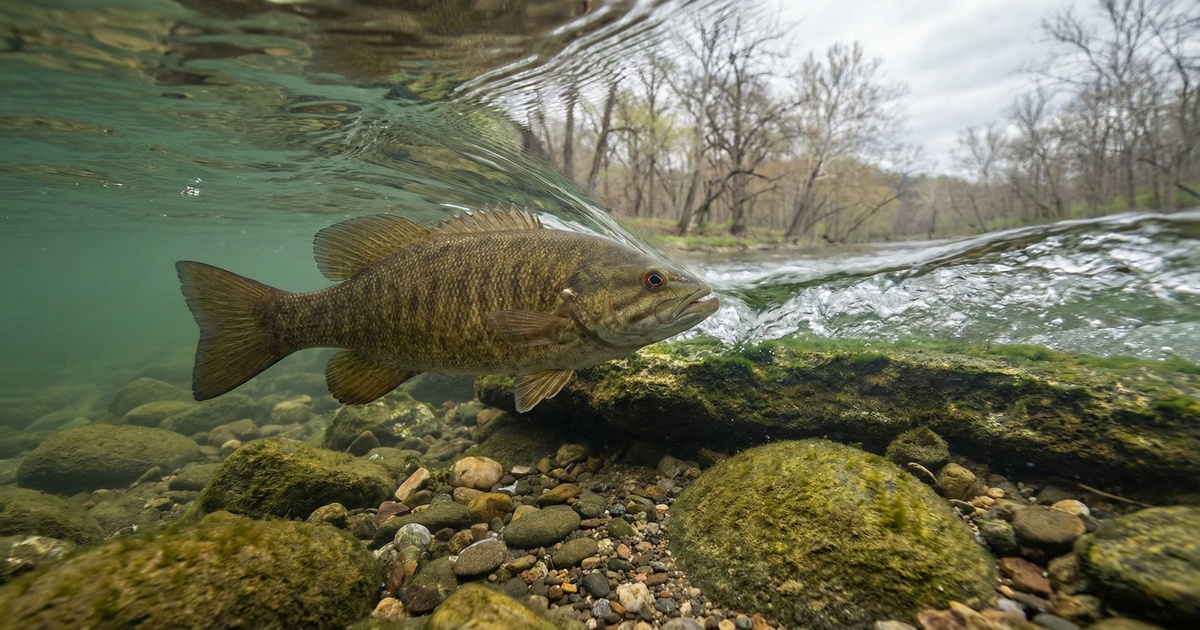
Eight years of kayak fishing Ozark and Midwest rivers has taught me one thing above everything else: smallmouth don't distribute randomly in current. They use specific features to conserve energy, ambush prey, and find thermally stable water. Learn those features and you stop burning miles of empty river.
Current Seams — The Primary Feeding Lane
A current seam is the transition zone where fast water meets slow water. On rivers, seams form on the downstream edges of points, boulders, bridge pilings, log jams, and islands. Fast water carries food. Slow water lets fish hold without burning energy. Smallmouth park right on that boundary and intercept whatever the current delivers.
The visible indicator is a line of disturbed surface water — foam, floating debris, a subtle surface crease — running downstream from an obstruction. Where you see that line, there's almost always a seam beneath it.
The most productive seams in spring are often subtler than you'd expect. Not dramatic whitewater, but a slight current break behind a submerged boulder, or the inside edge of a bend where water decelerates before sweeping back into the main channel. We're talking 6 inches of hydraulic relief — enough that a fish can sit facing into the current all day without fighting it, intercepting crawfish and baitfish as they wash through.
Field observation: In my experience, the first warm week of April on Ozark rivers almost always finds smallmouth stacked at the downstream end of seams rather than the sides. They're oriented up-current, and a jig drifted naturally into that zone will absolutely get eaten.
Rock Ledges — The Staging Headquarters
If current seams are feeding lanes, rock ledges are the staging headquarters. River smallmouth use ledges — particularly those running perpendicular to current or at a slight angle — as their pre-spawn holding structure. These underwater shelves, drop-offs, and flat rock formations let fish suspend in the water column to feed without fully committing to the shallow spawning areas they'll eventually move to.
On rivers I've fished across Missouri, southern Indiana, and Ohio, the best spring ledge fishing consistently falls in the 4–8 foot range. Deep enough that a cold front won't scatter fish entirely, shallow enough that a warming trend activates them quickly.
Features worth targeting:
- Flat bedrock shelves that step down into a deeper channel
- Large boulders with flat tops that create a protected "living room" on the downstream face
- Riprap banks where angular rock meets depth, common on regulated rivers
- Exposed limestone or shale ledges that absorb heat quickly in direct sunlight
USGS stream gauge data earns its keep here beyond just checking flow levels — understanding the underlying geology of a river stretch tells you what kind of structure to expect. Karst limestone country, which covers much of the Ozarks, Kentucky, and the Appalachian drainages of the Mid-Atlantic, produces exactly the ledge structure smallmouth are built to exploit.
Inside River Bends — The Overlooked Pre-Spawn Bank
Everyone fishes the outside of river bends where current scours depth and undercuts banks. The inside bend gets ignored because it's shallow and unimpressive-looking. In early spring, that ignored water is often where the fish are.
Inside bends accumulate gravel and sand, and that substrate warms faster than deep water when the sun angle is right. Pre-spawn smallmouth — especially heavy females loading up before the spawn — gravitate to these warming zones on sunny afternoons. They're not there at 7 a.m. They arrive around 11 and stay through mid-afternoon when solar input is at its peak.
Don't burn past inside bends on your float. Slow down, work parallel to the bank, and keep your presentation in the 2–4 foot zone along the gravel edge.
How Water Conditions Shape the Pre-Spawn Window
Here's why anglers get skunked on spring river trips they've been planning for weeks: they ignore water conditions. River smallmouth respond more strongly to current flow, clarity, and temperature swings than most anglers give them credit for.
Flow Rate and Clarity
A river running 150% of normal flow means turbid, fast-moving water that shoves fish into eddies and off the main channel entirely. I've launched into those conditions and done reasonably well — but not by fishing the main river. Success came from targeting backwater pockets, tributary mouths, and far inside-bend edges where dirty water doesn't fully penetrate.
Clarity is a significant factor. Smallmouth are meaningful sight-predators. When visibility drops below 12 inches, they're at a disadvantage and feeding efficiency drops. You can compensate with darker lure colors, rattling baits, and slower presentations — but the best spring river fishing consistently happens when you have 2 or more feet of visibility.
A pre-trip check on USGS streamflow gauges can save a two-hour drive. If the river is running above 150% of median discharge for the date, seriously consider waiting.
Barometric Pressure and Cold Fronts
Cold fronts do real damage to spring river smallmouth fishing. Not because fish stop eating completely, but because the sharp pressure drop followed by high pressure and clearing skies pushes fish deep and inactive for 24–48 hours.
The best pre-spawn fishing I've experienced has come in the 12–24 hour window before a front arrives — when pressure is falling, conditions are deteriorating, but the water is still warm from the previous days. Fish feed aggressively in that window. Check the pressure trend on HookCast before you launch. Steady or gradually rising pressure with no major fronts in the next 24 hours is your green light.
Water Temperature Benchmarks
| Water Temp | Smallmouth Behavior | Best Tactics |
|---|---|---|
| Below 45°F | Lethargic, deep holding | Drop shots, slow finesse presentations |
| 45–50°F | Slightly active, opportunistic | Ned rigs, grubs fished very slowly |
| 50–55°F | Pre-spawn movement begins | Jigs, tube baits, slow swimbaits |
| 55–60°F | Active feeding, staging on structure | Full lure menu opens up |
| 60–65°F | Spawning begins, territorially aggressive | Reaction baits, topwater starts producing |
Lures and Presentations for Spring River Smallmouth
I'm not a gear snob. I've caught fish on $2 tubes from a discount shelf and on premium $15 swimbaits. What actually matters is matching the presentation to current conditions and the fish's activity level. Here's what I fish, in order of confidence.
Tube Baits and Grubs — The River Smallmouth Standard
A 3.5–4 inch tube bait on a 3/16 to 3/8 oz jighead is the closest thing to a universal river smallmouth lure. It mimics a crawfish convincingly, handles multiple retrieves — drag, hop, swim — and remains effective in cold water when larger profiles get ignored.
In early spring when temperatures sit between 48–54°F, I'm fishing tube on 8–10 lb fluorocarbon, crawling it deliberately across rock ledges with 3–5 second pauses between movements. Most strikes come on the pause.
Colors that have consistently produced on Midwest rivers:
- Green pumpkin — clear to lightly stained water
- Smoke with silver flake — clear water, bright sun
- Brown/orange — off-color or stained conditions
- White — overcast skies, swimmy presentation
Ned Rig — Cold Water Specialist
When temperatures drop below 50°F and fish are locked tight, the Ned rig — a small mushroom-head jig (1/15 to 1/6 oz) paired with a 2.5–3 inch buoyant stick bait — is my first choice. The bait stands tail-up on the bottom between hops, which seems to trigger fish that simply won't commit to anything else.
Fish it along the bottom of ledges and the downstream edges of seams on 6–8 lb fluorocarbon with a light spinning rod. Slow down until it feels uncomfortably slow, then slow down again. It's finesse fishing in cold current, and it's quietly deadly.
Jigs — The Pre-Spawn Big Fish Bait
Once temperatures reach 54–58°F and fish are actively staging, a 3/8 oz football jig or casting jig with a craw trailer becomes my primary search tool. Make 3–5 casts across each piece of structure before moving. Jigs catch bigger fish on average, and in the pre-spawn window, the heaviest females are feeding heavily and holding on the best structure.
Work the upstream face of ledges, let the jig fall into the deeper water below, and pause longer than feels productive.
Swimbaits — Mid-Morning Movement Bait
When fish are breaking the surface or holding higher in the water column, a 3–4 inch paddle-tail swimbait on a 1/8 to 1/4 oz head covers that situation well. Swim it across current seams at mid-depth and vary retrieve speed until you find what they want.
In the pre-spawn window, I've had swimbait sessions that outpaced everything else — particularly on warmer afternoons when fish push up to feed actively rather than waiting for food to come to them.
Kayak-Specific Tactics for River Smallmouth
Kayaking rivers for smallmouth is one of the best things I do with my time on the water. The access is unmatched — water that boat ramps don't reach, a low profile that doesn't spook fish in clear shallows. But it requires adapting your approach to manage current effectively.
Managing Current While Fishing Structure
The most common mistake I see kayak anglers make on rivers: drifting too fast. You paddle to a promising ledge, make three casts, and you're already 30 yards downstream. That ledge might hold 10 fish.
Use a kayak anchor system to hold position on quality structure. I run a simple 4 lb folding anchor with a quick-release cleat — enough to hold on most moderate current. Where anchoring isn't practical in fast water, ferry your kayak with correction strokes to stay broadside to the current and extend your time on the target zone.
In shallower riffles and runs, I'll step out entirely and wade while keeping the kayak on a short leash. Better boat control, quieter presentation, and you can work downstream structure far more thoroughly than you can from a drifting seat.
Reading the River from the Seat
From a kayak you're low on the water, which helps with stealth but costs you sightlines to read surface features at distance. Keep polarized sunglasses on constantly — copper or amber lenses for overcast and stained conditions, gray for bright sun — and scan ahead rather than just focusing on your immediate target zone.
Look for:
- Water color changes indicating depth transitions
- Foam lines tracing current seams
- Boulders breaking the surface or creating visible downstream wakes
- Bank features that mirror what's underneath — a rock outcropping on shore often continues as a ledge below the waterline
Safety note: Spring river conditions mean elevated flows, colder water, and more floating debris than summer trips. Wear your PFD on moving water without exception. Cold water shock from even a brief swim in 50°F water is a genuine hazard. Check the USGS gauge before you launch, understand what the flow numbers mean for the specific river, and know your exit points before you put in.
Float-and-Fish vs. Park-and-Work
Two approaches are worth understanding: the float-and-fish strategy, where you cover 4–8 miles hitting obvious structure as you encounter it, versus the park-and-work strategy, where you anchor near high-probability structure and pick it apart methodically.
In the pre-spawn window when water sits between 52–60°F, I almost always favor park-and-work. Fish are bunched on specific staging areas. Finding a single good ledge or seam and working it thoroughly will regularly outperform covering miles of water that looks similar but holds far fewer fish.
Once water temperatures push above 60°F, fish scatter toward shallower spawning zones and the float-and-fish approach becomes more efficient.
Handling and Ethics During Pre-Spawn
Pre-spawn smallmouth are at their most physiologically vulnerable. Females are heavy with eggs. Post-release survival rates decline when fish are stressed in cold water. A few practices make a real difference:
- Barbless hooks reduce handling time and tissue damage significantly. I fish barbless on almost all finesse presentations now, and it costs me very few fish.
- Keep fish in the water as much as possible. Wet your hands before contact.
- Hold larger fish horizontally rather than vertically by the jaw — horizontal support prevents strain on internal organs and the swim bladder.
- Release fish in a calm eddy, oriented upstream, and hold them steady until they swim off under their own power rather than simply when you release your grip.
Check your state fishing regulations before every trip. Several Mid-Atlantic and Midwest rivers carry seasonal smallmouth closures or slot limits specifically timed to protect fish during the pre-spawn and spawn window. Fishing a closed section isn't just illegal — it undermines the conservation work that sustains the fishery for everyone fishing it now and in the future.
Spring River Smallmouth: Quick-Reference Checklist
Before You Go:
- [ ] Check USGS stream gauge — flows within 130% of median discharge preferred
- [ ] Check barometric pressure trend on HookCast — stable or gradually rising is ideal
- [ ] Verify water temperature if possible — 50–60°F is the productive pre-spawn window
- [ ] Confirm regulations for that specific river and county
On the Water:
- [ ] Polarized glasses on — read the water ahead constantly
- [ ] Anchor or wade to work structure thoroughly rather than drifting past it
- [ ] Start deep and slow in cold water (Ned rig, tube); transition to jigs and swimbaits as temperature rises through the day
- [ ] Prioritize downstream current seams, perpendicular rock ledges, and inside bends during peak afternoon sun
- [ ] Be patient with the 11 a.m.–2 p.m. solar window, especially early in the season
Handling:
- [ ] Wet hands before touching any fish
- [ ] Horizontal support on larger females
- [ ] Hold fish in calm, upstream-facing position until full recovery
- [ ] Keep photo time under 30 seconds and fish back in water immediately
FAQ
When do smallmouth bass start biting in rivers in spring?
River smallmouth become consistently active when water temperatures reach 50–55°F, with the best pre-spawn feeding window falling between 55–60°F. Depending on the watershed and the year, this typically occurs between late March and early May across the Midwest and Mid-Atlantic. Because river temperatures fluctuate more dramatically than lake temperatures, a warming trend of just 2–3 days can trigger significant feeding activity even if the season seems early by calendar standards.
What are the best lures for spring river smallmouth bass?
Tube baits and Ned rigs are the most reliable producers in colder water below 55°F. As water warms toward 58–60°F, football jigs with craw trailers and 3–4 inch paddle-tail swimbaits become increasingly effective. Match your jighead weight to the current — heavier in faster water, lighter in slow pools and eddies — and retrieve slower than feels natural until the water temperature tells you otherwise.
How does river current affect smallmouth bass fishing in spring?
Smallmouth exploit current by holding in eddies and behind structure where they can ambush food without fighting the flow. In spring, the most productive areas are current seams where fast water meets slow, the downstream faces of rock ledges, and the inside edges of river bends where water decelerates. Fishing success drops sharply when rivers run above 150% of normal flow due to reduced water clarity and fish being pushed into tight, difficult-to-reach holding positions.
Is it ethical to fish for smallmouth bass during the pre-spawn?
Pre-spawn smallmouth fishing is generally both ethical and legal, but it comes with genuine responsibility. Fish are more physiologically stressed during this period, so minimize handling time, maintain horizontal support on larger fish, and release them in calm water facing into the current. Some Mid-Atlantic and Midwest rivers carry seasonal regulations specifically protecting smallmouth during the spawn window, so always verify local rules before your trip. Barbless hooks and proper release technique measurably improve post-release survival rates.
How do I find smallmouth bass staging areas in a river I've never fished before?
Start with satellite imagery — Google Earth and onX Maps both reveal rock ledges, mid-river boulders, and changes in channel width that correspond to quality structure. Review USGS stream gauge data to understand the river's typical flow patterns and underlying geology. On the water, look for foam lines indicating current seams, color changes showing depth transitions, and boulders breaking the surface or creating visible wakes. In spring, concentrate on areas where deeper water (5–8 feet) transitions to moderate depth (2–4 feet) near stable bottom structure such as bedrock shelves or large consolidated rock.