Reading Tidal Current for Inshore Fishing: Eddies, Rips & Structure
My first saltwater trip nearly broke me.
I'd grown up fishing Missouri rivers, so I figured current was current. Then I stood on a grass bank near Beaufort, North Carolina for three hours — flounder and redfish supposedly everywhere — and caught exactly nothing. A retired shrimper watching from a nearby dock finally took pity on me.
"Son," he said, "the water's been slack for an hour. Give it twenty minutes and everything changes."
He was right. The moment the tide started moving again, reds materialized along that same edge like someone had flipped a switch. Same bank. Same lure. Different water.
That afternoon rewired how I think about inshore fishing. Tidal current isn't a background condition — it's the whole game. And most freshwater anglers who try saltwater for the first time walk right past it.
Here's what years of watching the water have taught me.
Why Tidal Current Matters More Than Tide Stage
Most anglers check the tide and stop there. High tide, low tide — noted. But tide stage (where the water level sits) matters a lot less than tidal current (whether and how fast the water is actually moving).
Fish don't care if it's high tide. They care what the water is doing with baitfish, oxygen, and temperature.
When tidal current runs, it does three things that matter to gamefish:
- Moves prey — shrimp, glass minnows, and crabs get swept along and pile up at predictable ambush points
- Oxygenates the water — moving water carries more dissolved oxygen than stagnant water, and fish metabolism follows
- Creates temperature edges — incoming ocean water and outgoing estuary water have different temperatures, and predators work those edges
NOAA Fisheries describes estuarine species like redfish, flounder, and speckled trout as highly opportunistic feeders that concentrate where tidal flow delivers prey to predictable locations. That's your whole fishing strategy in one sentence.
The windows that matter most are the first two hours of an incoming tide and the first two hours of outgoing — when current is accelerating and fish are actively feeding. Slack tide, the brief flat between tidal phases, is typically the slowest bite of the day.
Field observation: In my experience, the last hour before a tide change and the first hour after it — especially at the mouth of a tidal creek — produces more fish than any other window. Bait movement compresses right at that transition, and the predators know it.
Understanding Eddies: The Slack-Water Ambush Zones
An eddy is a pocket of slack or reverse-moving water that forms behind an obstruction in the current. Freshwater anglers know them from rivers — the calm water behind a boulder, the slow backswirl on the inside of a bend. Tidal systems work the same way, just at a larger scale.
Where Eddies Form Inshore
In tidal environments, look for eddies behind:
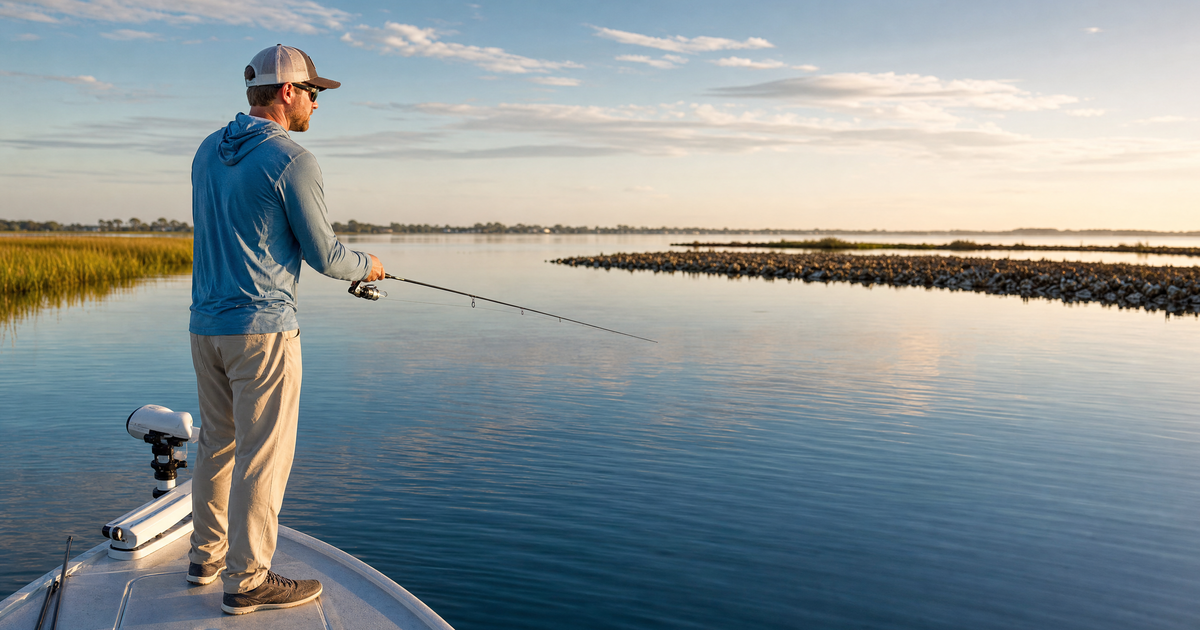
- Oyster bars and shell rakes — hard structure breaks the current and creates a calmer zone on the downstream side
- Dock pilings and bridge supports — a single piling creates a small eddy; a bridge creates a fishable current seam across its entire span
- Points of marsh grass — the trailing edge of a grass point extending into a tidal creek almost always holds an eddy
- Bends in tidal creeks — water moves faster on the outside of a bend and slower — sometimes reversing — on the inside
How Fish Use Eddies
Gamefish are ambush predators, not marathon runners. They don't want to fight current all day. They want to sit in slow water and dart into fast water to grab something being swept past.
Think of an eddy as a conveyor belt to a food court. Baitfish stream along the main current seam, and the redfish or trout holding in the adjacent slack just has to lunge forward, grab one, and drift back into position.
How to fish an eddy:
- Position yourself upcurrent and cast so your lure swings through the current seam right at the eddy's edge
- Let soft plastics and shrimp imitations sink and dead-drift through the transition zone — that seam between fast and slow water is where the strikes happen
- For topwater, walk a plug slowly along the current seam; the calmer water of the eddy makes your presentation more visible to fish holding in the slack
Pro tip: When fishing dock pilings in moving water, always hit the downcurrent side first. That's where the eddy forms and where fish stack. The upcurrent side is where baitfish approach from — not where predators hold.
Fishing Tidal Rips: Where the Current Does the Work
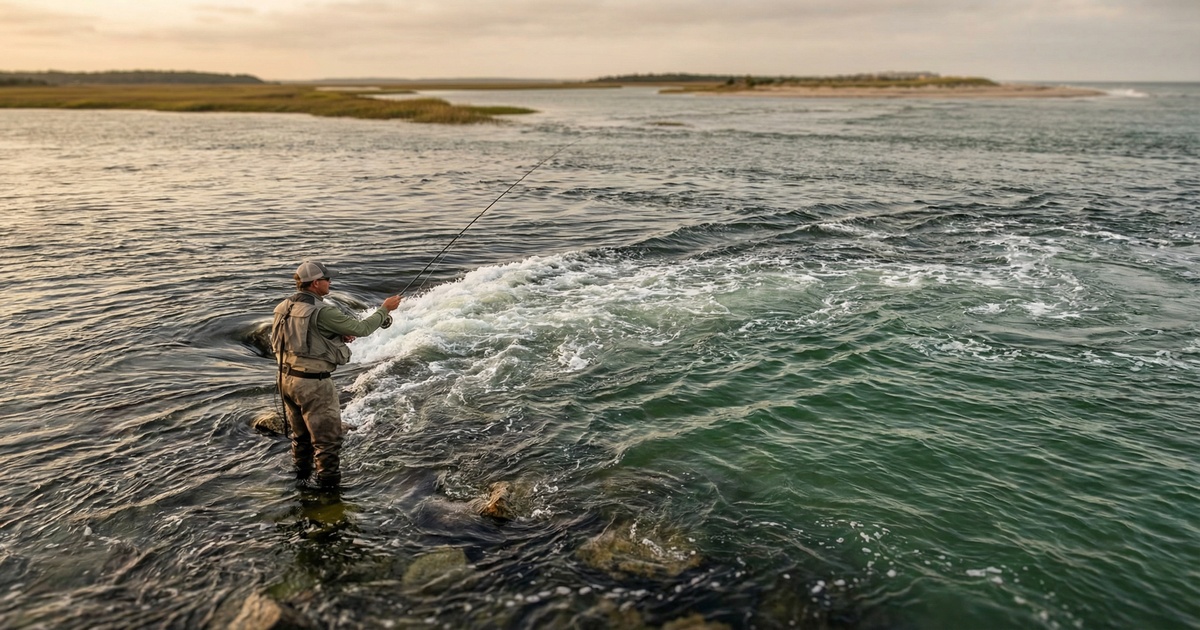
A tidal rip is a line of turbulence where two bodies of water moving at different speeds collide. You can see it on the surface — choppy, irregular water, often with a visible color change or a foam line running across open water. If you've ever noticed a streak of bubbles or debris cutting across an otherwise flat surface, you were probably looking at a rip or the edge of one.
Rips concentrate everything: bait, debris, temperature breaks. Predators park on the calmer side and pick off whatever the turbulence delivers to them.
Types of Tidal Rips to Look For
Channel-edge rips: Where a tidal creek or inlet channel carries strong current, the edge where deep moving water meets a shallow flat creates a rip line. Redfish and flounder hold on the flat just outside the main flow — close enough to eat, far enough to rest.
Inlet rips: The mouths of inlets get chaotic during strong tidal exchange, but the rip lines flanking the main current are consistently productive. Spanish mackerel, bluefish, and ladyfish work these hard during peak flow.
Submerged bar rips: A shallow shoal or bar beneath the surface forces water upward, creating surface turbulence and pushing bait up where it's visible. Diving birds are often the giveaway before you ever see the rip itself.
Reading a Rip Line Before You Cast
Before making a cast, idle or paddle along the rip and observe:
- Which way is current running? You want your lure moving with or across the current — not straight into it
- Is there visible bait? Glass minnows flickering at the surface, jumping mullet, or nervous water all tell you fish are already there
- Where's the calmer side? Fish the slack-water edge of the rip, not the turbulent center
Lure presentation in rips:
- Cast upcurrent and let your lure swing through the rip naturally — let the water do the work
- Heavy jigs (3/8 to 3/4 oz) hold position better than lighter ones in fast current; bucktail jigs and blade baits are classics for this reason
- For surface feeders working a rip, match the speed of fleeing baitfish — a fast-retrieved popper or walking bait can trigger explosive strikes
Structure + Current = Your GPS for Finding Fish
Current alone doesn't guarantee fish. The most productive spots are where current and structure intersect. Structure breaks current, creates eddies and seams, and gives fish a fixed reference point to hold and ambush from.
The Key Structures in Tidal Systems
Oyster bars: Arguably the most important inshore structure in the Southeast. Live oyster bars harbor enormous populations of crabs, shrimp, and small fish. When current sweeps over them, that forage gets dislodged and carried downcurrent — and gamefish stack on the downtide edge to intercept it. NOAA Sea Grant identifies oyster reefs as among the most productive estuarine habitats in North America, which explains why redfish, trout, and flounder treat them like a buffet.
Bridge and causeway pilings: Beyond the eddies they create, pilings build microhabitats. Barnacles and mussels colonize the concrete, drawing small fish, which draw larger fish. During current, each piling is a potential fish station. Work the downcurrent side during strong flow; fish tight to the structure during slack.
Drain holes and culverts: The most underrated tidal structure in inshore fishing. When a marsh drains through a culvert or a natural cut, it pushes a concentrated stream of baitfish, crabs, and shrimp into a larger body of water. Redfish and trout often stack right at the mouth of these drains, especially on a falling tide. The best ones are small enough to walk past — use your chart plotter and look for channels connecting to marsh ponds behind the main creek system.
Grass flat edges: The drop where a shallow grass flat meets deeper water is a current seam in waiting. Fish cruise these edges with the tide — pushing shallow on the rise to eat exposed crabs and shrimp, then retreating to the drop as water falls.
| Structure Type | Best Tidal Phase | Target Species | Presentation |
|---|---|---|---|
| Oyster bar (downtide edge) | Incoming or outgoing | Redfish, flounder | Soft plastic, Gulp shrimp |
| Bridge pilings | Any moving water | Trout, sheepshead | Jig, live shrimp |
| Marsh drain or culvert | Falling tide | Redfish, trout | Popping cork, soft plastic |
| Grass flat edge | Rising tide | Redfish, trout | Weedless soft plastic |
| Channel bend | Outgoing | Flounder, snook | Slow-rolled jig |
Incoming vs. Outgoing: Choosing Your Spots
These two phases fish completely differently. Knowing which structure to target during each will save you hours of unproductive water.
Incoming tide:
Water pushes back into the marsh, warming and oxygenating shallow flats. Redfish and trout move shallow to follow the tide. Work the grass edges and oyster bars that are just beginning to cover up. Current runs hardest through inlet channels and creek mouths during the early incoming phase — start there, then follow the fish shallow as the flat fills.
Outgoing tide:
Water drains out of the marsh and concentrates baitfish in creek channels and at drain points. Bait has nowhere to go — it gets funneled toward the exits, and predators position themselves at every one of them. Work the downcurrent side of any structure at the mouth of a draining creek or flat. This phase is often brutally productive.
Field observation: Outgoing tide during a spring tide cycle — around new and full moons — can produce some of the fastest inshore action I've ever seen. When the marsh really empties, fish stack at the exits and they're competing. You don't have to work very hard.
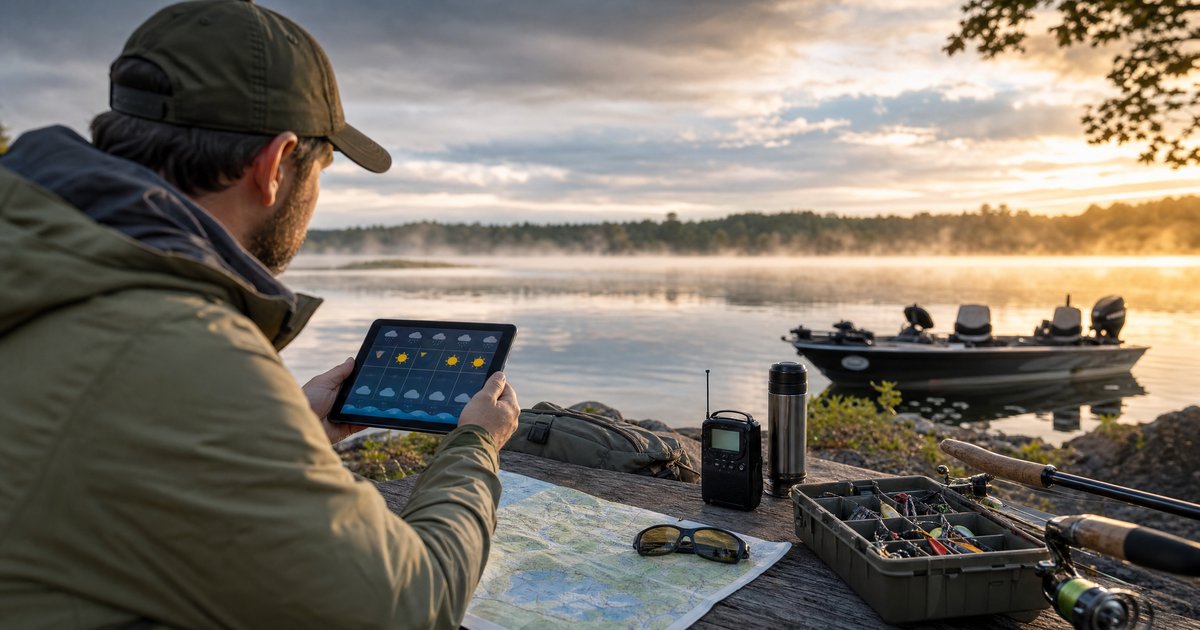
Before any inshore trip, I check tide charts on HookCast alongside the solunar data. Matching a strong feeding period to a moving tide phase is the closest thing to a guaranteed bite window I've found.
Current Speed, Barometric Pressure & When to Adjust
Not all moving water fishes the same. Current speed matters almost as much as current direction.
Moderate current — not ripping, not dead — is usually the sweet spot. Fast enough to push bait, slow enough for predators to hold position without burning energy. During extreme current, fish often retreat to slack zones and wait it out. During very slow current, they may not be feeding at all.
Barometric pressure compounds the tidal effect. A stable or slowly rising barometer during moving water is the best combination you can find inshore. A rapid pressure drop — typically preceding a cold front — can shut down feeding even during a textbook tidal phase.
NOAA Tides and Currents provides current speed data alongside height predictions for major stations, which is more useful than tide height alone. Standard atmospheric pressure is 1013.25 hPa; a reading falling quickly below 1005 hPa is worth factoring into your expectations before you launch. I check barometric pressure on HookCast before every trip — it explains a lot of the "should have been good but wasn't" days.
Adjusting Your Approach in Slow Current
When the current isn't cooperating:
- Downsize your presentation — smaller, subtler lures outperform big reaction baits in slack water
- Slow your retrieve way down — fish aren't chasing anything, so make it effortless for them
- Target shade and depth — fish retreat to deeper water or shaded structure during slack, especially in summer
- Wait it out — seriously, get a sandwich. The bite often turns on within thirty minutes of a tide change, and being in position matters more than grinding unproductive water
Quick-Reference Checklist: Reading Tidal Current
Use this before your next inshore trip.
Before you launch:
- [ ] Check when current starts moving — target the first two hours of incoming or outgoing
- [ ] Pull tidal current speed at the nearest NOAA station
- [ ] Check barometric pressure trend — stable or rising is best
- [ ] Identify three to five structure spots that match that tide phase
- [ ] Align your tide window with a solunar feeding period if possible
On the water:
- [ ] Read surface current before casting — look for foam lines, rip lines, and moving debris
- [ ] Position upcurrent of your target, present downcurrent
- [ ] Fish the downcurrent side of all hard structure first
- [ ] Watch for birds, nervous water, or jumping baitfish near rip lines
- [ ] When the bite slows, note the time — slack may be approaching
If you're getting skunked:
- [ ] Is the water actually moving? If not, how long until the next tide change?
- [ ] Are you fishing the wrong side of the structure for the current direction?
- [ ] Has barometric pressure dropped significantly in the last twelve hours?
- [ ] Do you need to downsize your presentation or slow your retrieve?
The biggest shift in my inshore fishing happened when I stopped asking where to fish and started asking when a specific spot would actually fish well. Current is the clock. Learn to read it, and the fish start making a lot more sense.
FAQ
What is tidal current fishing and how is it different from fishing the tide?
Tidal current fishing focuses on the movement of water — how fast it's flowing, in which direction, and how it interacts with structure — rather than simply whether the tide is high or low. Tide stage tells you how much water is present; current tells you whether fish are actively feeding and where bait is being pushed. Moving water concentrates prey and triggers feeding behavior in gamefish like redfish, trout, and flounder, making current phase the more important variable for inshore anglers.
What are tidal eddies and why do fish hold in them?
A tidal eddy is a pocket of slack or reverse-flowing water that forms on the downstream side of an obstruction — an oyster bar, dock piling, or grass point — in a moving tidal current. Fish use eddies as ambush stations because they can hold in calm water with minimal energy expenditure and dart into the adjacent fast water to intercept baitfish or crustaceans being swept past. The most productive zone is the seam where eddy meets current, not the dead center of the slack pocket.
When is the best time to fish tidal current inshore?
The most productive windows are generally the first one to two hours of an incoming tide and the first one to two hours of an outgoing tide, when current is accelerating and bait movement peaks. Slack tide tends to be the slowest part of the day. For maximum results, align a moving tide phase with a solunar feeding period and a stable or slowly rising barometric pressure.
How do tidal rips form and how should I fish them?
Tidal rips form where two bodies of water moving at different speeds collide, creating visible surface turbulence — choppy water, color changes, or foam lines. They occur most reliably at inlet mouths, along channel edges where deep moving water meets shallow flats, and over submerged bars. To fish a rip, position yourself on the calmer downcurrent side and cast upcurrent, letting your lure swing through the turbulence naturally. Heavy jigs, bucktail jigs, and fast-retrieved topwater lures all work well depending on what species are working the rip.
Does barometric pressure affect inshore tidal fishing?
Yes, significantly — even during a good tidal phase. A stable or slowly rising barometer paired with moving water typically produces the best action. A rapid pressure drop, often preceding a cold front, can shut down feeding behavior even when tidal current is ideal. Standard atmospheric pressure is 1013.25 hPa; a reading falling quickly below 1005 hPa is a meaningful red flag for your expectations on that trip.