Striped Bass Fishing in the Northeast: Following the Spring Migration from Chesapeake to Maine
Every April, I start watching the water temperature at the mouth of the Chesapeake Bay like a hawk. Not because I'm guiding down there — my home water is the Outer Banks — but because what happens in the Bay in April tells me exactly what's coming up the coast in May. That's the thing about striped bass fishing in the Northeast: it's not just a local game. It's a 1,500-mile story that plays out the same way every spring, and once you understand the plot, you stop guessing and start catching.
The spring striper migration is one of the most predictable fish movements on the entire East Coast. Big fish, reliable timing, consistent structure. If you know where to be and when, spring stripers are genuinely one of the more approachable targets in Northeast saltwater fishing — even for anglers who've never thrown a plug at a surf line before.
Here's how the whole thing works, from the Bay to Maine.
Why Stripers Migrate in Spring — and What's Driving Them
Before we get into specific spots and tactics, let's talk biology. Understanding why stripers move helps you predict when they'll show up at your local beach or jetty.
Striped bass (Morone saxatilis) are anadromous fish — they spawn in freshwater rivers and estuaries, then spend the warmer months feeding in coastal saltwater before heading back south in fall. According to NOAA Fisheries, the Chesapeake Bay produces approximately 70–80% of the Atlantic striper population. That's the engine room of this entire fishery.
Spawning in the Bay's tidal tributaries — the Susquehanna, Potomac, and Rappahannock rivers — typically peaks from late April through mid-May, when water temperatures reach the 62–68°F range. After spawning, fish are hungry and on the move. That post-spawn appetite, combined with warming coastal water, is what pushes stripers northward in a wave that carries through early July.
Water Temperature Is Your Calendar
The most reliable trigger I've found — and this holds across fifteen-plus springs on the coast — is the 55°F threshold. When nearshore water temps consistently crack 55°F at a given location, bait starts moving, and stripers follow within days. Sometimes hours.
This isn't an absolute rule. A sustained cold front can stall the bite even when temperatures look right. But if I had to pick one number to watch, it's 55°F.
Field note: In my experience, the mid-Atlantic bite often jumps the gun on thermometers. I've found fish active in 52°F water on an outgoing tide with bait in the wash, so don't wait for a perfect number. Watch the bait first.
The Role of Baitfish
Stripers don't migrate in a vacuum — they're following food. Menhaden (bunker) are the primary forage species driving the spring push, and they move north along the coast in dense schools starting in late April. Anywhere you find a bunker pod breaking the surface, you're looking at a striper buffet.
Secondary bait targets include sand eels, herring, and mackerel, which become increasingly important as you move into New England waters in June and July.
The Migration Timeline: Where Fish Are, Month by Month
This is the practical stuff. Here's how the spring migration unfolds from a timing standpoint, working south to north.
April: Chesapeake Bay and the Delaware Coast
The Chesapeake is ground zero. By early April, keeper stripers are already stacking up in the lower Bay near the Bay Bridge-Tunnel (Virginia Beach, VA), where structure concentrates baitfish and current rips hard on tidal changes. Trolling with umbrella rigs or chunking menhaden near the bridge pilings is a proven play.
By mid-April, fish are moving into the surf zone along the Delaware and Maryland beaches — Assateague, Ocean City, and Indian River Inlet all see their first consistent spring action. NOAA tidal predictions for the inlet are essential here because timing your chunk bait around the outgoing tide at Indian River can be the difference between action and nothing.
May: New Jersey and New York
This is the month most Northeast anglers live for. By early May, fish are spread along the Jersey Shore from Cape May to Sandy Hook. The surf at Island Beach State Park is exceptional during this window — big cows (40+ inches) chase bunker into the wash, and it's not unusual to see fish crashing bait in 18 inches of water.
New York Harbor and Raritan Bay light up mid-month as fish stage to push into the Hudson River. The Lower Bay deserves serious attention here — tidal rips off the Rockaways and the sandy flats off Sandy Hook both hold fish depending on tide phase. I always pull up tide charts for my area before deciding which side of the inlet to fish. On the New York Bight in May, the outgoing tide window is almost always more productive than the incoming.
June: Long Island Sound and Block Island
By early June, the bulk of the migration has cleared New Jersey and pushed into Long Island Sound and the Rhode Island coast. This is classic New England striper country — rocky points, ripping tidal currents, and bouldered shorelines that concentrate fish in very specific locations.
Montauk Point, at the eastern tip of Long Island, earns its legendary reputation. The tidal rips sweeping around the point create conveyor belt feeding conditions — fish stack in the current seams waiting for disoriented bait to wash past them. Dawn and dusk on the outgoing tide during a full or new moon phase is peak time here. If you're not on the water at Montauk within 90 minutes of sunset during a spring new moon, you're already late.
Block Island and the waters of The Race — the tidal strait connecting Block Island Sound to Long Island Sound — produce some of the Northeast's most consistent big-fish action in June. Current velocities in The Race can exceed 4 knots on a spring tide, and that kind of ripping water disorients bait and triggers aggressive feeding in stripers stacked in adjacent eddies.
July: Cape Cod and Maine
By late June and into July, fish that have been feeding hard on the mid-coast push all the way to Cape Cod and into Massachusetts Bay. The Cape Cod Canal is arguably the Northeast's most famous striper fishery — a man-made channel with powerful tidal currents that funnel bait like a pipe, drawing everyone from first-time bank anglers to seasoned plug-casters.
From the Canal, fish spread along the North Shore of Massachusetts, around Cape Ann, and push into New Hampshire and Maine by mid-July. Maine stripers often get less attention than their southern counterparts, but fish that reach Casco Bay and Penobscot Bay in July are typically large, well-fed, and relatively unpressured. The rocky coast up there rewards anglers who can read the water around tidal ledges and kelp edges.
Reading Structure and Tides: Where the Fish Actually Are
Knowing the migration timeline tells you when to show up. Reading structure tells you where to stand.
Beaches and Surf Zones
On a sandy beach, stripers aren't randomly distributed — they're hunting in specific micro-features:
- Troughs — the deeper channels running parallel to shore where bait collects and stripers cruise
- Cuts and holes — low spots between sandbars where current funnels through, creating ambush points
- Points and jetties — any structure that interrupts longshore current creates a slack eddy on the downcurrent side, and stripers hold in those eddies
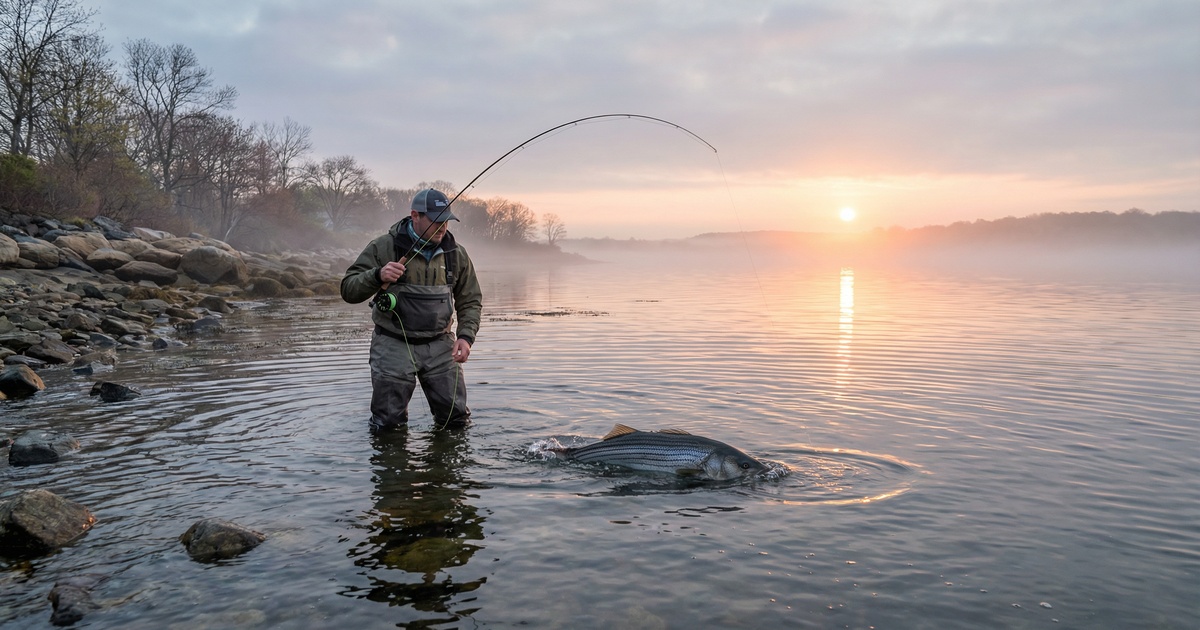
The outgoing tide creates a rip right off that sandbar — that's where baitfish get funneled, and stripers know it. You don't need to cast into deep water. Half the time, the bite is in three feet of wash right at the edge of the drop.
Tide phase matters enormously in the surf. Here's my general framework:
- Outgoing tide: fish the seaward edges of troughs and cuts as bait flushes out
- Last two hours of outgoing through first hour of incoming: often the most productive window
- High tide: fish can push into very shallow water, especially at night
- Incoming tide on a gradual beach slope: bait moves toward shore, fish follow
Rocky Points and Jetties
Rocky structure is where the Northeast striper game gets genuinely interesting. A rocky point on a tidal rip creates current seams — the lines where fast and slow water meet. Bait gets disoriented in these seams, and stripers position themselves on the downcurrent edge to pick off easy meals.
Cast upcurrent, let your lure swing through the seam, and hold on. The strike almost always comes right at the transition point.
Jetties work similarly, with the added variable of depth on one side versus shallow on the other. Work the deep side on an outgoing tide; switch to the shallow side on the incoming as fish push bait against the rocks.
Checking Conditions Before You Go
Barometric pressure is a factor that gets underestimated in saltwater fishing. A sharp pressure drop ahead of a storm often triggers a feeding frenzy; a sustained high-pressure system after a front can shut the bite down for 12–24 hours. Before any spring striper trip, I check the pressure trend on HookCast's weather page — not just the current reading, but whether it's rising or falling. A rapidly falling barometer in the 1005–1010 hPa range frequently lines up with some of the best striper bites I've seen in the surf.
Gear and Tactics for Spring Stripers
Surf Fishing Setup
For surf fishing the spring migration, I run a 10–11 foot medium-heavy rod with a 4500–6500 size spinning reel spooled with 30–65 lb braided line and a 20–30 lb fluorocarbon leader (6–8 feet). This setup handles everything from 1 oz metal lips in the wash to 3 oz chunk rigs on a windy Outer Banks morning.
Top surf lures for spring:
- Metal lip swimmers (Gibbs, Danny): worked slowly just below the surface, especially effective at night
- Bucktail jigs (1–2 oz): versatile — fish them near the bottom around cuts and jetties
- Soft plastic shads (9-inch paddle tails): match the bunker profile when peanut bunker are around
- Poppers and pencil plugs: deadly when fish are visibly blitzing on surface bait in daylight
Live and cut bait:
- Fresh menhaden (bunker) chunks on a fishfinder rig — nothing beats it when fish are in the area but ignoring lures
- Clams on a surf rig — underrated for big fish during a slow bite
- Sand eels on a two-hook rig — critical in New England where sand eel populations are dense
Light Tackle and Fly Fishing
For tidal rivers, estuaries, and calmer rockpile scenarios, a 7–9 foot medium casting rod or 9-weight fly rod opens up a lot of finesse options. Soft plastics on a light jig head (1/4–3/8 oz) are brutally effective in moving tidal water. A 1/0–2/0 Clouser Minnow on a full sinking line is my go-to fly for tidal rips.
The Night Advantage
Spring stripers are meaningfully more catchable after dark, particularly in areas that see heavy pressure during daylight. Bigger fish — 35 inches and up — overwhelmingly favor low-light periods when feeding in the surf and on structure. If you have the option to fish a two-hour window around midnight on a moving tide versus a three-hour window at noon, take the midnight shift every time.
Regulations You Need to Know
This is non-negotiable: striper regulations are complicated and change frequently, with significant variation by state. The Atlantic States Marine Fisheries Commission (ASMFC) manages the stock coastally, but each state sets its own season dates, slot limits, and possession rules within that framework.
As of recent seasons, much of the coast has moved to a one-fish bag limit with specific slot size requirements as the Commission works to rebuild the coastal stock. Some states maintain rules more restrictive than the coastwide standard.
Before every trip, confirm your state's current regulations directly. Don't rely on what applied last season — the rules genuinely change year to year.
Spring Striper Quick-Reference Checklist
Before you load the truck, run through this:
Timing and location:
- [ ] Confirmed water temps in your target area are approaching or above 55°F
- [ ] Checked the migration timeline — are fish likely to be in your area yet?
- [ ] Reviewed tidal charts for the target date (check tide charts here)
- [ ] Verified no major cold fronts incoming (which can stall the bite 24–48 hours)
Gear:
- [ ] 10–11 ft medium-heavy surf rod or light casting setup ready
- [ ] Braid-to-fluorocarbon leader connection checked and re-tied
- [ ] Mix of lures: metal lip or soft plastic plus a bucktail
- [ ] Fresh or frozen chunk bait as a backup
On the water:
- [ ] Arrive before first light if surf fishing (or 90 minutes before sunset)
- [ ] Read the beach for troughs, cuts, and points before making the first cast
- [ ] Note current direction and work lures with the current, not against it
- [ ] Watch for baitfish movement (nervous water, birds working) and position upcurrent
Legal:
- [ ] Current state regulations confirmed
- [ ] Valid saltwater fishing license for the target state
- [ ] Measuring device for slot compliance
FAQ
When does the striped bass migration reach New England?
The bulk of the spring striper migration reaches southern New England — Rhode Island, Connecticut, and the eastern end of Long Island — in early to mid-June. Fish push to Cape Cod and Massachusetts Bay through late June, with Maine typically seeing the best action from mid-July onward. Water temperature is the primary driver; fish arrive earlier in warm springs and later in cold ones.
What is the best tide to fish for striped bass in the surf?
The most consistently productive tidal window for surf fishing stripers is the last two hours of the outgoing tide through the first hour of the incoming. During the outgoing phase, baitfish get funneled through cuts and troughs in the sandbar structure, creating easy feeding opportunities for stripers. That said, a strong current in any phase — especially near inlets, jetties, or rocky points — can produce excellent fishing regardless of direction.
What size striped bass counts as a keeper in the Northeast?
Striper size limits vary by state and change frequently, so always check your specific state's current regulations before fishing. The Atlantic States Marine Fisheries Commission coordinates coastwide management, and in recent seasons most states have moved to a one-fish bag limit with a slot size or minimum size requirement. Do not rely on prior-year regulations — check your state fish and wildlife agency directly before each season.
What lures work best for spring striped bass fishing?
During the spring migration, metal lip swimmers, bucktail jigs, and large soft plastic paddle tails (8–10 inch) are top producers. When bunker are visibly present, matching that profile with a large soft plastic or swimming a fresh chunk of menhaden on a fishfinder rig is extremely effective. At night, slow-rolled metal lips and large soft plastics near structure and in tidal rips consistently outperform everything else — especially for larger fish.
How do water temperatures affect striper fishing in spring?
Striped bass become consistently active feeders in nearshore water once temperatures exceed approximately 55°F. Below that threshold, fish are present but often sluggish and less likely to chase lures aggressively. As temps climb toward 60–65°F, feeding activity peaks — this is prime spring fishing. Once summer water temps push above 72°F, stripers begin pulling off the beaches toward deeper, cooler water, which signals the end of the spring bite in most areas.