标题:Spring Smallmouth Bass in Rivers: Pre-Spawn Tactics for Bronzebacks
Spring Smallmouth Bass in Rivers: Pre-Spawn Tactics for Bronzebacks
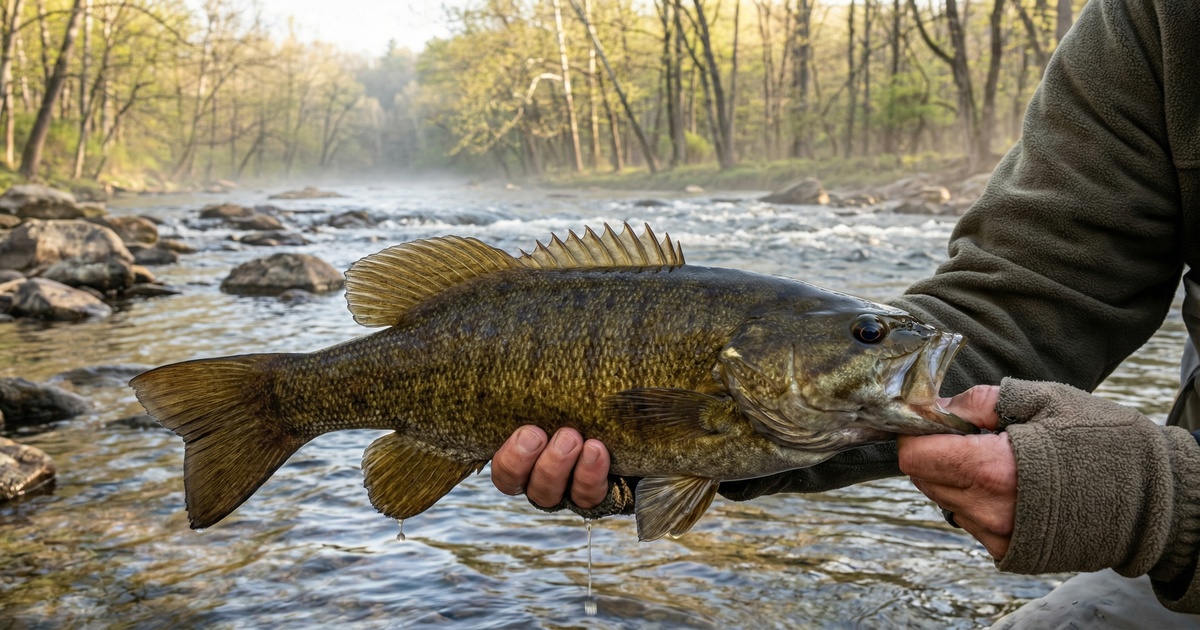
Mid-April on the Susquehanna. Water temp had finally crept to 52°F after a brutal cold snap the week before. My buddy Dave had been skunked on two straight trips — fishing the same deep winter holes he'd been hitting since February. I told him to move. Get off the bottom. Find the transition zones.
Third cast into a gravel flat tucked behind a mid-river boulder, he stuck a 19-inch smallmouth. Then another. Then a fat three-pounder that went airborne twice before he lipped it.
Nothing had changed about the river. Everything had changed about where the fish were and what they wanted.
That's pre-spawn smallmouth. It's one of the most predictable — and most misread — windows in freshwater fishing. Get it right, and you'll have days you talk about for years. Miss the transition, and you'll be throwing jigs into empty water wondering where the fish went.
Here's how to not miss it.
Why Pre-Spawn Is the Best Time to Target River Smallmouth
Spring smallmouth fishing gets lumped together as one season, but there are really three distinct phases: pre-spawn, spawn, and post-spawn. Each requires a different approach. Pre-spawn is, in my opinion, the best of the three — and it's the one most anglers rush past.
Here's what's happening biologically: as water temperatures climb from the low 40s toward the mid-50s°F, smallmouth begin transitioning out of their deep winter holding areas. They're not spawning yet — that happens when water temps consistently hit 60–65°F — but they're feeding aggressively to fuel up before the spawn. NOAA Fisheries notes that smallmouth bass are highly temperature-sensitive in their reproductive behavior, staging and moving predictably as thermal thresholds are crossed.
That feeding aggression, combined with fish that haven't seen much pressure all winter, makes pre-spawn prime time.
The window typically runs:
- Ohio, Indiana, Pennsylvania, West Virginia: Late March through late April
- New York, Michigan, Wisconsin: Mid-April through mid-May
- Upper Midwest (Minnesota, Wisconsin border rivers): Early to mid-May
But water temperature is your real calendar — forget the date on your phone. When the river hits 48–58°F, you're in the window. USGS stream gauges provide real-time temperature readings on most major rivers and will save you more than a few wasted drives.
Reading the River: Where Smallmouth Stack During Pre-Spawn
This is where most anglers go wrong. They're either still fishing winter-deep — 15-plus feet of slow, cold water — or they've jumped ahead mentally to the shallow gravel spawning beds. Pre-spawn fish live in between.
Transition Zones and Staging Areas
Think in terms of depth transitions: specifically, where deep, slow winter holding water meets medium-depth structure with current access.
Classic pre-spawn staging spots:
- Rock ledges and shelves at 4–10 feet — deep enough for security, shallow enough to intercept moving fish
- The downstream tail-out of a deep pool — fish move up from the depths and stage at the lip before pushing into the shallows
- Gravel points and inside bends — especially where deflected current creates a slower lane adjacent to flow
- Mid-river boulders — the eddy directly behind a large rock is a pre-spawn highway
- Riprap banks near tributary mouths — where warmer tributary water meets the main river
The underlying structural principle is current seams. Pre-spawn smallmouth want to burn minimal energy while staying positioned near warming shallows. They'll park right on the edge of fast water, using the current break to hold position and ambush whatever drifts through.
Water Temperature Micro-Zones
River temperature isn't uniform. South-facing banks, shallow dark-bottom flats, and tributary mouths often run 2–4°F warmer than the main channel. Find those warm pockets and you'll find fish that are a step ahead in their pre-spawn progression.
Field observation: On the New River in Virginia, I've consistently noticed fish stacked on south-facing ledge banks a full week before they show up on the north bank — same structure, same depth, just a few degrees warmer. Those early-season fish tend to be the biggest females.
Pre-Spawn Tactics: How to Fish Each Temperature Stage
Early Pre-Spawn (Water 44–50°F)
Fish are still somewhat lethargic and holding close to deeper structure. They're moving, but slowly. Your presentations need to slow down to match.
Best baits:
| Bait | Rigging/Setup | Presentation |
|---|---|---|
| Tube jig (3–4") | 3/16–1/4 oz. head, green pumpkin or smoke | Drag and pause on bottom |
| Ned rig | 1/16–1/8 oz. head, natural colors | Dead-stick on structure |
| Swimbait | 1/4 oz. underspin | Slow roll just above bottom |
| Drop shot | Size 1 hook, 8–12" drop | Shake-and-hold near ledges |
The Ned rig is criminally effective in cold water. That butt-up stance during a pause drives smallmouth crazy when they're not willing to chase. I've watched 50°F river fish absolutely crush a Ned after ignoring every other presentation. Keep retrieves slow and deliberate — a two-second pause after every pull. Let the bait do the work.
Mid Pre-Spawn (Water 50–56°F)
This is the sweet spot. Fish are actively feeding, moving shallower, and showing real aggression. You can pick up your pace and cover more water.
What's working:
- Blade baits — a classic for this temp range; rip it off bottom and let it flutter. Strikes often come on the fall.
- Suspending jerkbaits — work a twitch-twitch-pause and let them hang. Silver/chrome in clear water, chartreuse-shad in stained conditions.
- Small crankbaits (size 5–7) — a crawfish-pattern squarebill deflecting off rock ledges is lethal. Strike King KVD 1.5 or similar.
- Ned rig — still works, but you can fish it faster now.
On color: Match the forage. River crayfish dominate smallmouth diets in spring — brown, orange, and green pumpkin patterns work across all bait types. In stained water, add chartreuse or orange to your jig trailer. In clear, low water, go natural and subtle.
Late Pre-Spawn (Water 56–62°F)
Fish are staging immediately adjacent to spawning flats. Females are surveying beds. Aggression is high — they're both feeding hard and getting territorial.
This is topwater time. Yes, in 58°F water. I've seen smallmouth blow up a Pop-R in late April on river temps that most anglers would consider too cold for surface fishing. It doesn't happen all day, but during the warmest part of the afternoon — especially on a rising barometer — it absolutely happens.
Late pre-spawn go-to baits:
- Topwater walking baits (Heddon Zara Spook) — work shoreline structure and gravel transitions at first light
- Paddle tail swimbaits on a 3/16 oz. jighead — steady retrieve with occasional pauses over gravel flats
- Wacky-rigged tubes (weedless) — works well in slower pockets adjacent to spawning areas
- Inline spinners (Rooster Tail, Mepps) — underrated in rivers; cover water fast and trigger reaction strikes
Barometric Pressure and Pre-Spawn Feeding Windows
I talk about barometric pressure constantly. My fishing buddies get tired of hearing it. But it matters as much on a Midwest river as it does anywhere — river smallmouth are highly responsive to pressure changes.
Standard atmospheric pressure is 1013.25 hPa (29.92 inHg) per NOAA. What matters is the trend.
Rising pressure after a system passes is your best trigger for a strong pre-spawn bite. Fish that hunkered down during the front become active and chase. I've watched this pattern play out dozens of times: slow fishing during the front, lights-out fishing 12–24 hours after it clears.
Stable high pressure produces consistent but not explosive fishing. Reliable enough for a good day — just don't expect topwater blowups on every cast.
Falling pressure before an incoming front can produce a short burst of feeding activity, but once it drops below 29.70 inHg and keeps falling, the bite usually shuts down hard.
Before any spring river trip, I check the pressure trend at HookCast. What I want to see isn't just the current reading — it's whether I'm 12–24 hours past a front on a rising trend. That's the window I'll drive two hours for.
Pro tip: A cold front in April doesn't ruin the week. It just reschedules it. Plan your trip for two days after the front and you'll often have the best fishing of the month.
Gear, Line, and Tackle for River Pre-Spawn
River fishing demands different gear choices than lake fishing. Current affects your presentations, snags are constant, and you're often making tight casts to specific windows behind boulders.
Rod and Reel
- Medium-light spinning rod, 6'8"–7'2": For finesse presentations — Ned rig, drop shot, tube jig. Sensitive tip with enough backbone to muscle fish out of current.
- Medium casting rod, 7'–7'4": For jerkbaits, crankbaits, and swimbaits. Fluorocarbon-friendly with a slower tip than your typical braid setup.
Line
| Presentation | Line Choice | Why |
|---|---|---|
| Ned rig / finesse | 6–8 lb fluorocarbon or 10 lb braid + 6 lb fluoro leader | Sensitivity and low visibility |
| Jerkbait | 8–10 lb fluorocarbon | Slow sink, low stretch, correct action |
| Crankbait | 10–12 lb fluorocarbon | Deflects rock, controls dive depth |
| Topwater | 12–15 lb monofilament | Floats, enables walking action |
In clear Appalachian rivers especially, don't go heavy. River smallmouth see line. I've watched fish follow a 4-inch swimbait on 12 lb braid and turn off at the last second — swapped to 8 lb fluorocarbon and stuck the same fish on the next cast. That happens more than you'd think.
Keep the Tackle Box Honest
You don't need 300 baits. Pre-spawn smallmouth are focused. A tube jig, a Ned rig kit, a suspending jerkbait, a small crankbait, and a topwater walking bait will cover 90% of the situations you'll encounter. Pick colors based on water clarity and match the crayfish forage, and keep it simple.
River Safety and Wading Strategy
Wading for river smallmouth in spring is some of the best fishing you can have. It's also when I see anglers get into trouble.
Spring rivers run high and cold. Snowmelt and spring rains push flows well above summer norms. Check USGS streamflow data before you ever pull on waders — compare the gauge reading for your stretch to the historical median. If you're well above median, wade carefully or fish from a canoe or kayak instead.
Rules I don't bend:
- Never wade alone in fast water above knee height
- Felt-soled or studded wading boots on slippery rock-bottom rivers — not rubber-soled sneakers
- Use a wading staff when crossing any current above mid-thigh
- Un-clip your pack or vest quick-release before crossing moving water
The fish are worth it. But they'll be there next weekend too.
Spring Smallmouth Pre-Spawn: Quick-Reference Checklist
Timing:
- [ ] Water temp between 48–62°F (check USGS gauge)
- [ ] 1–3 days after cold front passage, rising barometer preferred
- [ ] Mid-morning through late afternoon for peak water temps
Location:
- [ ] Depth transitions: deep winter holes → 4–10 ft staging areas
- [ ] Current seams behind mid-river boulders
- [ ] South-facing banks and dark-bottom flats (warmer micro-zones)
- [ ] Tributary mouths and inside bends on gravel or rock bottom
Presentations by water temp:
- [ ] 44–50°F: Ned rig, tube jig, drop shot — slow and deliberate
- [ ] 50–56°F: Blade baits, suspending jerkbaits, crankbaits — medium pace
- [ ] 56–62°F: Swimbaits, topwater, wacky tubes near spawning flats
Tackle:
- [ ] Fluorocarbon line (6–10 lb finesse, 10–12 lb power presentations)
- [ ] Crayfish-pattern colors (brown, orange, green pumpkin) for stained water
- [ ] Silver and natural tones for clear water
- [ ] Medium-light spinning + medium casting combo covers most situations
Conditions:
- [ ] Check pressure trend before leaving (HookCast weather)
- [ ] Check USGS streamflow — avoid dangerously high water
- [ ] Afternoon bite often strongest as daily temps peak
FAQ
What water temperature triggers the pre-spawn for smallmouth bass in rivers?
Smallmouth begin their pre-spawn transition when river temperatures climb into the mid-to-upper 40s°F, with aggressive feeding ramping up significantly between 50–58°F. The spawn itself starts when water temperatures consistently hit 60–65°F. Monitoring real-time water temperature through USGS stream gauges is the most reliable way to time your trip — calendar dates are secondary to what the water is actually doing.
What are the best baits for spring smallmouth bass in rivers?
During early pre-spawn in cold water (44–50°F), slow finesse presentations like the Ned rig, tube jigs, and drop shots outperform aggressive approaches. As temps climb into the 50–56°F range, suspending jerkbaits, blade baits, and small crawfish-pattern crankbaits become highly effective. Late pre-spawn fish near 58–62°F will respond to swimbaits and even topwater lures during the warmest part of the afternoon.
How does barometric pressure affect smallmouth bass fishing in spring?
Smallmouth feeding activity correlates strongly with barometric pressure trends. Rising pressure in the 12–24 hours following a cold front typically produces the most aggressive, sustained pre-spawn feeding. Stable high pressure delivers consistent but less explosive fishing. A falling barometer before an incoming front can trigger a brief feeding flurry, but the bite generally shuts down as it continues dropping — fish go lethargic and tight to structure during low-pressure systems.
Where do smallmouth bass hold in rivers during the pre-spawn?
Pre-spawn smallmouth stage in transitional areas between their deep winter holding water and shallow spawning flats — typically 4–10 feet of depth near rock ledges, gravel points, and current seams behind large boulders. South-facing banks and tributary mouths often run several degrees warmer than the main channel and tend to hold the most advanced pre-spawn fish. The tail-out of a deep pool, where slow water meets a current edge, is one of the most reliable staging locations on any river.
Is it better to wade or use a boat for spring river smallmouth fishing?
Both approaches work well depending on the river system. Wading allows for precise, quiet presentations to specific pieces of structure but requires real caution in spring when flows are elevated from snowmelt. A canoe, kayak, or small jon boat lets you cover more water and access stretches that can't be waded safely. Always check USGS streamflow data before wading — if flows are significantly above historical median for the season, a watercraft is the safer and often more productive choice.